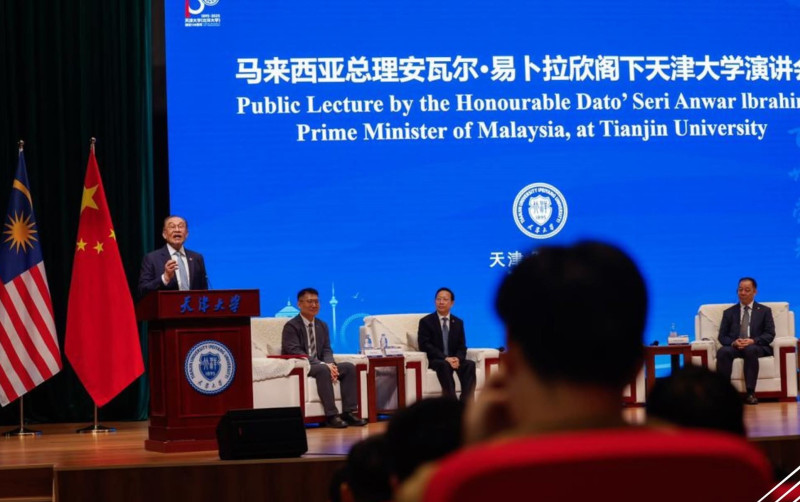
PRIME MINISTER Datuk Seri Anwar Ibrahim has urged Asian nations to take greater ownership of the global economic narrative, declaring that future realignments must be shaped not by Western capitals but by Asia itself.
“Today, we bear the responsibility to ensure that the next chapter is written in an Asian language, and in Asian ink,” he said, delivering a keynote address titled *Sovereign Interdependence: Building a Shared Future in Asia* at Tianjin University on Monday.
Anwar cited historical examples of global economic restructuring — including the post-WWII international monetary system and the 1971 collapse of the gold standard — as having been driven by Western interests. He also criticised the United States' recent adoption of retaliatory tariffs, calling it a “weaponisation of trade”.
“Each of these restructurings was written far from our shores. Asia was present, but it was not the author,” he said.
He warned of the risks of a divided global economy, referencing International Monetary Fund (IMF) forecasts which suggest that extreme trade and technological decoupling could cost some nations as much as 12 percent of their national income.
“Emerging economies will be particularly vulnerable. For decades, openness allowed them to leap forward, move toward higher incomes, and lift hundreds of millions out of poverty,” said Anwar. “If knowledge, technology and capital begin to flow only within gated blocs, opportunity may be denied just as others are beginning their ascent.”
To counter this, Anwar proposed a framework of “sovereign interdependence” — one that enables countries to maintain full sovereignty while remaining open to trade, investment, talent, and technology flows.
He drew inspiration from the 15th-century Chinese explorer Admiral Zheng He, who he said fostered peaceful exchange rather than conquest.
“Zheng He brought gifts, not conquest — an exchange, not subjugation,” Anwar said. “We must construct interdependence that strengthens sovereignty, not weakens it. Interdependence should not prompt fears of diluted autonomy. It should instead instil confidence that such reliance will multiply resilience.”
He called on Asia — as a global growth engine — to champion openness, stability and inclusivity in its own terms. He said China, as a civilisation-state, had a central role to play in advancing this vision.
“Malaysia, in its own way, can contribute by showing that it is possible to be sovereign without being suspicious, and open without being naïve,” he said. “Asia, as a diverse community of nations, must ensure that the next global economic restructuring brings not rupture — but shared justice and prosperity.”
The address was followed by a student Q\&A session. Tianjin University, one of China’s oldest modern institutions, is home to a number of Malaysian students, including those pursuing a dual-degree Chemical Engineering programme with Universiti Malaysia Pahang Al-Sultan Abdullah (UMPSA).
Anwar’s visit to Tianjin forms part of his four-day working trip to China — his fourth since assuming office in late 2022. - Sept 1, 2025