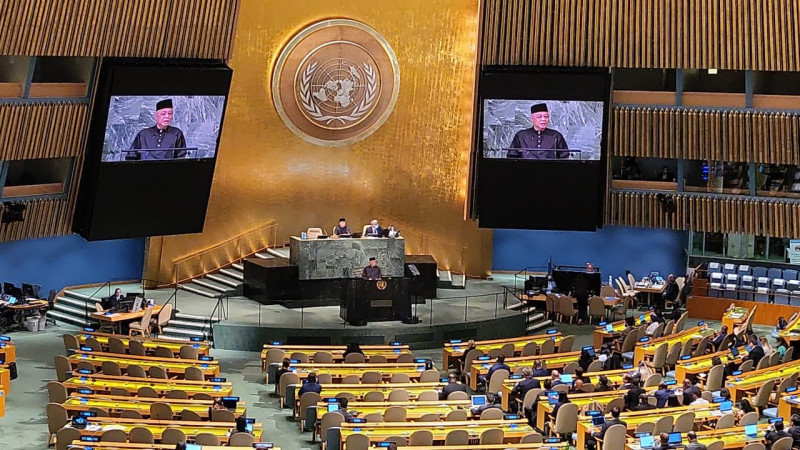
FOUR key Arab states — Saudi Arabia, Egypt, the United Arab Emirates and Oman — delivered coordinated and forceful rebukes of Israel’s ongoing military campaign in Gaza at the United Nations General Assembly on Saturday, warning that the region was on the brink of collapse due to inaction by the international community.
Reuters reported on Monday that Egypt’s Foreign Minister Badr Abdelatty issued a stark warning, declaring that the Middle East “is at a point of implosion”. He criticised the global community for “standing idly by as a spectator” while international law was “systematically violated” in Gaza and other regional conflicts.
“Israel’s wanton, unjust war waged against defenceless civilians for a sin they did not commit is transpiring without accountability,” Abdelatty said. He accused Israel of blocking Palestinian statehood and committing genocide — a charge Israel denies — while calling for renewed regional stability through the establishment of an independent Palestinian state.
Abdelatty, whose country has played a central mediating role in the Gaza crisis alongside the United States and Qatar, also pointed to wider regional instability, citing civil war in Sudan, the political vacuum in Libya, ongoing hostilities in Yemen, and Israeli incursions into Lebanese and Syrian territory.
Saudi Arabia’s Foreign Minister, Prince Faisal bin Farhan, echoed the condemnation, stating that “the suffering of Palestinians and the unprecedented humanitarian crisis in Gaza” demand urgent global action. He warned that continued failure to restrain Israel would escalate “war crimes and acts of genocide”.
“The only path that would guarantee the security of all countries in the region is the two-state solution,” he said. He announced that Saudi Arabia, alongside Norway and the European Union, had launched a coalition to implement that solution and welcomed the growing number of countries recognising Palestine, including at least 10 new recognitions announced at a high-level meeting in New York earlier in the week.
Farhan also condemned Israel’s recent attack on Qatar and urged the international community to take “firm measures” to deter Israeli aggression, which he said threatens global as well as regional security.
From Oman, Foreign Minister Badr bin Hamad al-Busaidi called on the world to impose sanctions on Israel and limit its military capacity. “The international community must apply effective pressure to bring Israel to the negotiating table,” he said, denouncing the use of starvation, occupation and collective punishment against Palestinians.
He called for a “global peaceful campaign” to end Israel’s blockade of Gaza and to support Palestinian statehood as a fundamental prerequisite for peace.
The United Arab Emirates’ Deputy Foreign Minister, Lana Nusseibeh, said the world was at a “pivotal moment” and there could be “no justification” for Hamas taking hostages or for Israel targeting tens of thousands of civilians, besieging them or displacing them by force.
She criticised Israel’s “unacceptable, expansionist ambitions” and its threats to annex the West Bank, urging all nations to recognise the state of Palestine “as an investment in a better future for the region”.
Highlighting the UAE’s broader diplomatic efforts — including mediating between Russia and Ukraine, Armenia and Azerbaijan, and de-escalating crises in South Asia — Nusseibeh said the Emirates aimed “not simply to manage conflicts, but to resolve them sustainably.”
The UAE, she added, is currently the largest humanitarian donor to Gaza and is promoting an agenda of tolerance, peace and regional security.
The speeches came just a day after Israeli Prime Minister Benjamin Netanyahu addressed the UN General Assembly, vowing to “finish the job” in Gaza following Hamas’ surprise attack on southern Israel on 7 October 2023, which killed around 1,200 people and resulted in 250 hostages being taken. - September 29, 2025