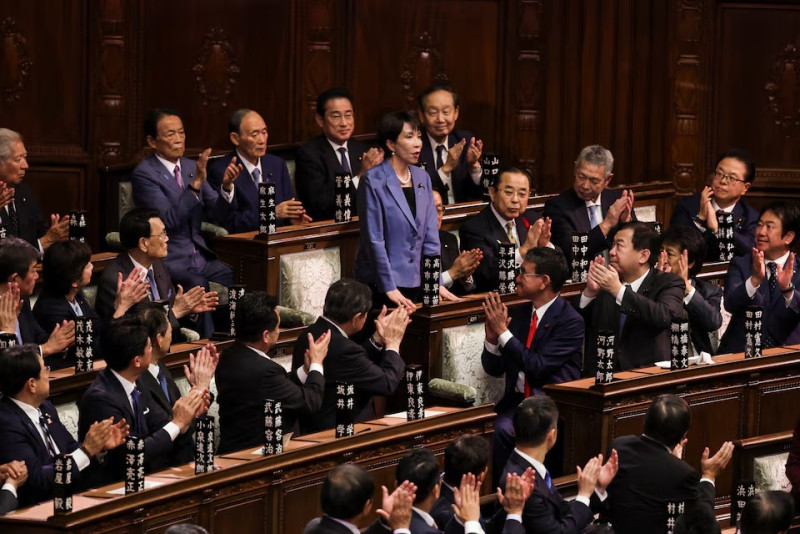
SANAE Takaichi assumed office on Tuesday as Japan’s first female prime minister, but hopes that her leadership might mark a turning point for women’s representation in politics were swiftly dampened after she appointed only two women to her 19-member cabinet.
Despite pledging during her campaign to bring gender parity in line with Nordic benchmarks, the line-up unveiled by Takaichi mirrored that of her predecessor and fell well short of expectations.
“The line-up she announced betrayed that promise from the outset,” said Tohko Tanaka, a professor of media and gender studies at the University of Tokyo. “This is extremely disappointing and offers no hope for women’s empowerment.”
At a press conference, Takaichi defended her selections, stating she had “prioritised equal opportunity” and “assigned the right people to the right positions”.
Reuters cited today that her choices were limited, she added, by the fact that only 13 percent of lawmakers in her Liberal Democratic Party (LDP) are women — a figure the party aims to raise to 30 percent by 2033.
Japan currently ranks 118th out of 148 countries in the World Economic Forum’s Global Gender Gap Report, the lowest among G7 nations. The report reflects the country’s poor record in women’s political representation and its large gender pay gap. In contrast, Nordic nations, where women make up 36 to 61 percent of cabinets, top the global rankings.
Although Takaichi’s rise — alongside Finance Minister Satsuki Katayama — shattered a long-standing glass ceiling, it remains largely symbolic without significant policy change, said Tiina Airaksinen, senior lecturer in Asian studies at the University of Helsinki.
“It has taken us more than 120 years to come into this situation,” she said, referring to Finland’s early adoption of women’s suffrage. “She can’t change everything in Japanese society immediately, but she can start the change.”
However, many remain sceptical that Takaichi intends to do so.
Often compared to Italy’s Giorgia Meloni, Takaichi has long been aligned with the LDP’s socially conservative values, and public opinion surveys suggest she is more popular among men than women.
“She is a woman who has advocated the LDP’s patriarchal model, in which men are supposed to overwork at the centre of society and women should support them through unpaid care work,” said Yayo Okano, a professor at Doshisha University specialising in feminist political theory.
Okano pointed to Takaichi’s support for the legal requirement that married couples share a single surname — a rule that in more than 90 percent of cases results in women adopting their husband’s name, with clear consequences for women’s career continuity. While critics, including business groups and some moderate LDP members, argue the rule is outdated and harmful, Takaichi has defended it as essential to preserving family unity.
Her appointment was made possible through a partnership between the LDP and the right-wing Japan Innovation Party (Ishin), agreed on Monday. Ishin backs small government and socially conservative policies, many of which are likely to disproportionately affect women, particularly those in vulnerable groups.
“Their social security policies, such as a stricter ability-to-pay principle, could tighten support for vulnerable groups including single parents and low-income earners, many of whom are women,” said Yoko Otsuka, professor of welfare policy and gender studies at Ritsumeikan University.
The two parties also pledged to maintain Japan’s male-only imperial succession — a stance Otsuka described as “simply sexist” and lacking rational justification.
Despite making history, Takaichi’s early decisions have raised doubts over whether her premiership will bring any meaningful shift in the country’s deeply entrenched gender norms. - October 22, 2025