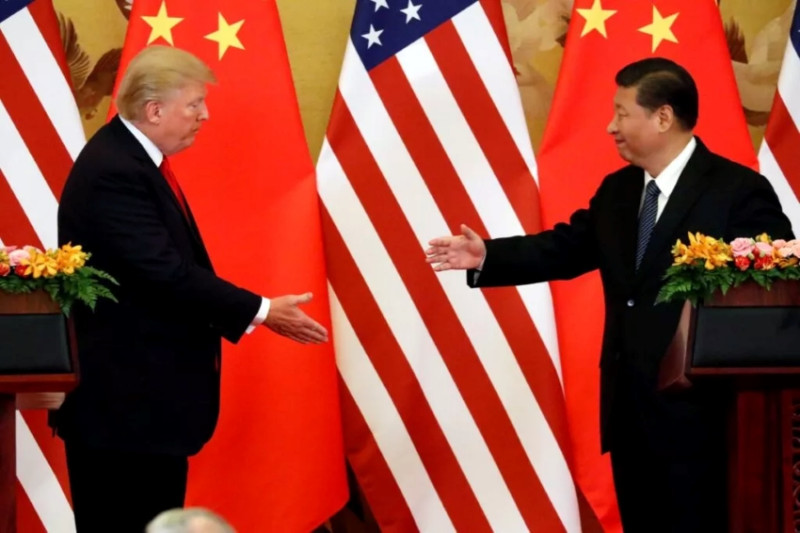
U.S. President Donald Trump has halved tariffs on Chinese goods linked to fentanyl trafficking following a meeting with Chinese President Xi Jinping in South Korea, agreeing to revive a joint working group aimed at curbing the deadly synthetic opioid trade.
The move marks a major shift in Trump’s approach, after his administration had dismissed cooperation with Beijing as ineffective and insisted that punitive tariffs would remain until China took tangible action against fentanyl supply chains.
Reuters reported that the new deal restores a communications channel previously embraced by China but criticised by U.S. Republican lawmakers, who argue that Beijing uses such mechanisms to stall progress.
“The administration has made significant compromises in its own position on China and counternarcotics by now accepting a commitment to launch a working group,” said Henrietta Levin, a former director for China on President Joe Biden’s National Security Council and now a senior fellow at the Center for Strategic and International Studies.
Levin noted that similar counternarcotics partnerships had been formed at least three times over the past decade under both Trump and Biden.
“You start to wonder how many times they can sell us exactly the same half-hearted commitment,” she said.
Trump officials, however, said this iteration would be results-driven rather than a symbolic forum for dialogue. U.S. Treasury Secretary Scott Bessent said the agreement represented a “fresh consensus” on tackling fentanyl flows and would be formalised through the new working group.
Chinese officials have vigorously defended Beijing’s record on fentanyl, accusing Washington of using the issue as political leverage.
China’s Foreign Ministry made no mention of fentanyl in its statement on the Trump–Xi meeting, while the Commerce Ministry merely said the two sides had “reached consensus” on cooperation.
“The U.S. needs to take concrete actions to create necessary conditions for the cooperation,” China’s embassy in Washington told Reuters, adding that Beijing “remains open to continuing the cooperation.”
Republican figures, including now–Vice President JD Vance, had previously attacked such engagements.
In 2023, Vance and several lawmakers accused the Biden administration of lifting sanctions to lure China into talks, arguing that “President Xi will only respond to strength. We must force his hand and make it clear that sanctions will only be lifted after the CCP stops the deadly production of fentanyl precursor chemicals.”
Following the latest accord, the White House said China had agreed to halt shipments of certain chemicals to North America and tighten export controls globally.
U.S. Trade Representative Jamieson Greer told Fox Business that Washington would retain a 10% tariff on China as leverage to ensure compliance.
“We still have leverage on this point to make sure the Chinese follow through on their obligations,” he said.
Analysts warned, however, that reimposing tariffs could jeopardise the fragile trade truce between the two powers, potentially affecting Trump’s planned visit to China in April.
Michael Froman, president of the Council on Foreign Relations and a former U.S. Trade Representative, said Trump’s tariff strategy would only prove effective if China delivered on its promises. “If not, I imagine those tariffs might go back up,” he wrote. - November 4, 2025