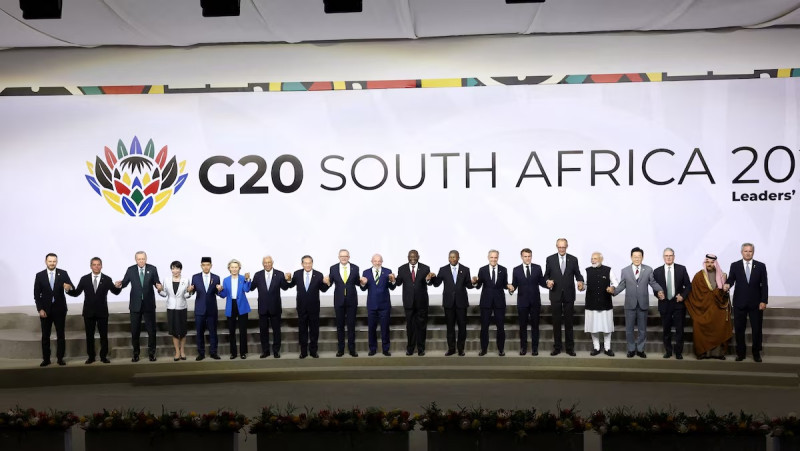
SOUTH Africa’s leadership of this year’s G20 summit in Johannesburg culminated in the adoption of a landmark declaration on climate and global issues, defying White House opposition and prompting sharp criticism from the United States.
The move highlights frictions over the group’s decision-making and the handling of sensitive geopolitical matters.
Reuters reported on Sunday that the Group of 20 leaders concluded their Johannesburg summit on Saturday by adopting a declaration addressing climate change and other pressing global challenges, despite formal objections from the United States.
The decision has intensified diplomatic tensions, with Washington accusing South Africa of “weaponising” its G20 presidency.
The declaration, drafted without input from the United States, is regarded by Pretoria as final and non-negotiable.
“We had the entire year of working towards this adoption and the past week has been quite intense,” said Vincent Magwenya, spokesperson for South African President Cyril Ramaphosa.
The White House sharply criticised the move, with spokeswoman Anna Kelly asserting that Ramaphosa had refused “to facilitate a smooth transition of the G20 presidency” and pressed ahead with the declaration despite “consistent and robust U.S. objections.”
She added that the United States looks forward to “restoring legitimacy” to the G20 when it assumes the rotating presidency next year.
Ramaphosa, who hosted the summit, had earlier described the declaration as reflecting “overwhelming consensus” among participating leaders.
However, Argentina withdrew at the final hour, citing objections to how the text referenced geopolitical conflicts, particularly the Middle East.
Argentina’s foreign minister, Pablo Quirno, explained, “Specifically, it addresses the longstanding Middle East conflict in a manner that fails to capture its full complexity.”
The document makes brief reference to the issue, stating that G20 members agree to work toward “a just, comprehensive, and lasting peace in … the Occupied Palestinian Territory.” Despite Argentina’s reservations, Ramaphosa chose to proceed with the adoption of the declaration.
The summit, intended as a platform for collective global action, has now underscored the complexities of international diplomacy, balancing climate commitments, geopolitical sensitivities, and competing national interests.
Analysts suggest that South Africa’s assertive approach signals its ambition to leave a distinct imprint on the G20’s agenda, even in the face of pushback from major powers. - November 23, 2025