RUSSIAN President Vladimir Putin has warned that elements of a U.S.-proposed plan to end the war in Ukraine are “unacceptable” to the Kremlin, suggesting that a breakthrough deal remains distant despite intensive diplomatic efforts by Washington.
The initiative, led by U.S. President Donald Trump’s special envoy Steve Witkoff and his son-in-law Jared Kushner, represents the most concerted push to halt hostilities since Russia launched its full-scale invasion nearly four years ago.
Yet critical obstacles persist, particularly over whether Ukraine must cede territory to Russia and how the country can be guaranteed protection from future Russian aggression.
Following a five-hour meeting at the Kremlin on Tuesday, Putin described the discussions with Witkoff and Kushner as “necessary” and “useful,” but acknowledged they involved “difficult work,” with some proposals deemed unacceptable.
Speaking to India Today ahead of a state visit to New Delhi, he said: “We had to go through practically every point, which is why it took so much time.
“It was a meaningful, highly specific and substantive conversation. Sometimes we said, ‘Yes, we can discuss this, but with that one we cannot agree.’”
The original U.S. 28-point peace proposal was reportedly reduced to 27 points and split into four packages, though Putin declined to specify which elements Russia could accept or reject.
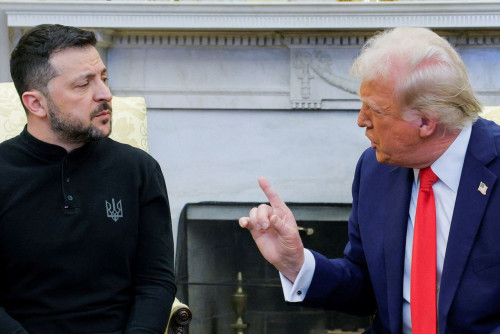
The Russian leader praised Trump’s efforts, stating that “achieving consensus among conflicting parties is no easy task,” while cautioning that revealing Russia’s position prematurely could undermine the American negotiation process.
Trump, meanwhile, said his envoys returned from the Kremlin session confident that Putin is interested in reaching a settlement, asserting: “Their impression was very strongly that he’d like to make a deal.”
The diplomatic manoeuvring occurs against a backdrop of ongoing violence in Ukraine. Overnight strikes by Russia targeted civilian areas, including Kryvyi Rih, wounding six people, among them a three-year-old girl.
Southern Kherson also suffered further casualties, with a six-year-old girl killed and the city’s thermal power plant temporarily shut down after sustained attacks, leaving tens of thousands without heating.
Additional Russian drone strikes damaged infrastructure in Odesa and the occupied Kherson region, where two men were killed in a Ukrainian counter-strike.
European leaders, largely excluded from the U.S.-Russia shuttle diplomacy, have voiced scepticism over Moscow’s intentions. French President Emmanuel Macron met with Chinese President Xi Jinping in Beijing to seek support for pressuring Russia toward a ceasefire.
Xi stated only that “China supports all efforts that work towards peace,” offering no concrete commitments.
Putin reiterated Russia’s objectives in eastern Ukraine, asserting: “All this boils down to one thing: Either we take back these territories by force, or eventually Ukrainian troops withdraw.”
The situation underscores the complexity of negotiating peace amid ongoing hostilities, entrenched territorial claims, and competing international interests, leaving the prospects for an immediate resolution uncertain. - December 5, 2025