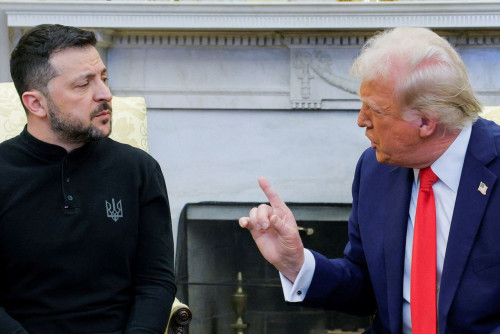
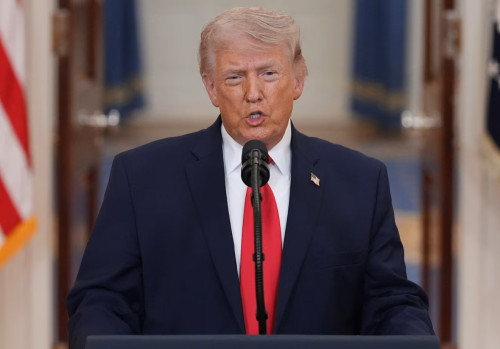
UKRAINIAN President Volodymyr Zelensky is meeting former United States President Donald Trump in Florida on Sunday in a bid to advance a proposed 20‑point plan to end the war with Russia, but profound disagreements over territorial terms and fresh Russian attacks cast doubt over prospects for a breakthrough.
Reuters reported on Sunday that Zelensky has signalled he will press Trump to soften US‑backed demands on Ukraine’s withdrawal from contested territory in the eastern Donbas region and to discuss the future status of the Zaporizhzhia nuclear power plant, among other sensitive issues.
Moscow has repeatedly insisted that Ukraine cede the entirety of the Donbas, including areas still under Kyiv’s control. Russian officials have rejected elements of the latest proposal, raising scepticism about whether President Vladimir Putin would embrace any agreement that emerges from Sunday’s discussions.
Speaking to journalists ahead of the meeting at Trump’s Florida residence, Zelensky said he hoped to convince Washington to ease its stance on Ukrainian forces pulling back completely from the Donbas.
“Failing that,” he said, “the entire 20‑point plan … should be put to a referendum vote.” He added that Russia would have to agree to a 60‑day ceasefire to allow Ukraine to prepare for and hold such a vote.
US officials described Zelensky’s willingness to consider a referendum as a significant concession, according to Axios, though a recent poll suggests Ukrainian voters may reject the plan.
The in‑person meeting, scheduled for 1 p.m. local time (1800 GMT), follows weeks of diplomatic engagement. European allies, at times sidelined from discussions, have been working to shape a post‑war security framework for Kyiv that would enjoy transatlantic support.
Despite broad agreement on many elements of the proposed framework, the question of whether any Ukrainian territory should be relinquished remains unresolved.
Ukrainian officials have asserted that at least two people were killed and dozens injured by Russian strikes on Saturday in Kyiv and elsewhere, underscoring the fragile backdrop to negotiations.
While Moscow demands full control of the Donbas, Kyiv wants the conflict’s frontlines frozen at their current positions.
The United States, seeking a compromise, has proposed creating a free economic zone in areas Ukraine might leave, though the mechanics of such an arrangement are unclear.
Zelensky and European supporters have expressed concern that Trump could make concessions that favour Russia, potentially leaving European nations to shoulder the burden of supporting a devastated Ukraine after nearly four years of war.
Russian forces have seized significant territory since the 2022 invasion, including full control of Crimea — annexed in 2014 — and large portions of the Donbas, Zaporizhzhia, and Kherson regions.
On 19 December, Putin reiterated conditions for peace that include Ukraine withdrawing from all of Donbas, Zaporizhzhia and Kherson, and renouncing its bid to join NATO — terms rejected by Kyiv and European leaders, who view Russia’s campaign as an imperial land grab.
The current 20‑point plan evolved from an earlier 28‑point proposal that emerged from talks involving US special envoy Steve Witkoff, Trump’s son‑in‑law Jared Kushner, and Russian envoy Kirill Dmitriev. Subsequent negotiations between Ukrainian officials and US mediators produced a document more favourable to Kyiv.
Canadian Prime Minister Mark Carney, standing alongside Zelensky in Halifax, described Saturday’s Russian air strikes as evidence that Putin “does not want peace” and pledged an additional C$2.5 billion (US$1.83 billion) in economic aid to Ukraine.
“The barbarism that we saw overnight — the attack on Kyiv — shows just how important it is that we stand with Ukraine in this difficult time,” Carney said.
European Commission President Ursula von der Leyen said on X that European leaders remained committed to “a just and lasting peace” that preserves Ukraine’s sovereignty and territorial integrity, while bolstering its defence and security. Zelensky said he planned further discussions with European counterparts after his meeting with Trump. - December 28, 2025