THE death toll from Iran’s nationwide protests has surpassed 2,000, according to activists, marking the deadliest episode of unrest in the country in decades and drawing comparisons with the turmoil of the 1979 Islamic Revolution.
AP reported today that the U.S.-based Human Rights Activists News Agency said at least 2,003 people have been killed since demonstrations erupted just over two weeks ago, initially over Iran’s worsening economy before expanding into direct challenges to the Islamic Republic’s leadership.
The group said 1,850 of the dead were protesters, 135 were government-affiliated personnel, nine were children and nine were civilians not involved in demonstrations. More than 16,700 people have reportedly been detained.
Iranian state television issued its first official acknowledgement of fatalities only after the activist figures emerged, quoting an official who said the country had “a lot of martyrs” and claiming a toll had not been released earlier because many of the dead suffered “gruesome injuries”.
The government has still not published an overall casualty figure, and the Associated Press said it could not independently verify the activists’ numbers, particularly with internet access largely cut inside Iran.
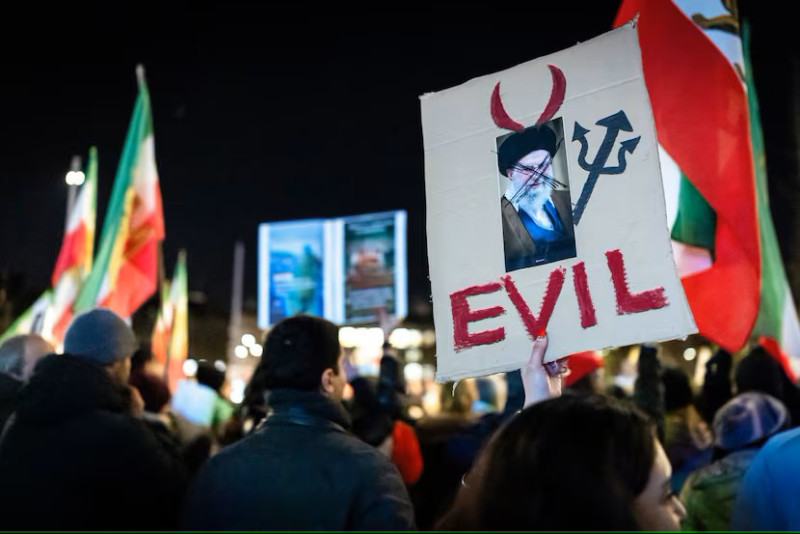
The protests have increasingly targeted the core of Iran’s political system. Images obtained from demonstrations in Tehran showed graffiti and chants calling for the death of Supreme Leader Ayatollah Ali Khamenei, a crime that can carry the death penalty. Khamenei, 86, has ruled Iran for more than three decades.
Skylar Thompson of the Human Rights Activists News Agency said the scale of the killings was unprecedented in recent memory.
She described the figures as “shocking”, noting that they had reached four times the toll of the months-long 2022 Mahsa Amini protests in a matter of weeks.
“We’re horrified, but we still think the number is conservative,” she said, warning that the toll was likely to rise further.
After days of near-total communications blackout, some Iranians were able to make phone calls abroad on Tuesday, though text messaging and full internet access remained unavailable.
Witnesses in Tehran described a city under intense security, with anti-riot police in helmets and body armour stationed at major intersections alongside members of the Revolutionary Guard’s Basij force, some carrying firearms. Plainclothes security officers were also visible in public spaces.
Several government buildings and banks were reported burned or damaged, and smashed cash machines dotted parts of the capital.
Shops were open but largely empty, witnesses said, and banks struggled to process transactions without internet connectivity.
Tehran’s Grand Bazaar, where protests began on 28 December amid the collapse of the rial, reopened after shopkeepers said security forces ordered them to do so, a claim not acknowledged by state media.
Some residents said authorities appeared to be searching for Starlink satellite internet terminals, with reports of apartment raids in northern Tehran. Although satellite dishes are illegal, enforcement has been lax in recent years.
Concerns about foreign intervention were also circulating among the public. Mahmoud, a shopkeeper who gave only his first name, said: “My customers talk about Trump’s reaction while wondering if he plans a military strike against the Islamic Republic. I don’t expect Trump or any other foreign country cares about the interests of Iranians.”
Reza, a taxi driver, said disillusionment was widespread but so was determination. “People — particularly young ones — are hopeless, but they talk about continuing the protests,” he said.
The unfolding crisis has prompted sharp exchanges between Tehran and Washington.
Soon after the activist death toll was reported, U.S. President Donald Trump wrote on his Truth Social platform: “Iranian Patriots, KEEP PROTESTING - TAKE OVER YOUR INSTITUTIONS!!!”
He added: “I have cancelled all meetings with Iranian Officials until the senseless killing of protesters STOPS. HELP IS ON ITS WAY.”
Hours later, however, Trump struck a more cautious note, telling reporters his administration was awaiting confirmation of the figures before acting “accordingly”.
Referring to Iranian security forces, he said: “It would seem to me that they have been badly misbehaving, but that is not confirmed.”
Iranian officials warned Trump against intervention. Ali Larijani, secretary of Iran’s Supreme National Security Council, responded online:
“We declare the names of the main killers of the people of Iran: 1- Trump 2-” Israeli Prime Minister Benjamin Netanyahu.
Inside Iran, state television broadcast images of large pro-government rallies held on Monday, with crowds chanting “Death to America!” and “Death to Israel!”
In a statement carried by state TV, Khamenei praised those demonstrations, saying: “This was a warning to American politicians to stop their deceit and not rely on traitorous mercenaries. The Iranian nation is strong and powerful and aware of the enemy.”
Iran’s attorney general has warned that anyone taking part in protests will be considered an “enemy of God”, a charge that carries the death penalty.
State television also announced that mortuary and morgue services would be free, a move seen as an acknowledgement that families had previously been charged high fees to retrieve the bodies of those killed.
With most external communications still blocked and arrests continuing, activists and witnesses fear the full human cost of the crackdown has yet to be revealed. - January 14, 2026


.jpg)