ISRAEL has signalled it will continue military operations against Iran “for as long as needed,” with officials insisting that the campaign will persist until Tehran’s military capabilities are significantly degraded.
Reuters reported Israeli Foreign Minister Gideon Saar telling reporters on Sunday that the country was committed to seeing the conflict through until all objectives are achieved.
Military spokesperson Lieutenant Colonel Nadav Shoshani elaborated on Monday that detailed operational plans cover the next three weeks, with further strategies mapped out beyond that period.
“We want to make sure that they are as weak as possible, this regime, and that we degrade all their capabilities, all parts and all wings of their security establishment,” Shoshani said.
The Israeli military, which has mobilised over 110,000 reservists, reports having thousands of targets remaining within Iran. It claims to have conducted some 7,600 strikes, eliminating roughly 70 per cent of Iran’s missile launchers, neutralising 85 per cent of its air defences, and striking multiple nuclear sites.
Israel also said its forces destroyed an aircraft used by Iran’s late supreme leader, Ali Khamenei, at Tehran’s Mehrabad Airport, a plane reportedly used by senior military and civilian leaders for domestic and international coordination.
Amid escalating operations, Israel has deployed ground troops in southern Lebanon in what Shoshani described as a “limited and targeted operation” against Hezbollah positions.
The move aims to bolster forward defences along the northern border, where the militant group has reportedly sent hundreds of fighters from its elite Radwan unit.
Israeli airstrikes on southern Lebanon on Monday killed three individuals, including two paramedics responding to an earlier strike.
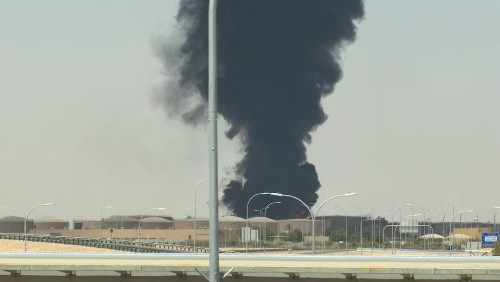
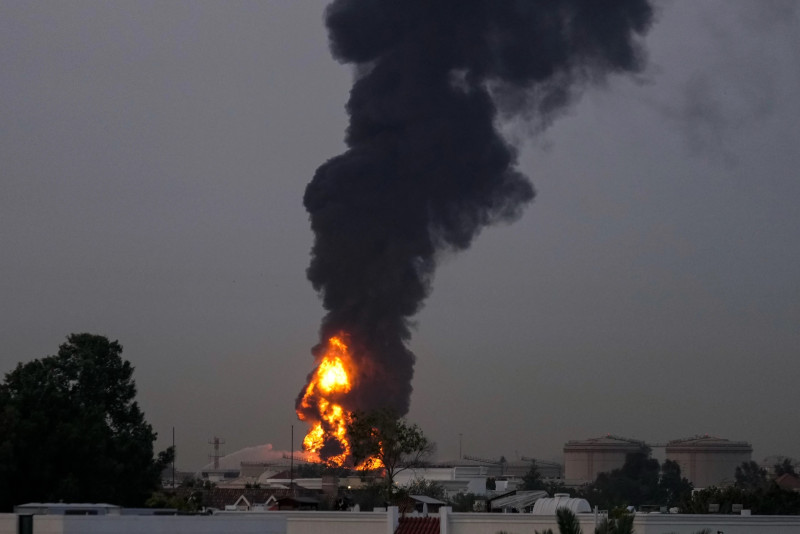
The conflict has also reverberated across the Gulf. Dubai International Airport temporarily suspended flights after a drone strike ignited a fuel tank, marking the third such attack on the airport since Iran launched assaults on Gulf states on 28 February.
Meanwhile, AP reported today that flights are now gradually resuming, with Emirates airline reporting a partial return to operations.
In Fujairah, oil loading operations were halted after a second drone attack in three days, threatening the transit of roughly 1 million barrels per day of Murban crude, equivalent to about 1 per cent of global demand.
In response, the European Union has signalled intentions to protect the Strait of Hormuz, a key global shipping route.
EU foreign policy chief Kaja Kallas said member states would discuss measures to keep the strait open, while French President Emmanuel Macron announced plans for a defensive naval escort mission involving European and non-European partners.
“The purpose is to enable, as soon as possible after the most intense phase of the conflict has ended, the escort of container ships and tankers to gradually reopen the Strait of Hormuz,” Macron said.
International reactions have called for clarity and restraint.
German Foreign Minister Johann Wadephul stressed the need for the United States and Israel to define their military objectives, warning of the regional and economic dangers posed by Iran.
Meanwhile, the United Kingdom announced £5 million (US$6.6 million) in humanitarian aid for over 800,000 Lebanese displaced by Israel’s operations against Hezbollah, with Foreign Secretary Yvette Cooper condemning the humanitarian impact.
Bahrain reported responding to missile and drone attacks on Monday, highlighting the widening regional effects of the conflict.
Israel’s military says it still has thousands of targets within Iran and remains prepared for sustained strikes.
“The war will go on for as long as needed,” Shoshani said, emphasising the ongoing commitment to degrade Iran’s military and security apparatus. - March 16, 2026