US President Donald Trump has intensified military operations against Iran following the collapse of a month-old interim ceasefire, raising the prospect of a broader regional conflict even as analysts question whether increased military pressure will compel Tehran to alter its position.
The renewed escalation comes as Washington seeks to break Iran's control over the strategically vital Strait of Hormuz and pressure Tehran into accepting US demands over regional security and its nuclear programme.
Despite the heightened military campaign, analysts said there is little evidence that the strategy, which has failed to secure meaningful concessions over the past four-and-a-half months of conflict, is likely to succeed this time.
Reuters reported that although both sides have stopped short of returning to full-scale war, hopes of a diplomatic breakthrough have faded as the conflict enters a new and more dangerous phase, pushing global oil prices higher and unsettling financial markets.
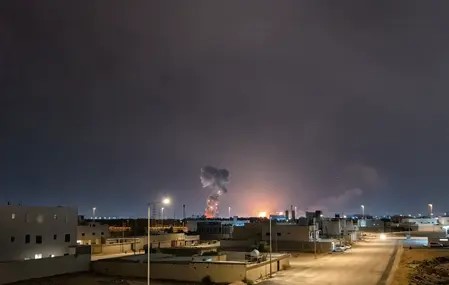
The exchange of attacks entered its sixth consecutive day on Thursday, while Iran signalled it could instruct Yemen's Houthi movement to close the Bab al-Mandeb Strait, a critical shipping route linking the Red Sea to the Gulf of Aden, should the United States strike Iran's power infrastructure.
Trump has publicly discussed expanding the list of US military targets to include Iranian energy facilities, bridges, the country's principal oil export hub on Kharg Island, and the deeply buried nuclear-linked facility known as Pickaxe Mountain.
While some of those options are viewed as politically and militarily risky, analysts said a significant escalation—short of a full-scale ground invasion—would be unlikely to achieve Washington's strategic objectives.
"There’s no reason to believe that this latest set of attacks or whatever the president has in mind will compel the Iranians to change their thinking," said Jonathan Panikoff, a former US deputy national intelligence officer for the Middle East who is now with the Atlantic Council.
"It’s perhaps more likely to harden their position."
A senior Trump administration official said the President continued to favour a diplomatic solution but insisted that "the only language that Iran understands is military might", adding that Washington would continue holding Tehran accountable for attacks on international shipping.
The collapse of the interim agreement also comes at a politically sensitive time for Trump, who is under pressure to end a conflict that has claimed thousands of lives, largely in Iran and Lebanon, while weighing on the US economy and his public approval ratings ahead of November's midterm elections.
Talks aimed at converting the temporary ceasefire into a permanent agreement have stalled, despite tentative signs of diplomatic engagement.
Trump recently welcomed what he described as the release of an American citizen detained in Iran, although Iran's judiciary denied that any prisoner exchange had taken place.
At the heart of the dispute are competing claims over the future management of the Strait of Hormuz, through which roughly one-fifth of the world's oil supply passes.
Iran maintains that it should retain a role in overseeing traffic through the strategic waterway, potentially including the collection of transit fees, while the United States and its Gulf allies insist on unrestricted freedom of navigation.
Tehran's renewed attacks on commercial shipping, which the White House described as a breach of the interim agreement, prompted Washington to reimpose a blockade on Iranian ports and revoke a waiver that had allowed Iran to resume international oil exports under the ceasefire.
According to three US officials, the latest wave of American air strikes is intended to weaken Iran's military capabilities and provide the White House with greater operational flexibility should it decide to expand the conflict.
Iran has responded by warning that it could target civilian infrastructure in neighbouring Gulf states hosting US military forces if Washington broadens its campaign.
Tehran is also reported to have instructed Yemen's Houthi rebels to prepare to disrupt shipping through the Bab al-Mandeb Strait should US attacks target Iran's electricity infrastructure, creating fresh risks for global energy markets.
Mark Dubowitz, chief executive of the Foundation for Defense of Democracies, argued that Iran's threats reflected strategic weakness, saying attempts to weaponise key maritime routes would accelerate international efforts to develop alternative energy transport corridors.
Other analysts cautioned that Trump risks repeating mistakes made when he launched the military campaign in February without clearly defining either its long-term objectives or an exit strategy.
Danny Citrinowicz, an Iran specialist at Israel's Institute for National Security Studies, said sustained military pressure was unlikely to force Tehran into submission.
"No matter how much pressure the administration applies, or how many new threats it issues, Iran's leadership is unlikely to capitulate," he said.
"If President Trump continues expanding the target set, Tehran is likely to respond in kind." - July 17, 2026



.jpeg)