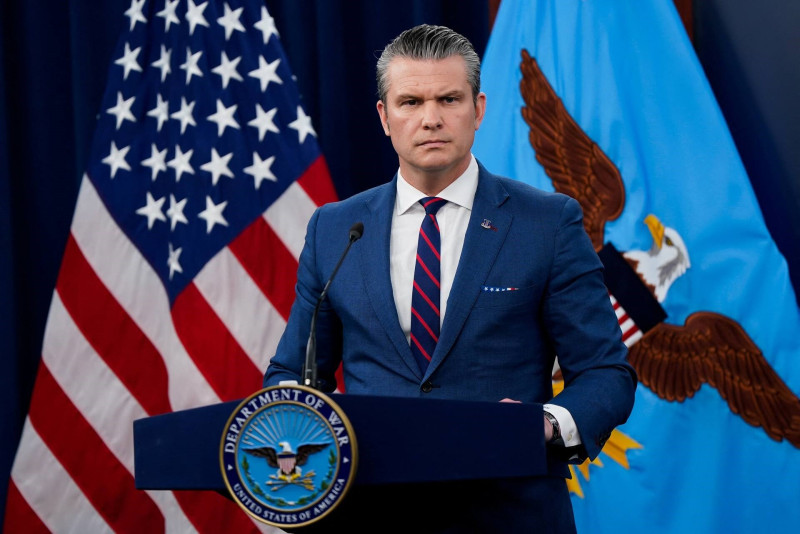
UNITED States Defence Secretary Pete Hegseth has sparked diplomatic unease after accusing European nations of failing to address what he described as an “invasion” linked to migration, delivering the remarks during a speech marking the anniversary of the D-Day landings in Normandy.
Speaking 82 years after Allied forces stormed the beaches of northern France in 1944, Hegseth drew a stark comparison between wartime defence of Europe and contemporary migration flows, arguing that European governments had become complacent in safeguarding the continent.
“Sadly, today, different European beaches are stormed by different dangerous ideologies,” BBC reported him saying.. “Beaches in Spain, in Italy, in Greece and Bulgaria. Boats and men arrive. When will European capitals do something about that invasion?”
His comments come at a time when migration remains one of the most politically sensitive issues across Europe, with hardline immigration parties gaining ground in several national elections and public debate increasingly focused on border control and asylum policy.
Hegseth’s intervention also reflects a broader escalation in rhetoric from senior figures within the Trump administration, which has repeatedly criticised European migration policies in recent months.
On Friday, US Vice-President JD Vance attributed the death of 18-year-old British student Henry Nowak, who was fatally stabbed in Southampton last year by Vickrum Digwa, to what he described as a “mass invasion of migrants” and said the “only response” was “righteous anger”.
Downing Street responded by condemning what it called external interference in domestic political affairs, stating that the Nowak family had “said they do not want his death to be used to create further division”.
The Crown Prosecution Service has confirmed that Digwa was born British.
In his Normandy address, Hegseth also warned that some European nations had become too comfortable with freedoms secured through wartime sacrifice, invoking the legacy of the Second World War.
Speaking at the historic D-Day site, he said: “The men who fought and died here restored freedom to Europe. That freedom must be maintained by this generation of leaders and war fighters or what they fought for was merely temporary.”
He added: “Freedom is not free.”
The D-Day landings, carried out on 6 June 1944, remain the largest seaborne military invasion in history, involving tens of thousands of Allied troops from the United Kingdom, United States and Canada landing across five beaches in Normandy in an operation that marked the beginning of the liberation of Nazi-occupied Western Europe.
Migration continues to be a defining political issue across the continent, with sea arrivals into Europe peaking in 2015 when more than one million people crossed the Mediterranean, according to United Nations figures.
More recently, between April 2025 and March 2026, a combined 169,341 sea arrivals were recorded across the United Kingdom, Greece, Italy, Spain and Cyprus, with the UK accounting for approximately 23 per cent of the total.
Between 1 January and 3 June 2026, 9,142 people crossed the English Channel by small boat from France, representing a 38 per cent decline compared with the same period the previous year.
US President Donald Trump has also repeatedly criticised European immigration policy, telling the United Nations last year that Europe was “going to hell” due to what he described as “uncontrolled migration”.
In response, UK Prime Minister Sir Keir Starmer rejected the remarks, stating they were “not right”, while acknowledging the need to address irregular migration, particularly Channel crossings.
The Trump administration has also advanced a more hardline domestic immigration agenda, with Immigration and Customs Enforcement (ICE) carrying out thousands of arrests since January 2025.
In its recently released National Security Strategy, the administration warned that if current trends continue, Europe could be “unrecognisable in 20 years or less”, citing concerns over demographic change and describing the prospect as “civilisational erasure”.
The remarks by Hegseth are expected to further strain already sensitive transatlantic discussions on migration policy, security cooperation and political rhetoric surrounding one of the most divisive issues in Western politics. - June 7, 2026











.jpg)