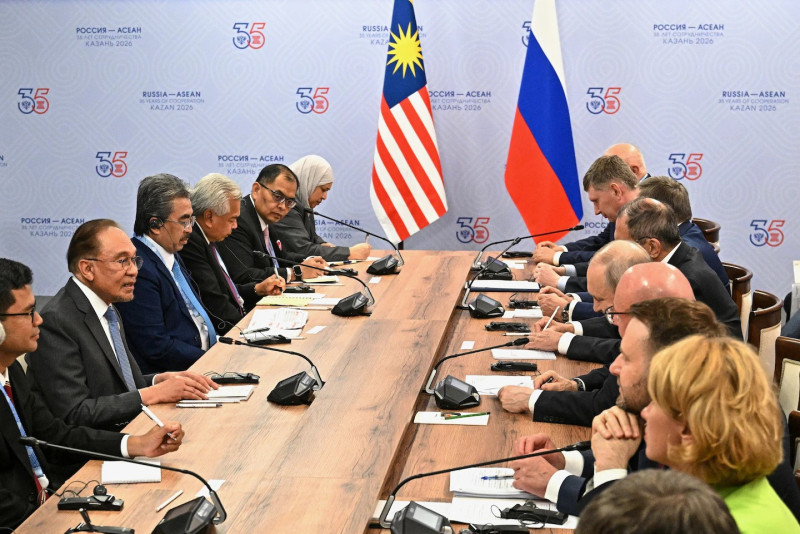
PRESIDENT Vladimir Putin has reaffirmed Russia's commitment to expanding its strategic partnership with Southeast Asia, welcoming leaders of the Association of Southeast Asian Nations (ASEAN) to Kazan for a summit aimed at strengthening economic, political and security cooperation amid an increasingly fragmented global landscape.
The two-day summit, marking the 35th anniversary of Russia-ASEAN relations, brings together leaders and senior representatives from Brunei, Cambodia, Indonesia, Laos, Malaysia, Myanmar, the Philippines, Singapore, Thailand, Timor-Leste and Vietnam to chart the next phase of cooperation between Moscow and the regional bloc.
AP reported on Thursday that Puttin addressed participants at a business forum held alongside the summit to generate fresh opportunities for closer commercial engagement.
"I am confident that it will create new opportunities for expanding mutually beneficial trade, investment, and industrial cooperation, while also strengthening direct dialogue between our business communities," he said.
Kremlin foreign affairs adviser Yuri Ushakov said discussions would focus on broadening Russia's "strategic partnership" with ASEAN while reviewing regional and international developments.
He said participating nations were expected to reaffirm their commitment to "forming a just and democratic multipolar world order based on the principles of international law and the United Nations Charter."
Ushakov also described relations between Russia and ASEAN as a "fruitful, equal and constructive dialogue", adding that Putin would hold a series of bilateral meetings with regional leaders during the summit.
The Russian leader co-chaired the meeting with Philippine President Ferdinand Marcos Jr., whose country currently holds ASEAN's rotating chairmanship.
During their bilateral talks, Putin highlighted the positive trajectory of relations between Moscow and Manila.
"Our countries enjoy mutually beneficial cooperation built on good traditions, mutual respect and consideration of each other's legitimate interests," he said.
Marcos thanked Putin for hosting the summit and invited him to attend the ASEAN Summit in Manila in November.
Putin also held separate meetings with Brunei's Sultan Hassanal Bolkiah and Malaysian Prime Minister Anwar Ibrahim as Russia sought to deepen engagement with individual ASEAN member states.
Speaking at an official reception for the visiting delegations, Putin stressed that Russia and ASEAN shared common principles in international affairs.
"Russia and ASEAN nations jointly stand for forming a just world order, defend the principles of sovereign equality of states, (of) non-interference into internal affairs," he said.
"All our states follow their own models of development and don't impose their views on anyone. And this is, indeed, our strength."
"Russia is ready for continuing active joint work with ASEAN member states with the goal of strengthening strategic partnership, in the interests of ensuring security, well-being and prosperity of our countries and peoples, as well as the Eurasian region as a whole."
On the margins of the summit, Putin also met Turkish Foreign Minister Hakan Fidan following his talks in Moscow with Russian Foreign Minister Sergey Lavrov.
The Russian president described bilateral relations with Turkey as continuing to strengthen.
"Our ties are developing steadily," Putin said, adding that relations between the two countries were "truly friendly and being filled with new meaning."
Fidan responded that both sides had numerous issues requiring discussion.
The summit reflects Russia's continuing efforts to reinforce its presence in Southeast Asia at a time when ASEAN members maintain carefully balanced foreign policies.
While countries such as the Philippines retain close strategic ties with the United States, others have expanded trade, energy and security cooperation with both Russia and China.
Several ASEAN member states, including the Philippines, Indonesia, Thailand and Vietnam, have either increased imports of Russian crude oil or expressed interest in doing so following the sharp rise in global energy prices triggered by the conflict involving Iran, underscoring Moscow's continuing importance as an energy supplier to the region. - June 18, 2026