JERUSALEM – It took just days for decades-old tensions between Israel and the Palestinian Islamist group Hamas to spiral out of control, causing deaths and chaos not just in Gaza but across the Jewish state.
As the escalating violence ignites riots in mixed Jewish-Arab towns in Israel and spurs wide unrest in the West Bank, what do both sides want to achieve in the worst flare-up of violence since 2014?
Hamas, rulers of the impoverished and blockaded Gaza Strip, the crowded home to some two million Palestinians, aims to become the de facto standard bearer of the Palestinian cause, capitalising on the fading leadership of the Palestinian Authority, based in the West Bank.
In a show of force, Hamas has unleashed some 2,300 rockets on Israel since last Monday, reaching as far as Tel Aviv to the north, and Ramon airport to the south.
Israel, meanwhile, has seized the moment to try to wipe out once and for all Hamas’ sway in the territory by attacking its very infrastructure, analysts say.
The explosion of unrest has centred around Palestinian anger at Israel’s occupation and annexation of east Jerusalem since 1967, amid a threat to evict four Palestinian families from their homes to give them to Jewish settlers.
More than 900 Palestinians were injured in weekend fury that erupted towards the end of the holy month of Ramadan, around the Al-Aqsa mosque compound, the holiest site in Islam after Mecca and Medina.
Amid the chaos, Hamas set an unrealistic ultimatum for all Israeli police to withdraw from the compound by 6pm Monday evening.
Inevitably, the deadline was not met, and Hamas swiftly unleashed a volley of rockets into Israel drawing an almost immediate response and a relentless Israeli bombardment of the Gaza Strip.
‘Harnessing’ street anger
It is a “new strategy and tactic” by Hamas to seek to link “the issue of Jerusalem with the resistance in Gaza”, said Jamal Al-Fadi, professor of political science in Gaza.
“This is a change to the rules of the game and the rules of engagement that serve the Palestinian situation,” he added, warning it may prove a “costly” move.
Political researcher Leila Seurat, from the Brussels-based Observatory of the Arab and Muslim Worlds, agreed, saying Hamas was “clearly seeking to undermine” Palestinian president Mahmud Abbas “who is already very weakened” by “positioning itself as the safeguard of the Palestinians, and above all Jerusalem”.
Abbas abruptly postponed this month’s Palestinian elections – the first in 15 years – even though Hamas and Abbas’s Fatah party had agreed on a roadmap for reconciliation to try to patch over deep divisions.
Setting no alternative date, Abbas said the vote could not take place until Israel agreed that all Palestinian residents of east Jerusalem can vote.
Hamas, which had been hoping to seal its legitimacy at the ballot box, did not hide its anger.
But Hamas “does not control” the unrest on the city streets, even if they want to “harness it”, said Seurat.
Bibi’s red line
Beleaguered Israeli Prime Minister Benjamin Netanyahu also seized the moment to make political capital, as he fights to retain the premiership following four inconclusive elections in the past two years.
Swiftly accusing Hamas of crossing “a red line”, he ordered in the military for what has been dubbed Operation Guardian of the Walls and, this time, the Israeli army did not just reply with a few missiles.
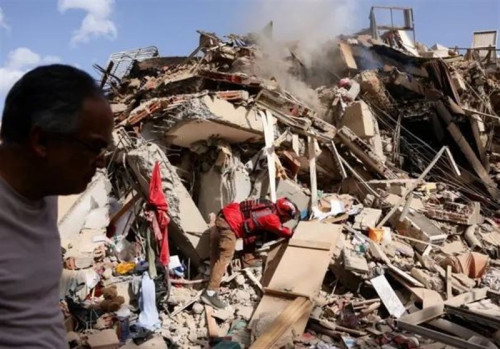
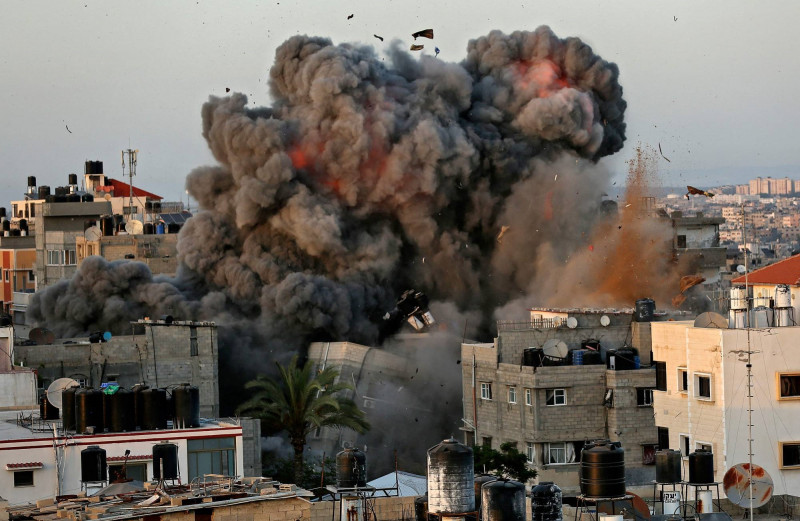
Since last Monday, the military has pounded Gaza and massed troops on the territory’s border with Israel, threatening a ground invasion.
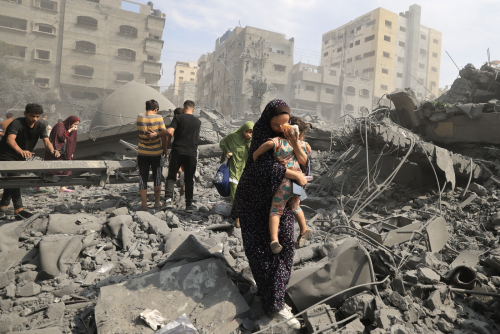
And the protection from the hail of Hamas rockets offered by Israel’s Iron Dome system, which has been intercepting most of the missiles, is buying time for the Israeli military to pursue its goal. So far, more than 130 Palestinians have been killed in the exchanges, while the death toll in Israel stands at nine.
“When the Palestinians get out of their shelters, they will find that many of the symbols of Hamas’ control of the Gaza Strip will have been destroyed, from banks to the intelligence centre,” said Netanyahu’s former national security adviser, Yaakov Amidror.
“Everything that is symbolising Hamas as the government of the Gaza Strip” will be gone, he told AFP, as Israel seeks “to destroy their military capability and infrastructure, this is the name of game”.
There is also clearly an “effort to kill as many Hamas members as possible and mainly commanders in the whole area of technical expertise who are leading the production system”.
Engineers, experts in rocket production, computer intelligence specialists, builders of mini-drones have all been targeted by the Israeli strikes.
“This will have a long term impact on the movement’s ability to make weapons,” an Israeli military source said.
The Israeli army said in a tweet Saturday that overnight strikes had hit a Hamas tunnel below a hotel that “was used to store weapons” as well as a “multi-barrelled rocket launcher”.
Israel is seeking to weaken Hamas and drive an even deeper wedge between the fractious Palestinian factions, said Gaza University political scientist, Naji Shurab.
But he warned “this is the most dangerous scenario” as it could cause the uprising to spread to the West Bank and “this will end the Palestinian Authority”, deepening the uncertainty and helplessness of a new generation of Palestinians. – AFP, May 17, 2021