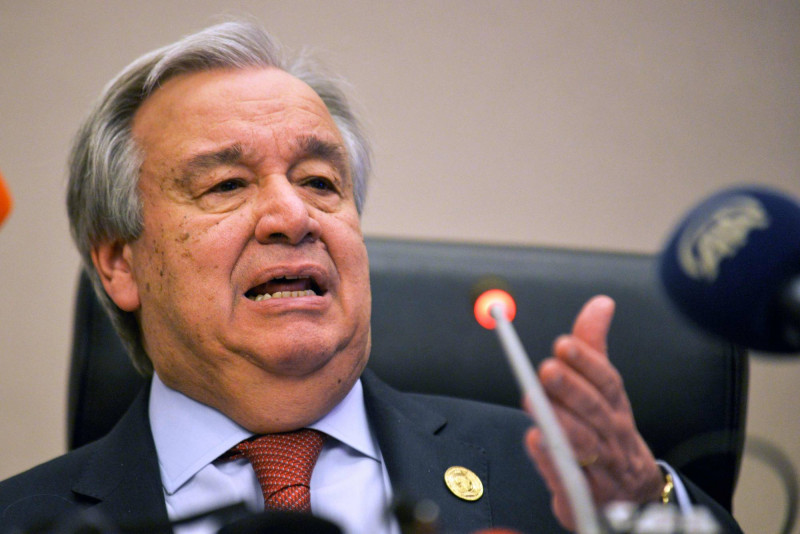
GENEVA – United Nations chief Antonio Guterres yesterday branded rich nations’ vaccine hogging as immoral and stupid, saying choking off poorer countries’ access to jabs risks undermining their own defences against the Covid-19 pandemic.
The World Health Organisation (WHO) said every country that has fully immunised more than 40% of its population is doing too little to stop the coronavirus crisis, as they should be ensuring doses go to nations left wide open to the virus.
WHO wanted 10% of the population in every country fully jabbed by end-September – a target missed in 56 nations “through no fault of their own”, said the organisation’s chief Tedros Adhanom Ghebreyesus.
The UN health agency said 1.5 billion vaccine doses are now being manufactured every month – with less than one week’s production needed to reach the 10% target.
“Vaccine inequality is aiding and abetting the Covid-19 pandemic,” Guterres told a virtual press conference alongside Tedros.
“It is allowing variants to develop and run wild, condemning the world to millions more deaths, and prolonging an economic slowdown that could cost trillions of dollars.”
He said if the virus spreads in areas with few vaccinated people, the chances of a variant emerging that could become resistant to vaccines become greater.
“All the vaccination efforts made in developed countries to vaccinate the whole of the population one, two or three times – all that effort will fall apart. And these people will not be protected.
“So, not to have the equitable distribution of vaccines is not only a question of being immoral, it is also a question of being stupid.”
‘Precipice of failure’
Tedros said more than 6.4 billion doses have been administered, and almost a third of the world’s population is fully vaccinated against Covid-19.
However, “those numbers mask a horrifying inequity”, he said.
“We stand on the precipice of failure” if vaccines are not immediately made widely available.
He said there are enough doses being produced to achieve WHO’s next target of seeing 40% in every country vaccinated by year-end – provided that they are distributed equitably.
Tedros also announced that WHO has finalised a clinical case definition for post-Covid-19 condition, often called “Long Covid”.
The definition states that symptoms appear within three months of infection, last for at least two months, and cannot be explained by an alternative diagnosis.
Common symptoms include fatigue, shortness of breath and cognitive dysfunction. They may appear following recovery from acute-stage Covid-19 or persist from the initial illness. Symptoms may also fluctuate over time.
“This standardised definition will help clinicians to identify patients more easily and provide them with the appropriate care, and is crucial for advancing recognition and research,” said Tedros. – AFP, October 8, 2021






.jpeg)