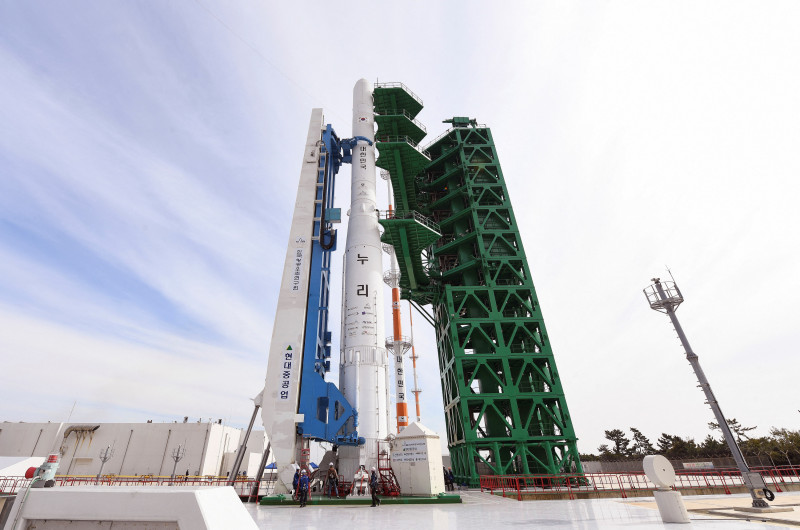
SEOUL – South Korea launched its first domestically developed space rocket today, carrying a 1.5-tonne payload as it seeks to join the ranks of advanced space-faring nations.
The Korean Satellite Launch Vehicle II, informally called Nuri, rose upwards from the launch site in Goheung trailing a column of flame, with a television commentator saying: “It looks like it’s soaring into the sky without problems.”
Within minutes it had reached 600km in altitude, the beginning of its targeted range.
South Korea has risen to become the world’s 12th-largest economy and a technologically advanced nation, home to the planet’s biggest smartphone and memory chip maker, Samsung Electronics.
But it has lagged in the headline-making world of spaceflight, where the Soviet Union led the way with the first satellite launch in 1957, closely followed by the United States.
In Asia, China, Japan, and India all have advanced space programmes, and the South’s nuclear-armed neighbour North Korea was the most recent entrant to the club of countries with their own satellite launch capability.
Ballistic missiles and space rockets use similar technology and Pyongyang put a 300kg satellite into orbit in 2012 in what Western countries condemned as a disguised missile test.
Even now, only six nations – not including North Korea – have successfully launched a one-tonne payload on their own rockets.
The South will become the seventh if Nuri succeeds in putting its 1.5-tonne dummy cargo into orbit.
The three-stage rocket has been a decade in development at a cost of 2 trillion won (RM7.1 billion). It weighs 200 tonnes and is 47.2m long, fitted with a total of six liquid-fuelled engines. – AFP, October 21, 2021