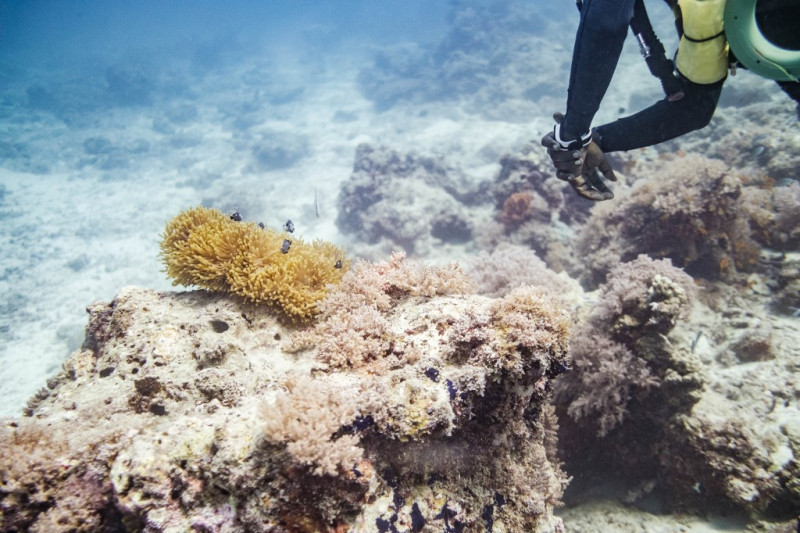
PARIS – Coral reefs that anchor a quarter of marine wildlife and the livelihoods of more than half-a-billion people will most likely be wiped out even if global warming is capped within Paris climate goals, researchers said Tuesday.
An average increase of 1.5°C above pre-industrial levels would see more than 99% of the world’s coral reefs unable to recover from ever more frequent marine heat waves, they reported in the journal PLOS Climate.
At two degrees of warming, mortality will be 100% according to the study, which used a new generation of climate models with an unprecedented resolution of one square kilometre.
“The stark reality is that there is no safe limit of global warming for coral reefs,” lead author Adele Dixon, a researcher at the University of Leeds’ School of Biology, said.
“1.5C is still too much warming for the ecosystems on the frontline of climate change.”
The 2015 Paris Agreement enjoins nearly 200 nations to keep global heating “well below” 2°C.
But with more deadly storms, floods, heatwaves and droughts after only 1.1°C of warming to date, the world has embraced the treaty’s more ambitious aspirational goal of a 1.5°C limit.
A landmark report in August by the United Nations’ IPCC climate science panel said global temperatures could hit the 1.5°C threshold as soon as 2030.
In 2018, the IPCC predicted that 70% to 90% of corals would be lost at the 1.5°C threshold, and 99% if temperatures rose another half-a-degree.
The new findings suggest those grim forecasts were in fact unduly optimistic.
Marine heatwaves
“Our work shows that corals worldwide will be even more at risk from climate change than we thought,” Dixon said.
The problem is marine heatwaves and the time it takes for living coral to recover from them, a healing period known as “thermal refugia”.
Coral communities usually need at least 10 years to bounce back, and that’s assuming “all other factors” – no pollution or dynamite fishing, for example – “are optimal”, said co-author Maria Berger, also at Leeds.
But increased warming is reducing the length of thermal refugia beyond the ability of corals to adapt.
“We project that more than 99% of coral reefs will be exposed at 1.5°C to intolerable thermal stress, and 100% of coral reefs at 2°C,” Berger said.
Australia’s Great Barrier Reef, the largest coral system in the world, has seen five mass bleaching events in the last 25 years.
An unpublished study obtained by AFP, written by experts at the US National Oceanic and Atmospheric Administration’s Coral Reef Watch unit, says the Great Barrier Reef was in the grips of a record-breaking heat spell yet again in November and December.
Oceans absorb about 93% of the excess heat from greenhouse gas emissions, shielding land surfaces but generating huge, long-lasting marine heatwaves that are already pushing many species of corals past their limits of tolerance.
A single so-called bleaching event in 1998 caused by warming waters wiped out 8% of all corals.
Coral reefs cover only a tiny fraction – 0.2% – of the ocean floor, but they are home to at least a quarter of all marine animals and plants.
Besides supporting marine ecosystems, they also provide protein, jobs and protection from storms and shoreline erosion for hundreds of millions of people worldwide.
The value of goods and services from coral reefs is about US$2.7 trillion per year, including US$36 billion in tourism, the report said.
Global warming, with the help of pollution, wiped out 14% of the world’s coral reefs from 2009 to 2018, leaving graveyards of bleached skeletons where vibrant ecosystems once thrived, recent research has shown.
Loss of coral during that period varied by region, ranging from five percent in East Asia to 95% in the eastern tropical Pacific. – AFP, February 2, 2022