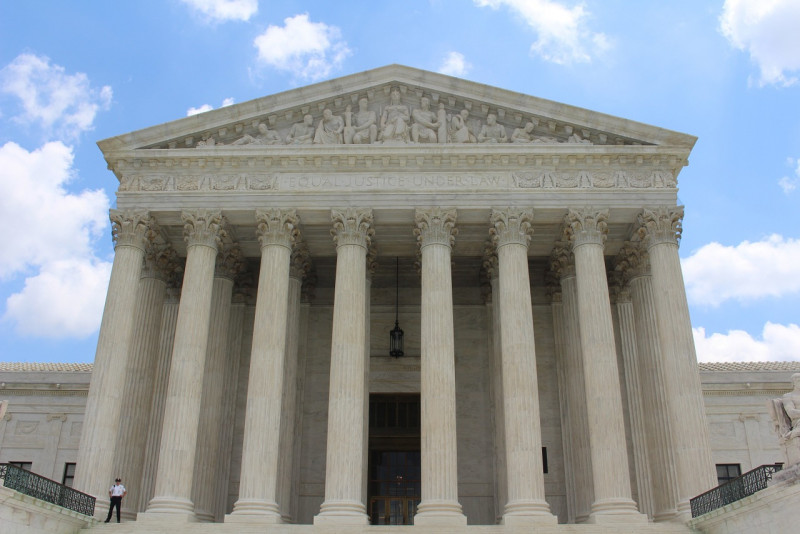
WASHINGTON – The wall separating church and state is one of the foundational principles of the United States.
Sonia Sotomayor, one of three liberal justices on the Supreme Court, is accusing her conservative majority colleagues of tearing it down.
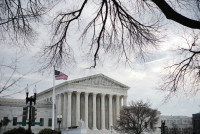
Sotomayor did not mince words in a dissent to a ruling by the nine-member court this week that the state of Maine cannot deny public funds to religious schools.
“There is nothing neutral about Maine’s program,” chief justice John Roberts wrote in an opinion joined by the other five conservative justices.
“The state pays tuition for certain students at private schools – so long as the schools are not religious,” Roberts said. “That is discrimination against religion.”
In a blistering dissent, Sotomayor, who was named to the court by Democratic president Barack Obama, wrote, “what a difference five years makes.”
“In 2017, I feared that the court was ‘leading us...to a place where separation of church and state is a constitutional slogan, not a constitutional commitment,’” she said.
“Today, the court leads us to a place where separation of church and state becomes a constitutional violation.”
Sotomayor ended her contribution with a pointed signoff.
“With growing concern for where this court will lead us next, I respectfully dissent,” she said.
Zachary Heiden, chief counsel at the American Civil Liberties Union of Maine, said the court’s ruling, which comes just days before a highly anticipated abortion rights decision, upended two decades of jurisprudence.
“For over 20 years, every court that has heard a challenge to Maine’s law that prohibits public funding of religious education has upheld its constitutionality,” Heiden said.
“But this Supreme Court has rendered a decision completely contrary to the founding principle of separation of church and state.”
Trump nominees
Lia Epperson, a law professor at American University who joined an amicus brief in the case in support of Maine, said the ruling was significant.
“This is the first time the court has explicitly required taxpayers to support something that is a specific religious activity – that is religious instruction,” Epperson said.
Steven Schwinn, a law professor at the University of Illinois Chicago, said the decision was the latest by the Roberts court “on a long trajectory of expanding the roles of religion in public life.”
“The court has not changed the underlying law,” Schwinn said. “It hasn’t gone so far as to overrule prior cases.
“And yet it nevertheless has moved inexorably in the direction of not only inviting religion more into public life but really mandating religion more into public life.”
“It’s done that incrementally,” he added. “You can agree or disagree with the direction the court is taking, it seems to me, but that the court is taking a direction is undeniable.”
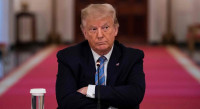
During his four years in the White House, president Donald Trump nominated three conservative justices, cementing a 6-3 right-wing majority on the nation’s highest court.
“If there was any question before there’s quite clearly a majority in favour of religion now,” Schwinn said.
Epperson agreed.
“We do have an increasingly religious and conservative court,” she said. “You will see that reflected in the decisions.
“This is the most Catholic the Supreme Court has ever been in its history in terms of the justices,” she noted.
‘Legitimate church’
Six of the nine justices are Catholic – Roberts, Clarence Thomas, Samuel Alito, Sotomayor, Brett Kavanaugh and Amy Coney Barrett.
Justices Elena Kagan and Stephen Breyer are Jewish while justice Neil Gorsuch is Episcopalian.
Ketanji Brown Jackson, who will be replacing the retiring Breyer next term, is Protestant.
According to a Gallup survey, 22% of the American adult population identifies as Catholic and 45% as non-Catholic Christians.
A total of 2% identify as Jewish and 21% say they have no formal religious identity.
Kevin Welner, a professor specialising in educational policy and law at the University of Colorado Boulder, said the Maine ruling could have some potential pitfalls.
“The example here is ‘Do we really want our government deciding which asserted religious beliefs are geniune?’” he said.
“‘This is a legitimate church. This is an illegitimate church.’”
“You could end up with a situation where eventually the state is going to have to come in and say ‘That’s a religious belief that we’re going to honour and that’s not.’” – AFP, June 23, 2022