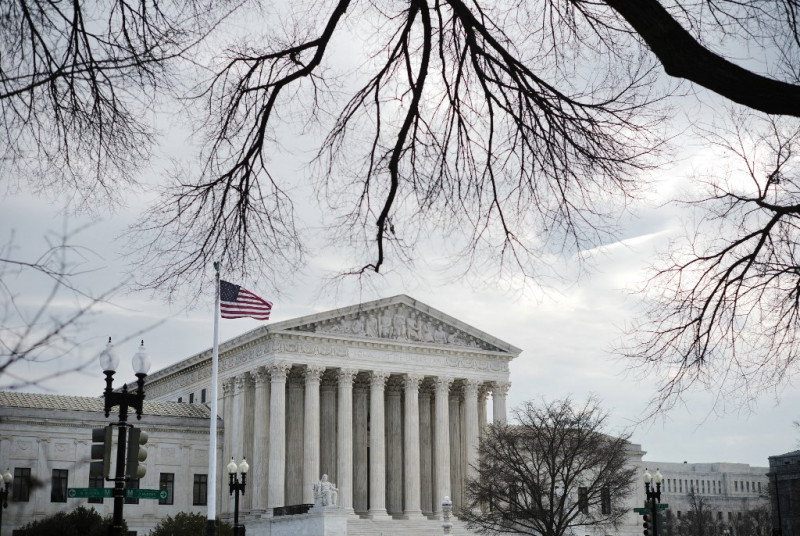
WASHINGTON – After abortion and guns, the US Supreme Court tackles another controversial and sensitive issue on Monday – the use of race in deciding who gets admitted to some of America’s top universities.
And the conservative-dominated court may be poised to make another historic U-turn, like it did in June when it overturned the landmark 1973 “Roe v Wade” decision guaranteeing a woman’s right to abortion.
The court is to hear two hours of oral arguments on the use of race in admissions to Harvard and the University of North Carolina (UNC) – respectively the oldest private and public institutions of higher education in the country.
Harvard and UNC, like a number of other competitive schools, use race as a factor in trying to ensure representation of minorities, historically African Americans, in the student body.
The policy known as “affirmative action” emerged from the Civil Rights Movement in the late 1960s to “help address our country’s long history of discrimination and systemic inequality in higher education,” said Yasmin Cader, deputy legal director at the American Civil Liberties Union (ACLU).
It has been controversial from the start, drawing fire mostly from the right, and a number of white students have mounted legal challenges over the years, claiming “reverse discrimination.”
Nine states have banned affirmative action at public universities including California, where voters did so in a ballot proposition in 1996 and rebuffed an attempt to revive the policy in 2020.
Students for Fair Admissions
The Supreme Court has previously upheld affirmative action, most recently in 2016 by a single vote, but its opponents believe the current right-leaning bench will lend a more sympathetic ear to their arguments.
“If they overturned Roe, I think they are equally likely to overturn Bakke,” said Ilya Shapiro, a senior fellow at the Manhattan Institute, a conservative think-tank.
In a landmark ruling in 1978 – Regents of the University of California v Bakke – the Supreme Court banned the use of quotas in admissions as unconstitutional.
But the court said race or ethnic origin can be considered as one factor among others in admitting students to ensure a diverse student body.
With six justices – three of whom were nominated by former president Donald Trump, a Republican – conservatives wield a solid majority on the nine-seat high court.
And those in favour of “colour-blind” admissions policies believe they may have an ally in Chief Justice John Roberts.
“The way to stop discrimination on the basis of race is to stop discriminating on the basis of race,” Roberts wrote in a ruling in a 2007 school integration case.
A group known as Students for Fair Admissions, which claims more than 20,000 members and was founded by Edward Blum, a long-time conservative opponent of affirmative action, is behind the latest attack on the policy.
In 2014, the group filed suits against Harvard and UNC claiming that their race-conscious admissions policies discriminate against equally qualified applicants of Asian-American origin.
Asian-American students are under-represented at the schools considering their record of superior academic achievement, according to the complaints.
“In a multiracial, multi-ethnic nation like ours, the college admissions bar cannot be raised for some races and ethnic groups but lowered for others,” according to Blum.
“Our nation cannot remedy past discrimination and racial preferences with new discrimination and different racial preferences.”
‘Diverse leaders’
After losing in lower courts, the group is seeking a ruling from the Supreme Court that the US constitution prohibits any form of discrimination – a decision that could also impact hiring, for example, or government contracting, where preference is sometimes given to minority-owned businesses.
The Supreme Court will hear one hour of argument in each case with Ketanji Brown Jackson, the court’s first African-American woman, sitting out the Harvard case because she has served previously on the board of overseers of the school.
The administration of Democratic President Joe Biden and a number of major American companies have weighed in on the side of the universities.
“Our nation’s future depends on having diverse leaders who are prepared to lead in an increasingly diverse society,” the Justice Department said.
Apple, General Motors and Starbucks joined a brief arguing that “diverse workforces” improve business performance “and thus strengthen the American and global economies.”
The ACLU’s Cader warned that a decision by the court overturning its previous support for affirmative action policies would have wide-ranging and long-lasting repercussions.
“We face the threat of the generations behind us having less rights than we had ourselves,” Cader said.
“And I can say that as an African American woman who went to law school under that precedent.” – AFP, October 29, 2022