BRISBANE – It went down to the wire, but it looks as if the threatened break-up of the Pacific Islands Forum has been averted. Subject to final approval when the forum leaders meet in Fiji next week, an agreement has been brokered that everyone can accept.
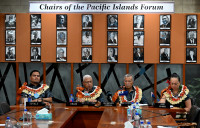
This means the “Micronesian Five” (Federated States of Micronesia, Kiribati, Nauru, Palau and the Republic of the Marshall Islands) will remain members of the region’s apex political organisation.
These countries had previously activated (and then paused) procedures to give up their forum membership. This was in response to a February 2021 vote in which the position of secretary-general was given to Henry Puna of the Cook Islands in preference to Ambassador Gerald Zackios of Marshall Islands.
Ambassador Zackios had been put forward as the Micronesian candidate on the basis that it was Micronesia’s “turn” to hold the senior leadership position at the forum’s secretariat in Suva. This in turn stemmed from an informal agreement that was made in 2013 when Micronesia agreed to support Dame Meg Taylor as secretary-general in preference to a Micronesian candidate. Zackios had been identified by Marshall Islands well in advance of the vote in February of last year.
Negotiated by a subgroup of the regional leadership who met in person in Suva in early June, the agreement has several aspects.
Mr Puna will step down as secretary-general in 2024. He will be succeeded by a Micronesian, who will serve a five-year term. Going forward, the secretary-general position will rotate between the three subgroups of the region – Melanesia, Micronesia and Polynesia.
In addition, there will be three deputy secretary-generals in the forum’s secretariat, one from each of the Pacific subregions. There will also be a sub-office of the secretariat in the northern part of the region.
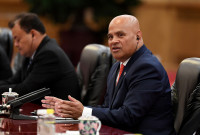
The President of Federated States of Micronesia, David Panuelo, said the agreement meant a “big dark cloud” had been lifted from the region. More recently, President Lionel Aingimea of Nauru welcomed this breakthrough that looks to have achieved its objective: keeping everyone inside the tent.
Meanwhile, plans are being finalised for the July 12-14 meeting of the forum leaders. The meeting will be the first time the leaders will have met in person since 2019.
It has been a journey of twists and turns to get to this stage, with many complicating factors along the way. The most significant drivers and blockages have arisen within the forum grouping.
But the increased tempo of geopolitical competition has created added urgency as the situation has unfolded. It has also led to more external attention and scrutiny than might otherwise have been the case.
Quiet shuttle diplomacy has played a major part in resolving the situation. Covid-19 and associated border closures have seriously limited opportunities for face-to-face meetings, but a high-level dialogue group within the forum has worked hard to overcome these hurdles and deliver a solution.
Prime Minister Bainimarama of Fiji is the current chair of the forum and has played a key role in the events of the last 18 months. He personally apologised to the Micronesian members for the hurt and embarrassment they suffered when Puna was elected as secretary-general.
Setback for ‘China plus 10’ plan
Significantly, both Australia and New Zealand were willing and able to take a back seat throughout the process. In part, this was a response to criticism – largely unfounded – that they had exercised undue influence to get Puna into the top job.
But it also appears to reflect a degree of self-awareness that their economic strength should not necessarily make them leaders in everything. This situation required Pacific diplomatic skills, rhetoric and gravitas that were located elsewhere.
Just as it looked as though there may not be a resolution ahead of the forum leaders’ meeting, Chinese foreign minister Wang Yi conducted a Pacific tour.
This, plus his government’s (failed) attempt to secure a “China plus 10” region-spanning economic, trade and security agreement, threw into sharp relief Beijing’s apparent intention to ramp up multilateral engagement in the region.
Previously its energy had been focused on bilateral relationships. This may have galvanised a degree of regional solidarity and a recognition that membership of the forum creates a buffer for small states as they seek to withstand external pressures.
In the immediate term, the resolution of this impasse means the forum leaders’s meeting can focus on some critical issues, including approval of the 2050 Strategy for the Blue Pacific Continent.
This is expected to be a foundational document to guide Pacific strategy in the near to medium term.
Aussie-NZ to bear 49% of forum funding
Some of the promises made to the “Micronesian Five” carry significant price tags. It is unclear who will pay for additional deputy secretary-general positions in Suva and a new sub-office in the region’s north.
One of the most notable achievements of the previous secretary-general, Dame Meg Taylor, was to restructure the funding of the forum so 51% of its costs are now met by the Pacific Islands membership, and the remaining 49% is provided by Australia and New Zealand.
This was a very important step, but if the costs of the agreement’s new promises are borne by Australia and New Zealand, there is a risk this will change.
Another likely implication is that there will be an increased focus on and engagement with subregional groupings.
Until this furore arose, the Micronesian Presidents’ Summit was little known. But the chair of this group – President Lionel Aingimea of Nauru – was a critical voice in many of the most important engagements. The group and its counterparts, the Melanesian Spearhead Group and the Polynesian Leaders’ Group may become more visible and influential in the patchwork landscape that is Pacific regionalism.
Not surprisingly, there have been calls for a review of the forum and the operations of its secretariat, including by Professor Steve Ratuva, a leading Pacific voice. The desire for processes and systems that are fit for purpose is very welcome, but there needs to be more to regionalism than simply reviewing regionalism.
This process highlighted the importance of Pacific regionalism and the centrality of the Pacific Islands Forum. Lessons learned along the way are likely to inform how the forum operates in the future and how well it can meet the needs and expectations of its membership. – The Vibes, July 11, 2022
Tess Newton Cain is the project lead for the Pacific Hub at the Griffith Asia Institute. She has written extensively on Pacific regionalism and is a dual citizen of Vanuatu and the UK
Published under Creative Commons and in partnership with 360info.org