
A THINK tank sees the faster adoption of the Regional Comprehensive Economic Partnership (RCEP) as a check and balance against the import tariffs in the global economy.
As RCEP is the world's largest free trade agreement and comprises 15 member countries: the 10 ASEAN nations (Brunei, Cambodia, Indonesia, Laos, Malaysia, Myanmar, Philippines, Singapore, Thailand, and Vietnam) and five free trade partners: Australia, China, Japan, New Zealand, and South Korea.
Its purpose is to liberalise rather than impede trade.
The Belt and Road Initiative Caucus for Asia Pacific (BRICAP) president Tan Sri Ong Tee Keat, a former Transport Minister, said that RCEP signatories need to consolidate and get the trade pact going against the punitive tariffs.
"If RCEP is to serve as a shield against uncertainty and a bridge toward resilience, we must now move from rhetoric to implementation," he said.
Strengthening the RCEP framework is not merely an economic imperative — it is a strategic priority.
"We must work towards actionable cooperation: simplifying rules, aligning standards, and empowering small medium enterprises (SMEs) to participate fully in cross - border trade."
The path toward deeper regional integration is not a sprint but a marathon — and ASEAN must run it together, not as fragmented competitors but as a cohesive community of destiny, said Ong.
Malaysia is a signatory to RCEP since 2022.
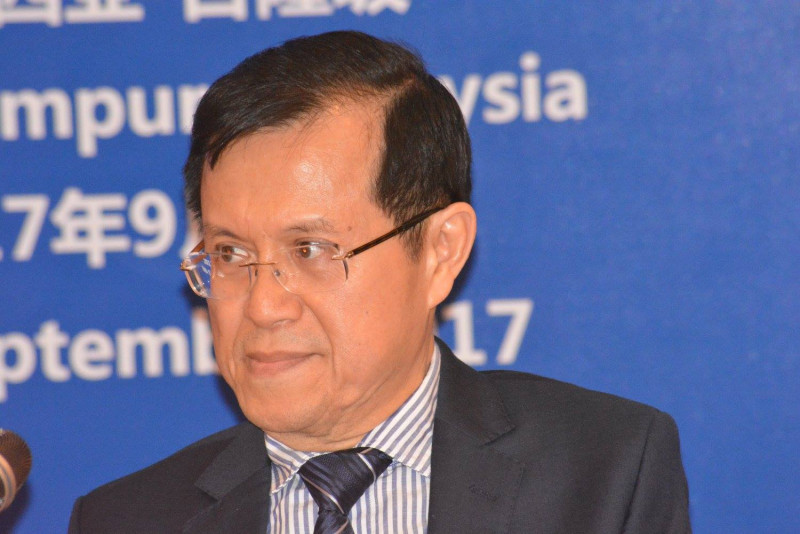
In collaboration with New Era University College (NEUC), he convened the BRICAP Seminar 2025 under the theme “Whither RCEP Amid the Trump Tariff Tumult?”
The full-day seminar gathered diplomats, policymakers, academics, and industry experts from across the Asia-Pacific to discuss the challenges of global protectionism.
Ong said that the reciprocal tariffs is a major destabilisation factor against the global supply chains and trade order.
BRICAP is a bridge between policy and the academia.
Among those who delivered papers were Shi Zhongjun, the ASEAN Centre's secretary - general, and China's representative Zheng Xuefang, who espoused that the country will continue to stand for multilateralism.
Former cabinet minister Datuk Seri Mustapa Mohamed said that RCEP can act as a pillar against trade protectionism.
He said the agreement represents a vital framework for promoting rules - based trade and multilateral cooperation in an increasingly fragmented world.
Mustapa acknowledged that RCEP’s implementation remains challenging due to varying levels of development among its members.
He stressed the need to enhance awareness and utilization of RCEP’s benefits, especially among the (SMEs).
After five years of extraordinary global disruption, the reaffirmation of commitment to WTO rules and a rules-based multilateral order was both timely and necessary," he said in reference to RCEP.
Ong also spoke of the challenges of transhipment where China's products make a detour to the southeast Asia region for repackaging before it is send to US.
Indeed, the vague definition of “transshipment" embodied in strategic ambiguity, opens the door to ever shifting interpretations, thus allowing Washington to “move the goalpost” at will as new tariff rounds are introduced.
Should this come to pass, not only would the China–ASEAN partnership suffer, but the entire RCEP architecture , including the collaborative interests linking China with Japan and South Korea, could find itself squarely within the crosshairs of Washington’s geopolitical gameplan, said Ong.
"At BRICAP, we believe that dialogue is the first step toward understanding, and understanding is the foundation of cooperation. As one of the region’s most active think tanks devoted to ASEAN-related discourse," he said. - November 13, 2025.