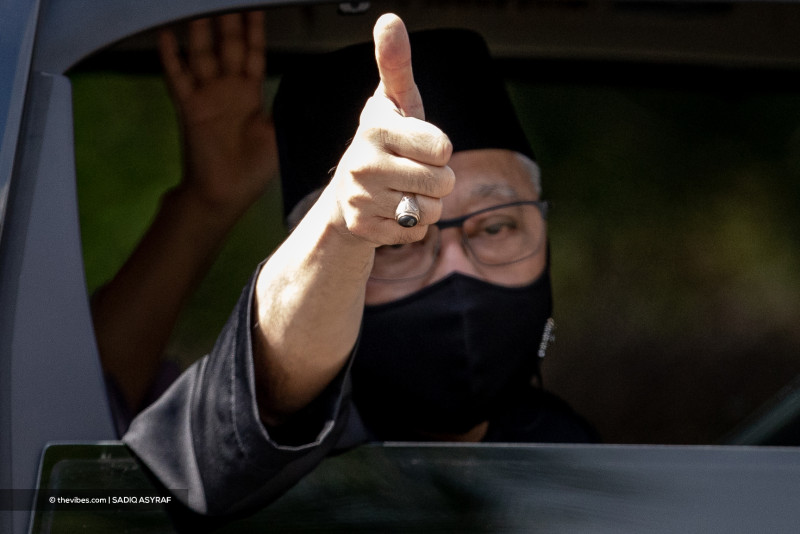

KUALA LUMPUR – Malaysian markets closed with little change on Friday, showing that the selection of Datuk Seri Ismail Sabri Yaakob as prime minister is broadly expected.
Having a more stable political environment will also ease investor concerns.
The benchmark FTSE Bursa Malaysia KLCI (FBM KLCI) is likely to trade within a tight range of between 1,510 and 1,530 points this week, amid reduced volatility in the market following the announcement of a new prime minister.
The ringgit rose slightly to 4.2393 per US dollar, while the FBM KLCI closed with a 0.2% gain to 1,518 points, bucking the regional trend among Asian peers Hong Kong, Japan, South Korea and the Philippines.
Weak oil prices and the greenback’s strength could also see the currency testing the 4.25 level.
Areca Capital Sdn Bhd chief executive officer and executive director Danny Wong said the political uncertainty has been an overhang on the markets and is undoubtedly priced-in over the past several weeks.
Nevertheless, we believe that whoever the prime minister is, he will need to not just work out a plan to fight Covid-19, but also have a roadmap for economic recovery.
“He will also be inheriting a country whose (adult) population is already 50% vaccinated with the first dose, while about 25% are fully vaccinated.
“It is only a matter of time before we see the effects of the vaccination on the number of daily cases and economy.”
The fund manager said he remains positive on the local equity market, based on foreign holdings – which are at very low levels at around 20.3% following three successive years of outflows totaling more than RM40 billion.

“Most bad news we believe have been priced-in, as the economy has been caught in a stop-start mode for about one and a half years amid the resurgence in cases, discovery and spread of Delta, and recent political uncertainty.
“Malaysia’s valuations are at their multiple year lows, which are akin to crisis-level valuations.
“Our price earnings ratio is around 13.4, while our price-to-book ratio is around 1.45 – these are close to below two and 1.4 standard deviation, below the respective five-year mean for both measures.”
Wong said he sees the vaccination progress as a bright spot, as it will lead to the reopening of economic activities.
If we are able to sustain this frantic pace of vaccination delivery and administration, herd immunity levels are not too far off.
“Some projections put this around the end of the third quarter or early fourth quarter. The government’s recent move to ease restrictions for fully vaccinated individuals will help boost economic activity, too.”
Political risk will subside for the time being, and there will be no general election (GE) due to the high number of daily cases, he added.
“A new prime minister is appointed until the next GE takes place. Depending on his performance, the tenure for the newly appointed prime minister will likely last one to two years.”
Hopes for more inclusiveness
Industries Unite (IU), a non-partisan trade coalition, said it is ready to engage with the new government to combat the Covid-19 pandemic, and save businesses, the economy and livelihoods of employees under challenged industry sectors.
The coalition hoped that more voices of inclusivity from medium, small and micro businesses will be included in the formulation of national policies, especially in the National Recovery Plan.
IU comprises 117 trade associations and chambers of commerce that represent 3.3 million businesses in Malaysia.
It is able to assist most agencies and ministries to collect data from the ground and propose enhanced standard operating procedures (SOPs), working with various ministries and ministers to achieve a common goal.
“We may have, on occasion, agreed to disagree, but we have always known and respected that we are on the same team. Many more initiatives and projects are in progress,” it said in a statement.
“We are ever ready, humble and vigilant to engage with the new government in steps to combat the Covid-19 pandemic, as well as save businesses and the economy, thus saving the livelihood of employees under these challenged industry sectors.
“We at IU extend our full support to the new prime minister and government.
“We pledge to assist in the government’s efforts towards improving the economy, welfare and well-being of the rakyat.
“We thank His Majesty the Yang di-Pertuan Agong for his advice that the new government prioritises working towards improving the welfare of the people and economy, and fighting the Covid-19 pandemic in an inclusive and united way.”
Malaysian Employers Federation (MEF) president Datuk Syed Hussain Syed Husman in a statement on Saturday said under Ismail Sabri’s leadership, it is hoped that Malaysia’s reputation and excellence as a fast-developing sovereign nation will be restored and enhanced despite the challenges of globalisation and Covid-19 crisis.
“Employers, especially small, medium and micro enterprises, are desperately seeking for a light at the end of the tunnel.
“To ensure their sustainability, we hope the government will consider providing additional support in terms of wage subsidies, so these employers can continue their operations and retain their employees.”
MEF has more than 6,500 ordinary members who are private companies, and 28 affiliate members, who altogether employ about four million private sector employees. – The Vibes, August 23, 2021