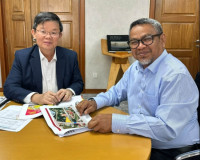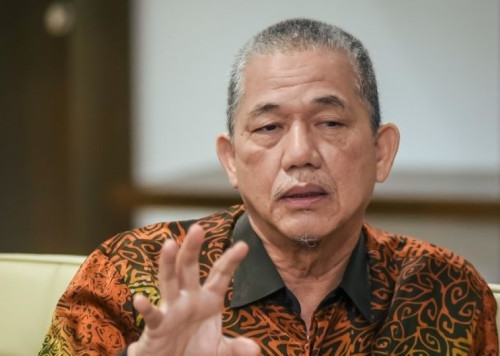
GEORGE TOWN – Penang investors should expand their businesses in Indonesia in the post-pandemic era given the archipelago’s vast land and natural resources, said Pensutra Alliance Berhad executive chairman Datuk Seri Abdul Rahman Maidin.
He said returns earned from investments in Indonesia can then be brought back and reinvested into Penang’s high-end industries.
Rahman added that local businessmen should tap unexploited potential in Sumatra, which is set be a haven for small and medium enterprises (SMEs) in the future.
He proposed the commercial environment in Sumatra, Acheh and Padang for investing, which matches the kind of business investors are seeking.
“I am not talking about the cottage industry. I am talking about SMEs, which employ between 50 people and 100 people.
“Many vendors here want to move to Indonesia, like those manufacturing motorcycle parts and electronic chips, and those in healthcare, renewable items business, education, digital and the creative economy.
“A commercial environment is important in this region to matchmake businesses with business communities.
“I have been acquainted with Sumatra since 1978, and Pensutra has been doing this since the company’s inception.
“Potential businessmen ask whom they should talk to and where they should go to invest, that is why I say a commercial environment is lacking here,” he said.
He also said that the Indonesian government with its omnibus laws has created a regulatory environment for new investors to invest in Indonesia.
He said that the government created a one-stop centre to distribute 3,000 licences needed for any kind of business.
With Indonesian President Joko Widodo identifying Sumatra as a food basket, the state has the potential to become Asia’s food basket at large.
“Most big companies have no problem going to Jakarta, but for SMEs, it is wise for them to go to Sumatra as the region has a vast land bank, ready labour market and an almost 70 million populace, which is advantageous for the tourism, agriculture and manufacturing sectors.
“However, the Indonesian government needs to create infrastructure facilities including roads, buildings, logistics and internet connections which are of utmost importance in this digital era,” he said.
Rahman said this at a webinar entitled “Indonesia Investment Update: Introducing Omnibus Law on Job Creation – A Game Changer” yesterday.
The session was organised by Indonesia’s Consul-General in Penang Bambang Suharto.
Investment promotion director (exhibition and promotion media) at Indonesia Investment Coordinating Board (BKPM), Cahyo Purnomo, and deputy assistant for investment strategy at the Indonesian Maritime and Investment Affairs Coordinating Ministry, Ferry A. Pasaribu, also addressed the session, which was moderated by SEED chief executive officer Stephen Lai.
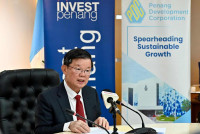
Penang Trade, Industry and Entrepreneurship Development Committee chairman Datuk Abdul Halim Hussain in his address said that he believes that there are still a lot of untapped opportunities within Indonesia for Malaysia, especially Penang.
He said Indonesia is still not among the top five main importing and exporting countries for Malaysia. However, bilateral trade data has shown that Malaysia’s major exports to Indonesia consist of petroleum products (18.5%), chemicals and chemical products (16.3%), transport equipment (15.7%), electrical and electronic (E&E) products (8.1%) as well as machinery, equipment and parts (7.6%).
Over the years, Penang’s engineering pool has successfully nurtured a number of home-grown global E&E players that have made us proud. Not only that, Penang has also a flourished scene of multinational corporations specialising in machinery, equipment and chemical products.
“With the Indonesian omnibus law creating a business-friendly ecosystem for foreign investors, Penang – being Malaysia’s E&E powerhouse that contributes substantially towards Malaysia’s total manufacturing exports – should grab this opportunity and tap into the Indonesian market soon.
“On the other hand, culturally, there are a lot of similarities between Malaysia and Indonesia and this creates even better market acceptance for Malaysian products and services in the market, subsequently giving Malaysian exporters an edge,” he added.
Halim said that with the federal government promising to ratify the Regional Comprehensive Economic Partnership (RCEP) agreement by mid-December, both Malaysia and Indonesia being member states are set to benefit from the Free Trade Agreement (FTA) with a market that covers almost one-third of the world’s population.
The RCEP, which is the only FTA to include China, Japan and South Korea, presents significant trading and investment opportunities when regional trade facilitation is enhanced, by phasing out import tariffs and accelerating access to the Chinese market and investors.
Moving into the post-pandemic era, the RCEP is crucial in managing future disruption by stabilising manufacturing and trade activities in order to mitigate future economic challenges, like the one posed by the Covid-19 pandemic, when the industry is enabled to seek to diversify its supply chain connectivity across the region.
Halim hopes Penang is still committed to developing its medical tourism sector, which generates approximately 40% to 50% of the nation’s medical tourism income.
“I am happy to note that Indonesians make up the biggest group of inbound tourists seeking medical treatment at various medical facilities in Penang, based on statistics available to us.
“This is due to Penang’s cultural similarities with Indonesia and the availability of direct flight connections from several Indonesian cities.
“I hope this sector will continue to appeal to our Indonesian friends and the state government will stay committed in strengthening the success factors for Penang’s medical tourism industry, particularly in developing supporting infrastructure like hotels and malls,” Halim added. – The Vibes, October 8, 2021
.jpeg)