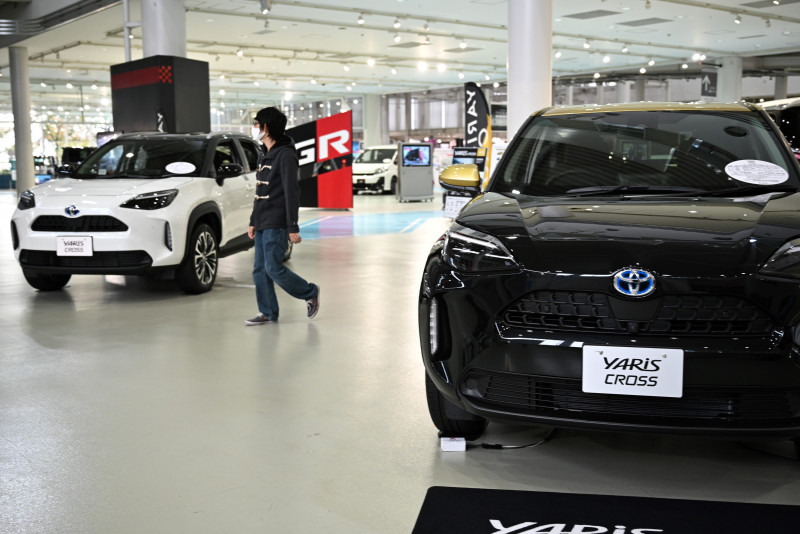
TOKYO – Toyota upgraded its full-year profit forecast today after a strong quarter that saw it weather production cuts caused by a chip crunch and supply chain issues in pandemic-hit Southeast Asia.
The world's top-selling automaker has recovered quicker than its competitors from some of the impact from Covid, but has been unable to avoid the twin pain of the semiconductor shortage and a supply bottleneck caused by factory disruption.
Though the Japanese giant lifted its annual net profit forecast, chief financial officer Kenta Kon sounded a note of caution, saying raw material costs were rising.
He also apologised for delays experienced by buyers after the chip shortage forced Toyota to cut output by some 550,000 units in the July-September period.
We're very sorry we're making many customers wait for the delivery of their cars due to production cuts. We're making efforts to deliver cars as soon as possible,” Kon told reporters.
The global shortage of microchips – essential components of modern cars – has forced many automakers to slow or temporarily halt production.
Toyota will continue reducing output during the current quarter, and has lowered its annual production target for 2021-22 to nine million vehicles from the 9.3 million previously planned.
The company now forecasts net profit of 2.49 trillion yen (US$21.8 billion, RM90.5 billion) for the fiscal year to March 2022, up from an earlier estimate of 2.3 trillion yen.
It left unchanged its annual sales estimate of 30 trillion yen.
The forecast hike came on the back of a jump in net profit in the three months to September of 33.2% to 626.7 billion yen.
Battery investment
Kon said the strong results in the past two quarters were thanks to cost-cutting and making efficient use of fixed costs, while improving the appeal of products and investing for growth.
“Due to tightening demand in the new car market, the price of used cars is much higher and the residual value situation has been favourable,” he added.
Satoru Takada, an auto analyst at Tokyo-based research and consulting firm TIW said there was a “good chance” Toyota will “retain the crown of the world's number one carmaker”.
Operations began slowing down from the first quarter as Toyota faced difficult conditions in terms of its parts procurement in Asia,” he said before the earnings release.
“But its business environment is improving as the impact of the chip shortage appears to be easing,” Takada said, calling a weaker yen a “tailwind” for Toyota and noting that its recently launched models are “all selling well”.
But analysts warned that the chip shortage may actually be far from over as pandemic recovery further boosts demand for semiconductors in many sectors.
Last week, General Motors and Ford reported lower profits as the semiconductor crunch dented sales, and both US auto giants cautioned that shortages would persist into 2022.
Volkswagen also said underlying profits tumbled in the third quarter as the chip shortage left it unable to meet demand for its vehicles.
Honda is to announce its quarterly earnings tomorrow ahead of Nissan's next week.
Analysts are also focusing on the recent shift to electric vehicles among leading automakers, driven by growing concerns over emissions.
Toyota, which pioneered hybrid cars, has announced plans for its first global line-up of battery-powered electric vehicles as other carmakers have pulled ahead in the sector.
Last month the firm said it will invest US$13.6 billion in batteries for electric vehicles by 2030, including the construction of a factory in the United States.
In June, Toyota said it aimed to make its production carbon-neutral by 2035, replacing the previous target date of 2050.
But despite its efforts, a list published by Greenpeace this week ranked Toyota as one of the worst major automakers for emission efforts. – AFP, November 4, 2021