Business

Govt may lean on Petronas to help plug fuel subsidy bill: OCBC economist

Putrajaya faces choice between spending more and allowing inflationary spike, he says

Updated 4 years ago · Published on 11 Mar 2022 5:00PM

Govt may lean on Petronas to help plug fuel subsidy bill: OCBC economist
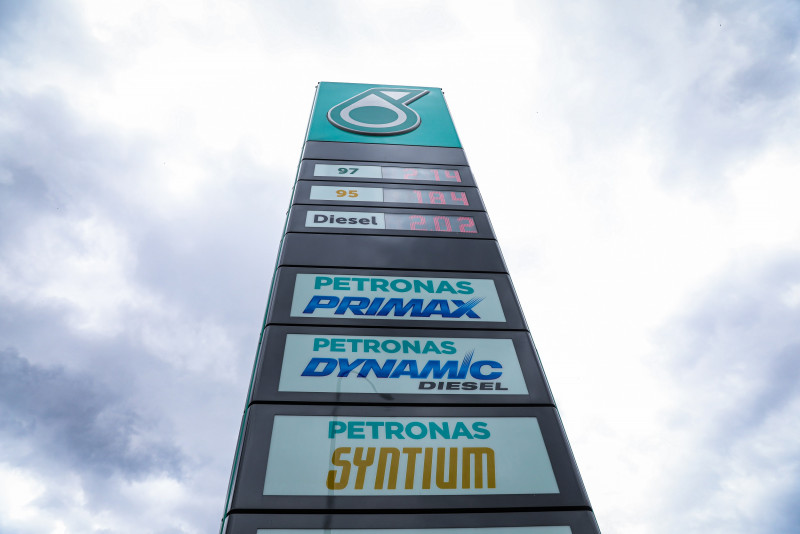
OCBC economist says that Putrajaya’s access to the Petronas pot would be especially important, given that it remains unclear how the targeted subsidy scheme would work in practice. – The Vibes file pic, March 11, 2022

KUALA LUMPUR – As the government expects fuel subsidies to top RM28 billion in 2022 due to the rising world crude oil prices, an OCBC Bank economist reckons that it may end up leaning on state-owned oil and gas company Petroliam Nasional Bhd (Petronas) for special dividends to help plug the subsidy bill.

Wellian Wiranto said the move would also help keep the broader fiscal deficit at around the targeted 6% of gross domestic product (GDP) as first budgeted in Budget 2022.

Yesterday, Finance Minister Tengku Datuk Seri Zafrul Tengku Abdul Aziz told Parliament that if the global crude oil price remains above US$100 per barrel (US$1=RM4.187), total subsidies for the whole of 2022 are expected to reach RM28 billion compared with RM11 billion for 2021.

He also said the government will review the fuel and cooking oil subsidy mechanisms so that they will be more targeted towards aiding and subsidising vulnerable groups and those who really need help.

“Having access to the Petronas pot would be especially important, given that it remains unclear how the targeted subsidy scheme would work in practice,” Wellian said in a note today.

However, he noted that given the large gap between real and subsidised prices, for instance, the RON95 fuel sells at RM2.05 a litre – although it costs 80% higher at RM3.70 a litre – potential leakages from some “creative” transactions cannot be dismissed.

On the surge in crude oil prices, Wellian said although it benefits the trade balance and fiscal revenue for Malaysia, the net oil and gas producer will have to choose between a rise in fiscal expenditure if it keeps the fuel subsidy, and an inflationary wave if it does not.

“By keeping the subsidy scheme broadly in place, the passthrough of dizzyingly high commodity prices to domestic inflation should remain relatively muted for Malaysia,” he continued. “We are tuning our 2022 inflation view upward due to the broader impulse, but rather narrowly, from 2.3% to 2.7% year-on-year now.” – Bernama, March 11, 2022
Related News

Malaysia / 4d

Targeted diesel subsidy system improvements expected in ‘1 to 2 months’

Business / 2w

Traders keep watch on inflation data as energy prices fuel fresh concerns

Malaysia / 2mth

Acquisition of two gas blocks to Petronas an extraordinary development - PM

Malaysia / 2mth

PM Anwar dismisses talk of fuel price hikes

Opinion / 2mth

Should petrol subsidies be removed and the savings redistributed to the poor?

Malaysia / 2mth

What matters: Policies that truly understand the rakyat

Spotlight

Malaysia

Private university CFO charged over alleged RM6.56m CBT

World

Unleashed 60kg dog in Hong Kong mauls poodle, bichon frise to death (video)

Malaysia

Three family members killed after Immigration truck runs red light

Malaysia

Woman, believed to be foreigner, allegedly causes disturbance at KLIA (video)

Opinion

Has DAP chosen the path to a slow death?

Malaysia

Three years of bullying at school puts 15-year-old at risk of hearing loss

By Alfian Z.M. Tahir

Malaysia

Police officer's wife cries, pleads for leniency after misusing disabled child's account

Malaysia

Organised cybergroups likely behind rise in racial hate on social media

You may be interested

Business

Tey Por Yee and four others ordered to pay RM103.75m in SC civil suit

Business

Independent review needed, not blind denial, to address US claims – maritime expert

Business

FMM urges input tax credits as government reviews GST features for SST

Business

Oil prices hold above US$84 as Middle East tensions persist

Business

Oil prices surge as US-Iran standoff, Ukraine strikes rattle global energy markets