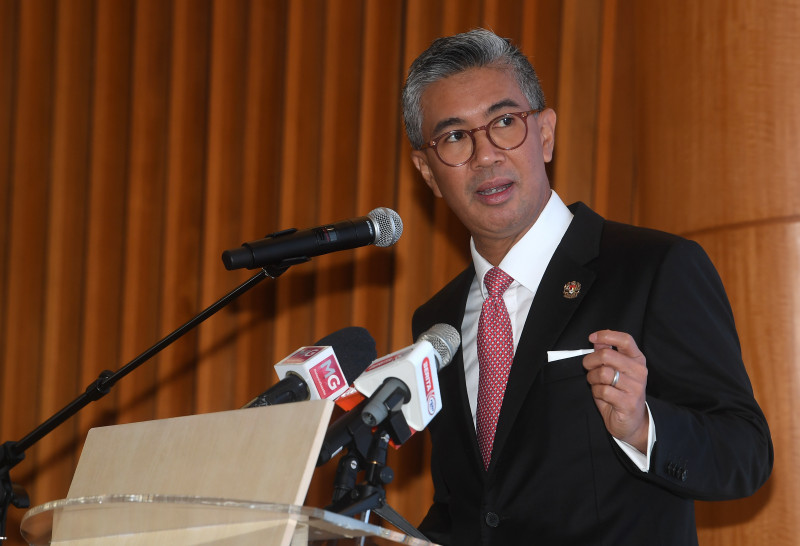
KUALA LUMPUR – The world’s major powers must take responsibility for their policy decisions, especially those impacting the global economy, according to Finance Minister Datuk Seri Tengku Zafrul Tengku Abdul Aziz.
He said although the world continues to recover from the effects of the Covid-19 pandemic, various new challenges have emerged that affect the prospects of the global economy, which may slip into a recession.
According to him, these are due to the continuing geopolitical tensions between the United States and China; the unending war in Ukraine; threats of climate change such as floods and droughts in several countries that have affected food supply; and China’s zero-Covid-19 policy, which continues to disrupt global supply chains.
“These are factors beyond our control. They have triggered a surge in the prices of various commodities and basic goods, hence raising inflation rates in most countries to levels not seen in decades,” he said in a statement today.
He was responding to various reports, concerns, and queries submitted to the Finance Ministry, especially in relation to the ringgit’s value and the nation’s current economic developments.
He said that to combat inflation, the monetary policy decisions of several world powers have affected the positions of developing countries, and Malaysia is not exempted.
The finance minister noted that the US Federal Reserve has hiked interest rates aggressively up to 3.25%, much higher than Malaysia’s overnight policy rate of 2.5%.
“While this has led to the ringgit depreciating 10.5% in the year to date, other currencies have also fallen, at an even higher rate, which proves that this is a global phenomenon,” he said.
Tengku Zafrul said the impact of the rise in the US interest rate has impacted many countries but this does not mean that these countries should be considered failures.
“Every country has its own challenges and monetary policies and the currency exchange value of each country is not a benchmark to determine if they are facing a crisis or not.
“The real definition of an economic crisis is when the gross domestic product (GDP) declines sharply; unemployment and bankruptcy increase significantly; and the overall standard of living is affected, while the definition of a financial crisis is when there is a sudden depreciation in the value of some of the financial assets within a short period.
“This includes the sudden fall in the stock market and currency value within a short period, as well as the failure of the government to repay debts,” he said.
The situation in Malaysia today, he said, is different from the situation experienced in 1998-1999, 2009, or 2020, and stems from global inflationary pressure that led to uncertainty in the global capital market.
“The impact includes a limited access to funds and increased rate of financing that will continue to affect the economy,” he said.
Tengku Zafrul said the special position of the US dollar as the world’s reserve currency and as a safe-haven asset has driven global investors to shift their funds to the US amid an uncertain situation, thus increasing the demand for the greenback.
“All these factors will also have an impact on Malaysia’s GDP for 2023, which is projected to be lower than in 2022,” he said. – Bernama, October 1, 2022