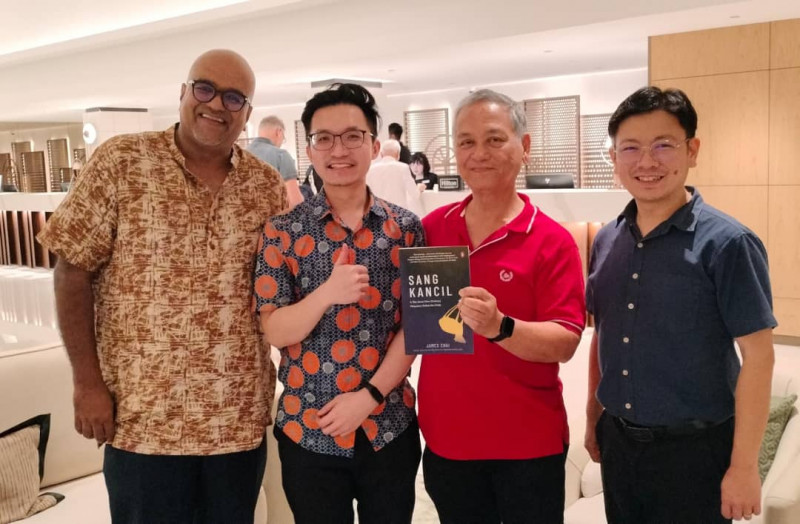
SANG KANCIL, a book authored by James Chai on the tale of seven ordinary Malaysians who defied the odds when they tried to challenge the status quo, has hit local bookstores amid glowing peer reviews.
The seven include an “aunty” who became the face of Malaysia’s Bersih protest movements; an inconspicuous civil servant, Nor Salwani Muhammad, whose secret recording exposed the world’s largest financial scandal and led to the charging of former prime minister Datuk Seri Najib Razak over the 1MDB scandal; and a Dayak engineer, Peter Kallang, whose grassroots movement stopped the construction of the multi-million ringgit hydroelectric dam on the Baram River.
“Aunty Bersih” Anne Ooi, who passed away in March, was remembered by most Malaysians for her defiant walk through tear gas and pulling an all-nighter on the streets of Kuala Lumpur as she championed democracy. She was 78.
The inspirational act of a group of Sikhs from the Gurdwara Sahib in Petaling Jaya, who fed and cared for thousands during one of Malaysia’s worst floods, are also featured in this book by Chai, who was also the winner of the Fan Yew Teng grant for independent writing last year.
Other “inspirational Malaysians” in the book are Dr Serena Nik-Zainal, an “underestimated” mother of two who became the first woman to win the Nobel Prize for Cancer Research; Fahmi Reza the “punk graphic artist” who created the most popular political artwork to leave state-sanctioned censorship in shreds; and Marcus Yam, the photographer who won the Pulitzer Prize despite being expelled from school.
Chai, in explaining the title of the book, said Sang Kancil is one animal that is well known in Malaysian folklore as a creature, despite its small size, always triumphing in battles against larger animals.
“This story, passed down verbally as folklore, has lived in the minds of Malaysians for hundreds of years,” Chai explained in the opening chapter of the book.
“Any boy or girl in Malaysia could tell you stories about this (mousedeer),” he added.
Ha-Joon Chang, professor at the School of Oriental and African Studies at the University of London, in a peer review said the book directly challenges the conventional wisdom that big social changes require large-scale confrontational – even violent – movements, led by charismatic heroes.
Chang, author of “Economics: The User’s Guide and Edible Economics – A Hungry Economist Explains the World”, added Sang Kancil “will change the way we understand social transformation and thus the way our societies are transformed in the coming years”.
Faisal Tehrani, author of “1515” and winner of Malaysia’s National Art Award, described the book as a “rarest presentation of literature”.
“Compilation of small voices making giant moves. A collection of oral history on how ordinary people can shape the world.”
Chai even has tips on how to read his book.
“Writers try to convince themselves that all readers are ideal readers who will flip through every page. But we know that is not true,” he wrote.
“The best you could hope for is that at least some insights are picked up rather than none."
For those who have only 10 minutes to read the book, he said they should go to the final chapter called “What We Can Do”.
This chapter encapsulates universal lessons that can be applied in our daily lives to make our country better.
“It is the ‘so-what’ of the book after spending a few hundred pages giving examples of what other inspiring Malaysian underdogs have done.”
For those who have only 30 minutes, he advised them to read the subtitles of each chapter and the final boxed section of “Key Takeaways”, as well as the final chapter.
“The key takeaways are supposed to show you how the underdogs have succeeded in their unique ways.”
Those who have one hour, browse the “Contents” page, he said, and then decide if there is one chapter that is worth reading in its entirety. – May 25, 2024


_explaining_about_his_book.jpg)