
THE Asean Human Rights Cartoon Exhibition kicked-off earlier this week, and with it the release of artworks by 37 cartoonists from across Southeast Asia.
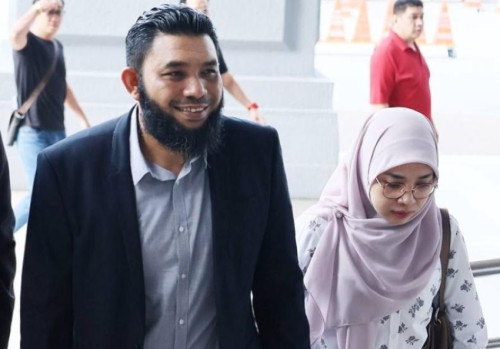
In this second profile feature, we spoke to one of the participating cartoonists of the month-long event, the co-founder of the arts & culture community Eksentrika, Sukhbir Cheema.
The Vibes: Do you remember your first cartoon?
Sukbir Cheema: To be honest, compared to my peers in this exhibition, my experience and journey with cartooning arrived fairly recently.
In 2014, when I was a journalist with The Rakyat Post (TRP) I began experimenting with sketching. Urged by a couple of colleagues and friends to publish my cartoons on the platform, I decided to give this idea a go.
At that time, the hike in petrol prices was a huge debate. So I drew a cartoon of a man riding on a horse to work and ran by the idea with Paula Ann Robertson, who was the head designer for the news portal then.
Paula looked at the cartoon, laughed, and said, "I think our readers will love this. Let's upload it!"
On November 3, 2014, I officially became a cartoonist and regularly drew for TRP's comic section which was aptly named, 'Teh O Toons Kurang Manis'.
However, due to the political climate then, some of my cartoons faced censorship. But looking back, I am extremely thankful for the opportunity. It was the second craziest thing I did in my career as a journalist.
TV: What is so striking behind political cartoons?
SC: I think political cartoons sum up issues in ways words can't. Instead of using thousands of confusing words, a simple cartoon can easily reveal a message clearly to the public.
In fact, I firmly believe political cartoonists are geniuses because they simplify an extremely complex issue/topic to the point a common person on the street can easily understand what is at stake.
This is why many governments find political cartoonists and activists who use art as dangerous. Because of their intelligence.
TV: How do you view it as an impactful medium to promote dialogue?
SC: I think the most recent case of cartoons (or art) being impactful is Fahmi Reza who was recently arrested for supposedly insulting the monarchy.
The issue led many to openly discuss the role of monarchy in the country, the double standards practiced when it came to implementing the SOPs and distributing vaccines, and the efficiency of Malaysia's leadership.
Art serves as a medium for people to express and discuss pressing matters. In fact, countries that allow its people to do so without punitive measures are mature in terms of democracy and human rights.
In the case of Fahmi, his arrest over his art activism online has only symbolically led to the start of Malaysia's very pro-democracy movement because upon his release, the first thing the activist did was do the three-finger salute. To me, that's art at its finest form.
TV: Why did you decide to participate in the exhibition?
SC: I cannot slap lawmakers who practice injustice in the face because that is a criminal offense. But I can do that through art.
Recent years have seen Southeast Asia sliding. With the Myanmar coup, a leadership crisis in Malaysia, the Orang Asli losing their homes, foreign workers being mistreated, the only safe but efficient way to address these issues is through art.
TV: Has there not been enough support for you outside of it?
SC: Being a political cartoonist is dangerous and if you are someone who wants to make money, please don't do this. That said, I'm glad to say that there are many friends and people I consider as family who've given me their support in recent years.
TV: How can it be improved?
SC: I cannot speak on behalf of other cartoonists but personally for me, I do significantly need to improve in terms of delivering my message even more effectively. My art style needs to be upgraded too.
Joining this exhibition thrills me because I see so many good works on display with various art style. These serve as inspiration for me to only strive to be better.
TV: The story behind the cartoon of your choice?
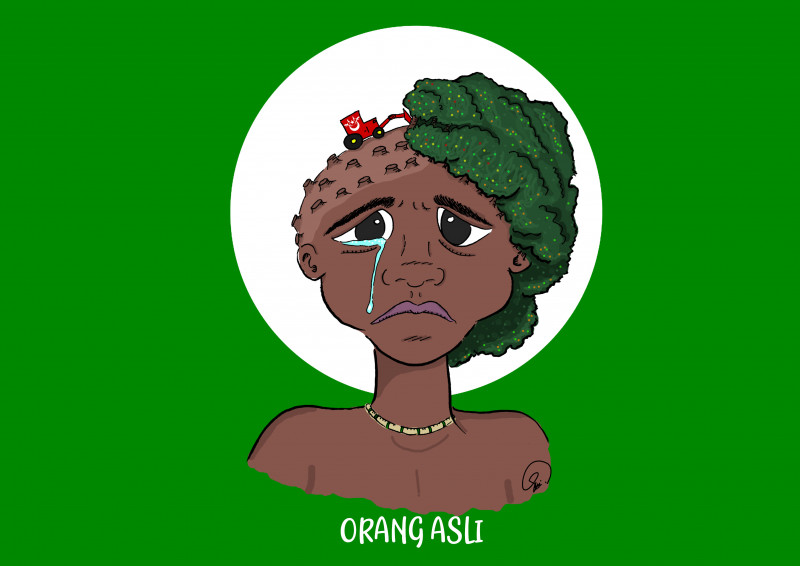
SC: I feel the Orang Asli losing their land due to deforestation and foreign workers being mistreated is often considered less important in Malaysia simply because issues concerning the three major races are always at the forefront.
But what Malaysians forget is that these people are the reason Malaysia exists and continues to exist and I firmly believe they're Malaysians too. Yes, including the foreign workers. This is why I decided to focus on these two issues.
TV: What was the riskiest art you have ever drawn / produced?
SC: This was back in 2015 when Tok Guru Nik Abdul Aziz Nik Mat passed on. His death came almost a year after Karpal Singh passed away.
Losing two great Malaysians, I drew a tribute cartoon where I depicted Karpal hugging Tok Guru in the afterlife.
This cartoon incensed many Muslim hardliners who criticised it because they said a Muslim and non-Muslim cannot be together in the same heaven because Karpal was an infidel. It was so bad that Malaysian Muslim Solidarity (ISMA) uploaded the cartoon on its website and call for it to be removed by TRP.
However, many Malaysians (both Muslims and non-Muslims) also felt that the message of the cartoon was delivered in not only a clear but affectionate way.
Sadly, the cartoon was removed from TRP.
TV: Who are you as an artist?
SC: My artworks are visual representations of the realities of life.
TV: What do you hope for in the reactions from what is delivered through your art?
SC: Two things; 1) Inspire people to express themselves creatively about issues/matters that they are extremely passionate about. 2) Inspire people to actively get involved in finding solutions to a problem that was highlighted in my artworks. – The Vibes, May 7, 2021
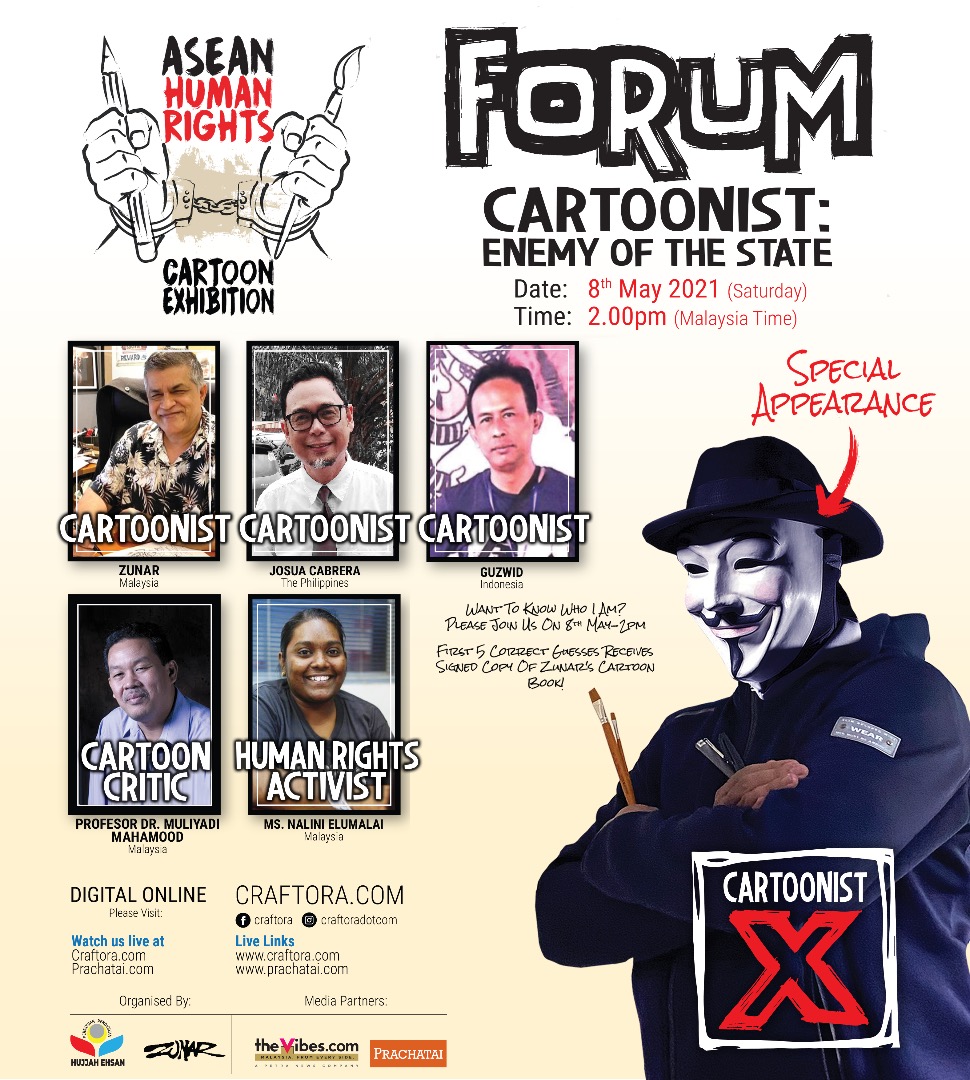
Catch the next forum, ‘Cartoonists: Enemy of the state’ on Saturday, May 8, 2021, at 2pm Malaysian time on www.craftora.com