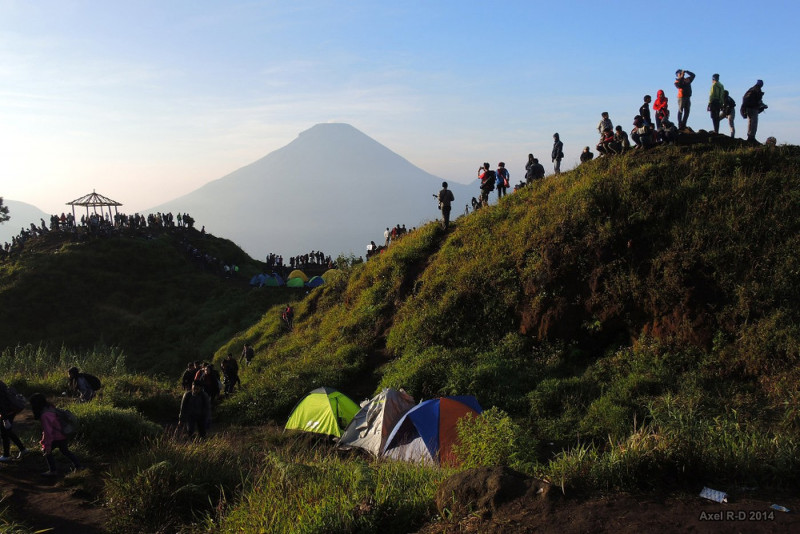
AT the foot of Mount Sindoro, a popular tourist site in Indonesia’s Central Java, locals set the rules for visitors. Break the rules and a fine of up to 1 million rupiah (US$67, about RM300) applies, but if you can’t pay you might instead be asked to plant tree seeds.
The Sindoro Mountain area is one of a growing number of the 1734 ‘desa wisata’ or rural tourist villages seeking to ensure sustainability for future generations of Indonesians.
While initially aimed at increasing cross-sectoral income, promoting the local economy using local resources, desa wisata in Kebumen Regency and Temanggung Regency in Central Java are vulnerable to environmental damage from tourism.
The Karangsembung Karangbolong Geopark Area (GKK) in Kebumen Regency is a large nature reserve area covering 117 villages. It has 41 geological sites, 10 cultural sites, and 8 biological sites.
In 2017, the Government of Kebumen Regency issued a master plan for tourism development in the region with a focus on collaborative governance, and invited others to get involved. Since then they have brought many stakeholders together to help ensure sustainability.
In one case Padjadjaran University conducted a summer programme bringing students from 12 countries to explore the GKK Area in 2019.
In Temanggung Regency the residents of Ngadimulyo Village set up the Papringan Market in a disused bamboo forest. In this unique market, not only are all the buildings and ornaments made of bamboo, visitors are also required to use bamboo coins to shop there.
The initiative aims to improve the welfare of local communities, boosting the local economy as well as delivering a tourist destination that is free of solid waste – especially plastic. Having attracted the attention of Indonesia's Minister of Tourism, the location is now home to an annual event bringing more economic benefit to the region.
The event called Java Tantara is made up of three main cultural and historical-travelling activities: the Mountain Festival, the Daendels Run, and the Rally Truck Festival. These activities are held with the support of numerous regencies and cities in South, Central, and North Java.
Tourism contributes around 4.1% to Indonesia’s annual GDP, but the Indonesian government is seeking to push this to 10-12% in the next 5-10 years.
Tourism has multiplier effects for the Indonesian economy, increasing the income of local residents through culinary businesses, souvenirs, accommodation, transportation, and tour guiding. Tourism also generates spill-over effects into other sectors.
But when the primary aim of tourism development is increased income, the end result can be overexploitation. Solid waste problems and environmental damage from industrial development in tourist destinations are real, but problems can also extend beyond the environment to issues such as theft, changes to the lifestyle of local residents and soaring property prices, as evidenced by one study in Yogyakarta.
In Sumatra, Bukittinggi City has seen traffic congestion problems, increased CO2 emissions, and negative impacts on the biotic environment, such as extensive graffiti on trees and plants and visitors who give food carelessly to animals. And Bali, one of Indonesia's leading destinations, was forced to declare a 'garbage emergency' on some of the most popular beaches for tourists after they became littered with plastic.
As a result, responsible and sustainable tourism are gaining ground in Indonesia.
Responsible tourism emphasises the role of tourists behaving according to the ethics and social norms that apply in the tourist destinations they visit. Sustainable tourism, according to the UN, “takes full account of its current and future economic, social and environmental impacts, addressing the needs of visitors, the industry, the environment and host communities”. It places more emphasis on the roles of policymakers and community leaders.
Ultimately, sustainable tourism development must involve market regulation, but also factor in the behaviour of tourists and tourism industry players. Without the market there is no tourism sector, but without regulatory frameworks setting certain limits on growth there can be no sustainable tourism. Strong regulations and institutionalised rules will ring hollow if people are not sincerely willing to act and behave in responsible ways. – The Vibes, September 5, 2022
Sri Hastjarjo is a researcher in the Journalism and Public Communication Research Group, the Faculty of Social and Political Sciences, Sebelas Maret University, Indonesia. His research interests are in journalism and community development, public communication, and impacts of new media to society.
Rutiana D. Wahyunengeseh is a researcher in the Center for Regional Information and Development, the Institute for Research and Community Services, Sebelas Maret University, Indonesia. Her research interests are public policy, local government planning and budget, and issues related to SDGs in Indonesia.
Published under Creative Commons and in partnership with 360info.org