TREES do not carry passports. Hornbills are notoriously poor at customs declarations. Elephants cross jurisdictions without consulting the relevant ministry.
This creates a problem for maps.
At the northern edge of Perak, close to Thailand, Royal Belum State Park covers 1,175 square kilometres. Officially gazetted in 2007, it entered Malaysia’s tentative list for UNESCO World Heritage status in 2017.
Belum does not behave like an administrative unit. It belongs to a larger forest landscape linked ecologically to Temengor and protected areas beyond the Thai border.
The political line is real for soldiers, forestry departments, immigration officers and conservation budgets. It is less persuasive to water, seeds, weather and wildlife.
The forest was there before the border.
This is what gives Belum its particular force. It sits where several versions of time collide: geological, indigenous, military and the hurried pace of modern development.
Tourism brochures answer with one magnificent number, routinely describing Belum-Temengor as a rainforest more than 130 million years old — older than the Amazon and the Congo.
The claim travels more easily than its scientific proof.
Belum needs no such salesmanship. A forest does not become more worthy of protection because it wins an imaginary antiquity contest against the Amazon.
Its power comes from something stranger: what looks timeless is threaded through with the recent history of the Malaysian state.
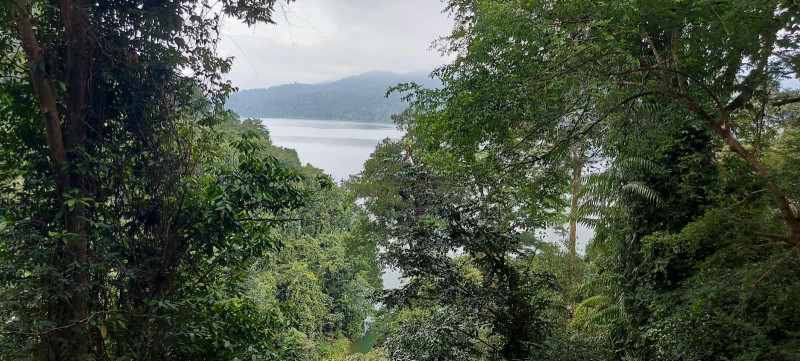
The vast body of water associated with Belum is not an ancient lake. Temengor Lake was created by a hydroelectric dam operational in the late 1970s.
The East-West Highway, running between Gerik and Jeli, was built during the communist insurgency and opened to the public in 1982.
The road and dam served development and national security in a territory where armed groups operated near the Thai frontier.
Today, visitors use that same infrastructure to reach what is marketed as wilderness.
There is something cinematic in that reversal. A landscape once penetrated by roads, military strategy and engineering is now approached as a sanctuary from the modern world.
The lake that opens the forest to boats exists because valleys were flooded. The highway that brings visitors towards nature also served security objectives during the insurgency.
Belum is not untouched. It is touched by everything. That does not make it less mysterious; it makes the mystery more honest.
We have developed a sentimental idea of forests as places outside history, calling them pristine or virgin, as though humanity arrived five minutes ago.
But Belum contains human lives and memories that cannot be edited out of the frame.
Jahai Orang Asli communities live within this landscape. Some Jahai community members have participated in projects involving seed collection, native-tree nurseries and forest restoration.
Orang Asli community patrol teams have also joined anti-poaching work.
This matters because the language of conservation can quietly reproduce the same mistake as the language of tourism. Both can present the forest as empty — one for wonder, the other for management.
Belum is neither empty nor silent. It contains knowledge that predates the state park, alongside human difficulties: disrupted livelihoods, uneven access to services, poaching, contested economic interests and the long consequences of infrastructure imposed upon a living landscape.
The temptation is to describe such a forest as Malaysia’s lung. It is a convenient metaphor, but a misleading one. A lung exists to keep another body alive. Belum does not exist merely to breathe on our behalf, compensate for emissions elsewhere or appear in speeches about natural capital.
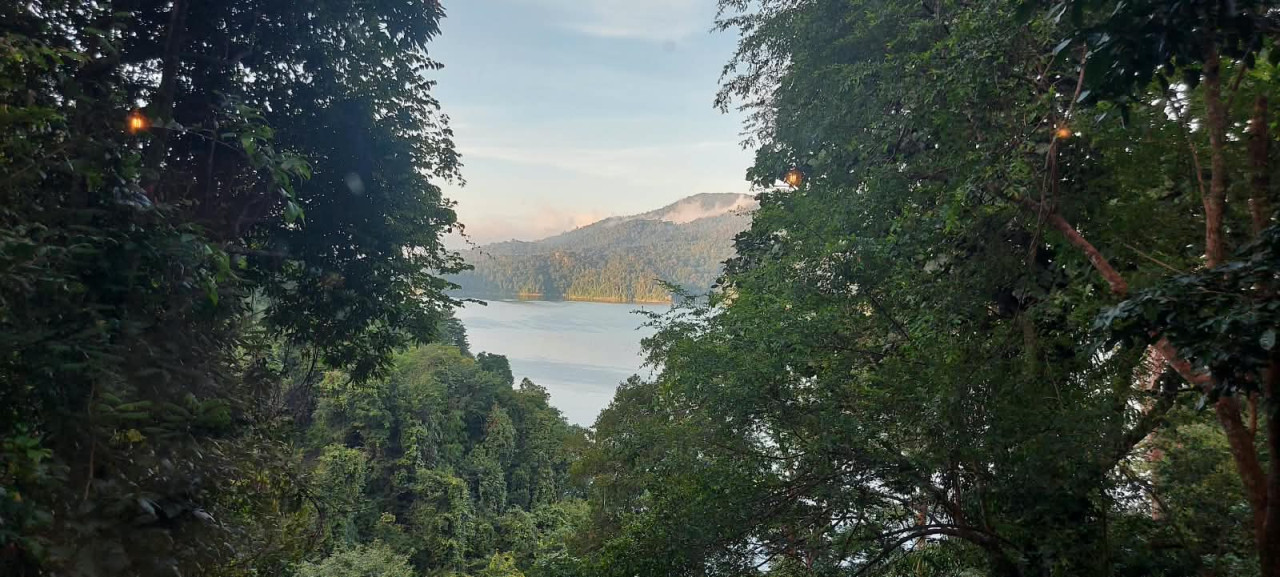
The forest is not an organ we own. Nor is it a museum. The Malayan tiger, Asian elephant and hornbills found across the wider Belum-Temengor landscape are not exhibits surviving inside a green enclosure.
They depend on movement and connections extending beyond official boundaries. A tiger has little use for a gazette if the forest on the other side of the line has disappeared.
Conservation remains organised according to human jurisdictions, while the life being conserved operates through systems that ignore them.
A river begins in one authority’s territory and becomes someone else’s water. An animal feeds in one reserve and breeds in another.
Forests in Malaysia are ecologically connected, in places, with forests in Thailand, while the two countries retain different institutions and priorities.
The forest does not abolish sovereignty. It exposes its limitations.
Belum is therefore both secret and open to the world. Secret, because much of what happens under its canopy remains unseen, refusing the fantasy that everything can be made legible.
Open, because its survival is tied to regional corridors, scientific research, indigenous participation and decisions taken far beyond Perak.
The deepest experience offered by a forest may not be escape — a product sold to tired urbanites — but a change in the scale by which we measure our importance.
The tree does not know that a minister has opened a conference. The elephant does not know that a conservation strategy has been launched. The hornbill does not care about a possible UNESCO label.
Yet all three may live or die because of such decisions. That is the paradox of Belum: magnificently indifferent to our ceremonies, completely vulnerable to our choices.
In Malay, belum also means “not yet”. Whatever the unproven relationship between the place name and the word, the linguistic coincidence is difficult to resist.
Not yet completely understood. Not yet reduced to scenery. Not yet lost.
The forest was there before the border. Whether it remains after us is the more uncomfortable question. – October 14, 2026
Pascal H. Grégoire is a career diplomat and essayist who served as Belgium's Ambassador to Malaysia from 2018 to 2022. He is the editor of Contre-Jour and currently the ambassador of Belgium to the Kingdom of Saudi Arabia.