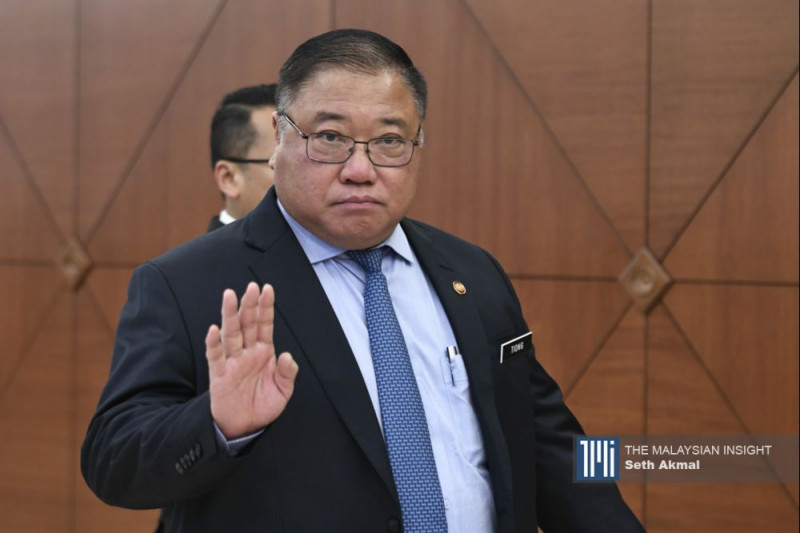
PROGRESSIVE Democratic Party (PDP) president Tiong King Sing is testing the waters with his suggestion that Gabungan Parti Sarawak (GPS) coalition do away with the traditional method of distributing seats among component parties in elections, observers said.
They said there is no need for the PDP chief to be anxious about seat distribution.
Universiti Kebangsaan Malaysia political analyst Novel Lyndon said Tiong was gauging the reaction of GPS component leaders ahead of the next polls.
“He's just testing the waters,” said Lyndon.
State elections are expected in 2026.
Lyndon said “the warlords in PSB” were pressing Tiong to make the call. Lyndon was referring to leaders of the disbanded Parti Sarawak Bersatu (PSB) who have joined PDP.
These former PSB leaders fear their seats would be given to Sarawak United People's Party (SUPP) to contest now that they are in GPS as the constitutiencies are considered “traditional SUPP seats", Lyndon said.
Last week, Tiong suggested that GPS stop allocating the so-called “traditional seats” to parties that had contested them in the past. Tiong's recommendation that the allocation should be determined by the electorate has been interpreted by some GPS leaders as a call for a free-for-all fight among component parties for seats.
GPS, which holds 79 of the 82 seats in the Sarawak assembly, is made up of PDP, SUPP, Parti Pesaka Bumiputera Bersatu (PBB),and Parti Rakyat Sarawak (PRS).
Former PSB leaders such as Wong Soon Koh and Johnical Rayong hold seats that GPS traditionally leaves to SUPP to contest. Wong won the predominantly Chinese seat of Bawang Assan in Sibu, and Rayong the Iban-majority seat of Engkilili. They took the seats with them when they defected from SUPP in 2014 amid a power struggle.
Tiong's Dudong seat was a traditional SUPP seat until he unexpectedly ran for it in the 2021 state elections.
Lyndon said what Tiong proposed would pose a dilemma for GPS leaders. The squabble over seats, he added, is something “that is sure to happen” in the run-up to the state elections.
Tasmania University Asian governance expert James Chin said Tiong, who is the federal tourism minister, should not be anxious yet about seat allocation.
Chin said the rule since the days of Barisan Nasional days was to allow the party that holds the seat to defend it. GPS has not changed the policy.
"He thinks he needs to get over this rule otherwise PBB and SUPP will claim the (PDP) seats,” Chin said.
“The key question is: Will GPS recognise the merger between PDP and PSB? If they recognise the merger, then the seats are regarded as PDP seats and there should not be an issue.”
Chin said that ultimately, it is Premier Abang Johari Openg who calls the shots.
“Traditionally in Sarawak, other than this golden rule that you hold on to your seat, the premier has the final say on seat allocation. Sarawak is unlike other states where a courtesy list is given to the prime minister. In Sarawak, that doesn't happen.”
He said that if Abang Johari should decide to give the “traditional seats” to PDP, SUPP would have to toe the line.
Chin said Abang Johari would need to tread carefully.
“He shouldn't rock the boat too much. If he allocates all the potentially disputed seats to PDP, there could be trouble because PDP might overtake the third strongest component party in the coalition, PRS. That will create another set of problems for GPS.”
Chin said the number one priority for GPS in the 2026 state elections is to “win big.”
“They must win very big because if they don't, it will be harder for them to deal with the redelineation exercise.”
Chin said GPS needs to be strong in Sarawak so that the coalition could demand a redelineation that suited “their view of what Sarawak needs.”
“If they perform badly, Putrajaya could turn around and say you can't have all you want.”
Last week, PBB vice-president Abdul Karim Hamzah said GPS had already worked out a “good equilibrium” in the distrbution of seats. – May 30, 2024.












_Datuk_Rusdi_Mohd_Isa._Facebook_pic..png)