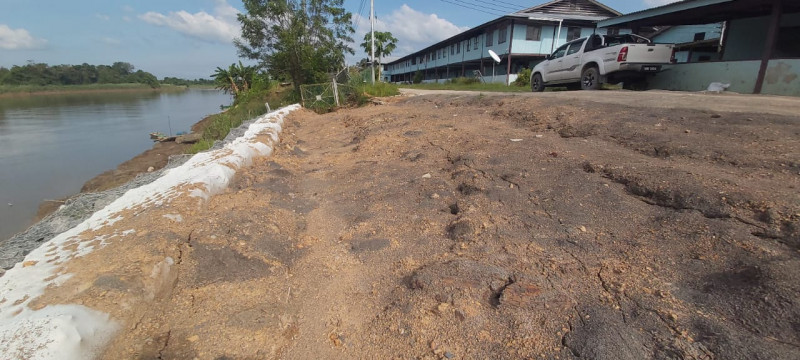
A “cheap” solution to tackle the river bank erosion and save the homes of indigenous Kenyah villagers at Long Ikang is in danger of being swallowed by the Baram River - Sarawak's second longest river stretching approximately 400 km from the central highlands of the interior down to the South China Sea.
“The soil packed behind the newly constructed gabion wall at the river bank in Long Ikang, are showing signs of sinking,” the village's most prominent resident, Peter Kallang, told Vibes recently.
Kallang is the chairman of the environmental conservancy civil society organisation (CSO) Save Rivers.
The 20m long gabion, believed to have cost “a few hundred thousand ringgit” to build, could meet the same fate as the RM200,000 gabion wall built at the village that just slid into the Baram River more than two decades ago.
“That's exactly what we fear will happen,” Kallang said as he questioned the authorities' insistence on having the gabion wall as a solution when it was already shown the structure could not hold back the power of the river.
“This is not the first time the gabion wall is being used in the village,” he said alluding to the wall that their former elected representative forked out the money to build to prevent the village's Roman Catholic St Peter’s chapel from sliding into the river.
Villagers two years ago dismantled the chapel and relocated it to a safer ground after the gabion wall was destroyed by the river and the river's edge kept creeping up to it.
A gabion wall is a type of retaining wall or structural barrier made from wire mesh containers (gabions) that are filled with rocks, stones, or other aggregates.
Gabion walls are commonly used in civil engineering, landscaping, and construction projects for purposes such as soil erosion control, stabilising slopes, or providing structural support.
The gabion walls allow water to pass through, reducing pressure from water buildup, making them ideal for drainage and erosion control.
Save Rivers, in a joint report with the CSO Platform for Reform, Building and Empowering Advocacy for Climate Change and Habitat, better known by its acronym B.E.A.CC.H, to the federal government had stated “a lackadaisical attitude towards the current flooding incidents could be detrimental to thousands of communities in Baram which include damage to crops and property, and eventual displacement, leading to potential land conflicts in the long run, ultimately impeding Sarawak’s plan for socio-economic development for its people”.
The two CSOs had last year proposed the construction of river groynes - a low wall or sturdy barrier - to tackle the erosion and frequent flooding problem along the river.
As an erosion control and riverbank protection solution, the groynes will direct the flow of the river to a desired stretch of the river thus reducing the water velocity near the riverbank.
The RM12 .7 million projected cost of constructing the groynes at the four villages most threatened by the river bank erosion – Kuala Tutoh, Long Sibong, Long Ikang and Long Banyok – might be why the federal government is lukewarm to the proposal.
In July, the federal government announced RM 950 million is being set aside under the 12 Malaysia Plan to reduce flood risk across the country.
Kallang, in response to that announcement, said while it was “heartening to know that the government had allocated RM950 million to reduce flood risk and for emergency works arising from such disasters nationwide, Long Ikang or Baram as a whole doesn’t have any allocation in the much-needed budget”.
Hesaid the villagers in Long Ikang are among the Baram communities who have seen the destruction of various buildings like churches, storehouses, village shops, boat sheds, and paddy barns.
“All the ruins resulted from constant floods and erosion which have been getting increasingly frequent in the last 15 and 20 years.
“The erosion and landslide of the Baram River at Long Ikang made the distance between the banks of the river dangerously close to the longhouse. At some points, the edge of the gutter is a mere four metres from the river banks.”
He said erosion and landslides are continuing processes in the area if left ignored or not properly controlled.
“A proposal made by the villagers for mitigation at the same time restoration of the river bank is the groynes method which is widely used in developed countries. The recommendation was made by professionals consulted by the villagers, with the support of the B.E.A.CC.H”.
B.E.A.CC.H is a Malaysian CSO Platform for Reform, focusing on environmental issues, particularly climate change and habitat preservation. - September 23, 2024

















.jpeg)