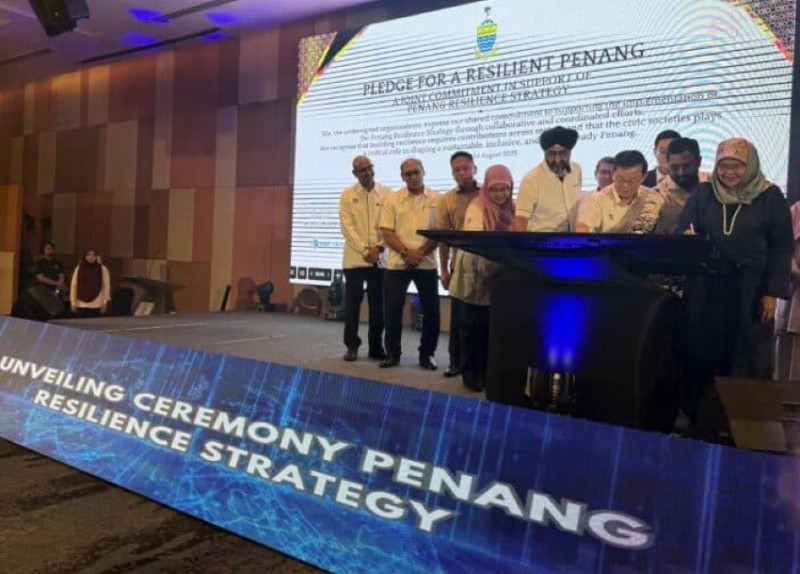

PENANG has become the first Malaysian state to unveil a comprehensive Resilience Strategy aimed at equipping the state to confront climate threats, natural disasters, and socio-economic challenges head-on.
Launched by Chief Minister Chow Kon Yeow at the Eastin Hotel, the Penang Resilience Strategy (PRS) outlines a roadmap for building a more adaptive, inclusive and data-driven state, grounded in sustainable development and preparedness.
“Our PRS is a declaration of intent and a testament to the state’s commitment to proactive governance in an era of increasing uncertainty,” said Chow. “The initiative is more than just the unveiling of a document; it is a collective commitment to futureproof our beloved state against the uncertainties and disruptions of an ever-changing world.”
The PRS aims to tackle systemic vulnerabilities such as flash floods, landslides, worsening droughts, economic disparities, and the long-term threat of rising sea levels, while maintaining readiness for rare events such as tsunamis.
Notably, the strategy was developed with the expertise of Datuk Seri Dr Maimunah Mohd Sharif, the former Penang Island City Council mayor and past executive director of UN-Habitat. A seasoned advocate of liveable and sustainable cities, Maimunah now serves as the 15th Mayor of Kuala Lumpur City Hall.
Maimunah emphasised the importance of embedding resilience in city planning, drawing upon feedback from diverse communities. “Resilience is how we sustain liveable cities despite the growing challenges,” she said.
Penang’s PRS, parked under the State Planning Division, is the result of years of collaboration among government agencies, civil society, academia, the private sector and international partners, including its connection to the global Resilient Cities Network. The MBPP Town Planning Division was tasked with stakeholder engagement to shape the plan’s direction and recommendations.
The launch coincided with a multi-agency workshop, involving Think City Sdn Bhd and state executive councillor Zairil Khir Johari, whom Chow credited with reviving the resilience agenda in Penang.
Meanwhile, Chow also announced the deferment of a scheduled water tariff adjustment under the national Tariff Setting Mechanism. Initially set to begin on 1 August 2025, the implementation will now be postponed by one year to 1 July 2026 to help mitigate the rising cost of living.
The decision benefits 715,957 water consumers across the state. Chow stated that the deferral would allow Penangites some relief amid economic pressures, while ensuring that future tariff adjustments fund essential upgrades to the state’s water infrastructure.
“For the new tariff, the average increase in monthly water bills for 79.88 per cent of the 613,660 domestic consumers in Penang who use up to 35 cubic metres per month will be between RM0.30 and RM2.55,” he explained. “The average increase in water bills for 95.38 per cent of the 98,155 non-domestic consumers who use up to 200 cubic metres per month will be between RM3.60 and RM35.70 per month.”
Elsewhere in Peninsular Malaysia and Labuan, domestic water tariffs are set to increase from 1 August 2025 following a newly gazetted structure by the National Water Services Commission (SPAN). The revision includes an average hike of RM0.20 per cubic metre, from RM2.55 to RM2.75. However, domestic consumers in Perak are exempt from the adjustment.
SPAN has stated that the move is part of efforts to ensure a more sustainable water services structure and to help operators better manage operational and maintenance costs. - August 2, 2025