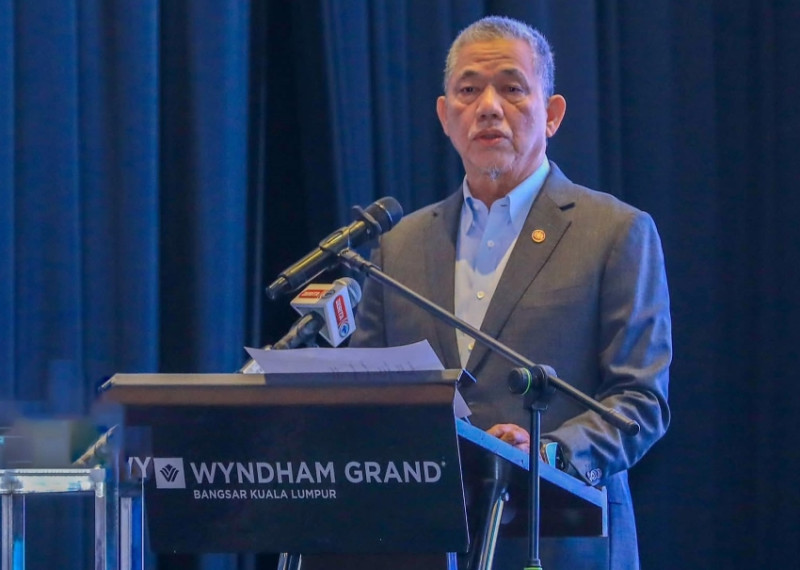
MALAYSIA will move decisively to harness artificial intelligence as a catalyst for sustainability, energy security and inclusive growth, Deputy Prime Minister II Datuk Seri Fadillah Yusof said in a keynote address that set out the country’s strategy for navigating the convergence of digitalisation, climate action and economic transformation.
Speaking at the Global AI, Digital and Green Economy Summit 2025 in Kuala Lumpur, Fadillah said leadership in the age of artificial intelligence carried a profound moral responsibility, invoking a hadith of the Prophet Muhammad: “Each of you is a shepherd, and each of you is responsible for his flock.”
He said the message was a reminder that “authority is not privilege, progress is not entitlement, and innovation is not neutral,” stressing that decisions in policy, investment and technology must account for their impact on people, communities and future generations.
“Today, as we speak of artificial intelligence, digitalisation, and the green economy, we are ultimately speaking about amanah — the trust placed upon us to lead wisely in a rapidly changing world,” he said.
Fadillah said the current decade would be decisive as the global energy transition, the rise of artificial intelligence and the urgency of climate action increasingly converged.
“The question before us is not whether change will happen, but whether we will shape it deliberately, or allow it to unfold without direction,” he said.
He said Malaysia’s approach was clear and uncompromising.
“If we are serious about building a low-carbon economy that is competitive, inclusive, and resilient, then we must do three things at the same time: we must modernise our power systems, digitalise our economies with trustworthy artificial intelligence, and translate climate ambition into bankable, investable projects.”
Quoting Nelson Mandela, he said, “It always seems impossible until it is done,” adding that sustainability must move beyond aspiration and be “executed, measured, and delivered”.
Fadillah said Malaysia’s National Energy Transition Roadmap, which targets around 70 per cent renewable energy capacity by 2050, would require a fundamental transformation of the power system.
He stressed that grid modernisation was “non-negotiable”, pointing to multi-year investments by Tenaga Nasional Berhad that incorporate AI-enabled planning, automation and battery energy storage.
“But ambition must be matched by outcomes,” he said. “We expect faster connections, fewer bottlenecks, reduced curtailment, and stronger resilience during extreme weather events.”
The grid, he added, “must become not only larger, but smarter and more adaptive”.
He said regional power integration would be critical to achieving energy security at scale, citing the Laos–Thailand–Malaysia–Singapore Power Integration Project as proof that cross-border trade in clean electricity could work.
“Our task now is to expand and replicate such arrangements across ASEAN Power Grid corridors, turning the region’s diversity of resources into collective energy security,” he said.
Within Malaysia, he highlighted Sarawak as a model of leadership, citing its hydropower resources, advances in hydrogen technologies and growing interest from partners such as Japan and South Korea. “Sarawak is not merely producing clean energy — it is de-risking new value chains for the entire nation,” he said, adding that early leadership created shared advantage.
Fadillah said artificial intelligence would play a central role in improving energy efficiency, describing it as a way to unlock “the fastest clean megawatt”, which he said was “the one we do not have to build”.
He said AI could optimise demand, predict peaks and coordinate storage in real time, allowing buildings, factories, electric vehicles and prosumers to function collectively as virtual power plants.
However, he warned that trust was essential.
“AI-driven systems only work if data flows securely and systems are cyber-resilient,” he said, adding that solutions must be “secure by design, transparent in operation, and resilient in the face of evolving threats”.
He also acknowledged the environmental footprint of artificial intelligence itself, noting that data centres were energy-intensive.
He said Malaysia had issued guidelines to ensure such facilities were efficient and sustainable, with tighter expectations on power usage effectiveness, renewable energy sourcing and waste-heat recovery.
“Growth in digital infrastructure is welcome, but it must be green growth by design, not by afterthought,” he said.
Turning to climate finance, Fadillah said capital would only flow when risk was properly priced and integrity upheld. He pointed to the progress of Malaysia’s voluntary carbon market through Bursa Carbon Malaysia, which has seen domestic nature-based credit auctions and updated market guidance.
“We will continue strengthening this market so that high-quality carbon credits and renewable energy certificates crowd in private finance for real, verifiable decarbonisation,” he said.
He said ASEAN’s commitment to raise the renewable share of installed power capacity to 45 per cent and deepen energy-efficiency gains by 2030 reflected serious intent, but alignment on standards, taxonomies and interconnection rules was needed to move faster together.
Fadillah acknowledged that significant challenges remained, including grid bottlenecks and the surging power demand from AI computing. He said only projects meeting stringent efficiency and clean-energy thresholds would be supported, and integrity would remain non-negotiable.
“Carbon credits, renewable energy certificates, and so-called ‘AI for good’ initiatives must withstand independent scrutiny and full transparency,” he said.
He said the government was aligning policy, regulation and procurement to ensure artificial intelligence enabled grid resilience, supported sustainable digital infrastructure and accelerated decarbonisation projects.
Calling for collective action, he urged utilities, manufacturers, data-centre investors, financiers and ASEAN partners to act with urgency and responsibility. Quoting Tun Hussein Onn, he said, “True leadership is not about popularity, but about responsibility.”
Fadillah added Malaysia’s direction was firm. “We are building a modern grid, a digital economy powered by trustworthy artificial intelligence, and climate finance systems that deliver real-world decarbonisation,” he said.
Quoting Mahatma Gandhi, he added, “The best way to find yourself is to lose yourself in the service of others,” and said that guided by this principle, artificial intelligence would serve humanity, sustainability would uplift communities and growth would be measured not only by profit, but by shared progress. - December 15, 2025