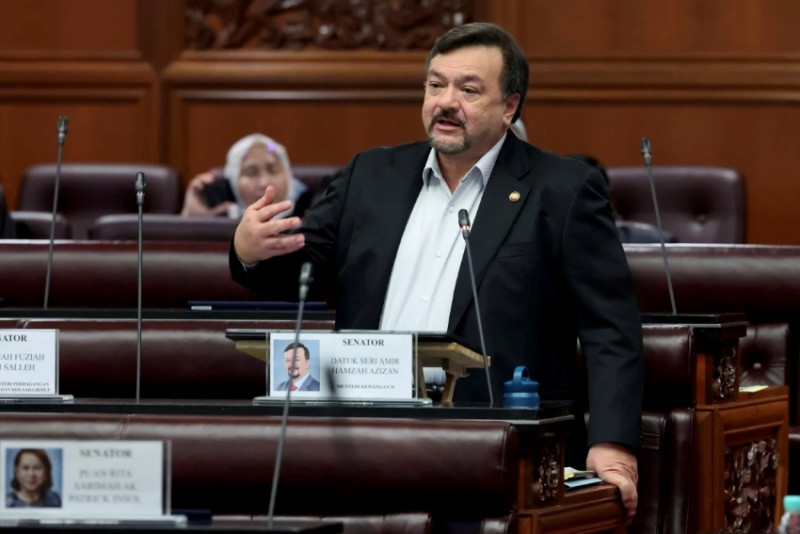
IN his winding-up speech on the Supply Bill 2026, Finance Minister II Datuk Seri Amir Hamzah Azizan outlined key measures to strengthen social protection, streamline subsidies, and support small businesses, while maintaining prudent fiscal management under the Economic MADANI framework.
Speaking in the Dewan Negara today, Amir described Budget 2026 as “a people’s budget,” the fourth under the MADANI government and the first aligned with the Thirteenth Malaysia Plan (RMK-13).
“The Budget emphasises the welfare of the people, strengthens the national economy, and ensures sustainable financial management,” he said, noting its role in enhancing social protections, health services, and sound governance.
On subsidies, Amir addressed the transition from blanket subsidies to targeted support.
He acknowledged discussions by Senators Puan Rita Sarimah Patrick Insol and Datuk Haji Mustafa Musa, and highlighted that targeted subsidies have yielded savings of RM15.5 billion.
These funds are being redirected towards social programmes benefiting citizens directly, in line with the MADANI economic framework.
Specific allocations for 2026 include RM15 billion for the Tunai Rahmah Contribution and SARA, with an additional RM2 billion as a one-off SARA reward, RM3.1 billion for welfare assistance via the Department of Social Welfare, RM1 billion for cost-of-living support including the MADANI Sales Programme, RM794 million for the Back-to-School Assistance, RM216 million for the My50 monthly transport pass initiative, and RM200 million for 30-Day and Concession Cards under BAS.MY for bus users including persons with disabilities, senior citizens, schoolchildren, and students.
Addressing concerns over fuel subsidies, the Minister confirmed that the BUDI MADANI RON95 initiative has been expanded to over 23,000 fishermen and registered boat operators without active driving licences, particularly in Sabah and Sarawak. Special permits are also available for small-scale buyers purchasing more than 20 litres of petrol or diesel, ensuring subsidised fuel is not misappropriated.
On economic development, he highlighted measures to strengthen micro, small, and medium enterprises (MSMEs) through initiatives such as the Business Financing Guarantee Scheme, with RM30 billion allocated for targeted sectors including Bumiputera businesses, high-tech and semiconductor industries, mid-sized export-oriented companies, halal and tourism sectors, and micro-financing.
The Minister also detailed support programmes including Maju Usahawan MADANI 2.0, BSN Micro Financing, Skim Paduri MADANI, and iTEKAD by Bank Negara Malaysia.
“For self-employed gig workers, the i-Saraan Plus matched contribution has been increased to encourage consistent EPF contributions, with incentives up to RM600 depending on yearly contributions,” Amir said, responding to queries from Senators.
On insurance and banking, the Minister confirmed that interim measures have been implemented to mitigate rising medical insurance premiums, benefiting more than 90 per cent of policyholders with less than ten per cent adjustment in the first year.
“We are also developing the RESET initiative, a collaboration among the Finance Ministry, Health Ministry, Bank Negara, and key stakeholders to manage medical cost inflation,” he added.
The Minister added efforts to protect young citizens from bankruptcy, debt, and online fraud, citing initiatives by the Credit Counselling and Debt Management Agency (AKPK) and the National Fraud Response Centre.
From January to November 2025, nearly 120,000 calls were received, with 51,000 fraud cases recorded and RM28 million in transactions blocked.
On government procurement, Amir reaffirmed that all acquisitions will adhere to principles of public accountability, transparency, value, competition, and fairness.
The recently passed Government Procurement Bill strengthens oversight and allows sanctions for companies found in breach, including blacklisting directors for up to five years.
On taxation, he confirmed that no new taxes will be introduced in Budget 2026, while research on carbon pricing continues in line with Malaysia’s net-zero commitment by 2050.
The government has also implemented e-Invoicing initiatives, with over 110,000 taxpayers issuing 794 million e-Invoices to date, ensuring compliance without overburdening small businesses.
The 2024 personal income tax collection reached RM41.1 billion, while real estate gains tax collection rose to RM2.01 billion, reflecting the sector’s growth.
Regarding federal-state allocations, he noted Sabah’s share has increased from RM14 billion in 2023 to RM17 billion in 2026, including special grants and strategic projects such as the Pan Borneo Highway, rural water and electricity supplies, village roads, and social infrastructure.
Environmental conservation funding for biodiversity and forests remains at RM250 million, with disbursements already made in three tranches. Water and flood mitigation projects in Kelantan have received RM465 million in 2026, contributing to a total RM2.2 billion nationwide flood mitigation plan.
On fiscal management, Amir emphasised that development expenditure remains sustainable at around 3 per cent of GDP, noting that allocations for high-impact projects have been maintained across RMK cycles.
“The priority remains development spending that strengthens infrastructure and provides direct benefits to the people,” he said.
Concluding his address, the Finance Minister II expressed gratitude for contributions from all senators.
“The Ministry of Finance has listened to all stakeholders in planning and presenting the 2026 Budget: a People’s Budget. With God’s will, we pray that these efforts will have a positive impact on the citizens, the economy, and the nation.”
Following Amir’s winding-up speech, the Dewan Negara (Senate) on Monday approved the Supply Bill (Budget) 2026, presided over by the Senate President, Datuk Awang Bemee Awang Ali Basah.
The bill was passed with a majority following its third reading by the Finance Minister II, after concluding a seven-day period of debate and closing remarks. - December 15, 2025