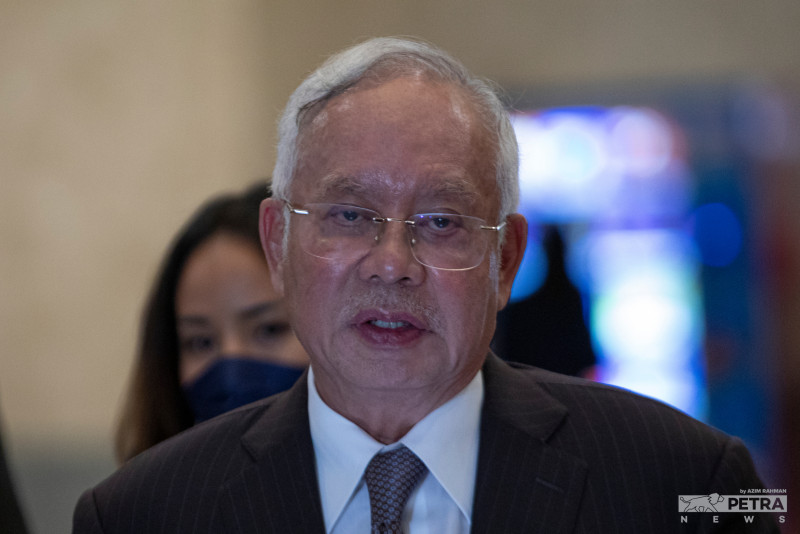
THE Kuala Lumpur High Court is set to deliver its long-awaited verdict today in the principal criminal trial linked to the multibillion-ringgit 1Malaysia Development Berhad (1MDB) scandal, with former prime minister Datuk Seri Najib Razak facing the possibility of further years behind bars.
Proceedings are expected to begin at about 9.00am in Putrajaya, Malaysia’s administrative capital, where Judge Collin Lawrence Sequerah will read out the decision in a case widely regarded as the centrepiece of the sprawling 1MDB affair.
The trial concerns some RM2.28 billion allegedly siphoned from the state investment fund into Najib’s personal bank accounts.
Najib, now 72, is charged with four counts of abuse of power and 21 counts of money laundering. A guilty verdict would add to the six-year jail term he is currently serving following his conviction in the SRC International case, which involved RM42 million linked to a former 1MDB subsidiary.
His original 12-year sentence in that case was halved, while his fine was reduced from RM210 million to RM50 million.
If convicted in the 1MDB trial, the court will have to decide whether any new prison terms should run concurrently or consecutively, a determination with major implications for the length of time Najib would remain incarcerated. If acquitted, he would still return to Kajang Prison to continue serving his existing sentence.
The marathon trial stretched across 303 hearing days, including 10 days of final submissions that concluded in October. Prosecutors called dozens of witnesses, including senior figures from 1MDB and Bank Negara Malaysia, and relied on extensive banking records and documentary evidence to support their case.
The prosecution argues that Najib abused his positions as prime minister, finance minister and chairman of 1MDB’s advisory board to exert control over the fund and facilitate the movement of vast sums into his personal accounts.
During closing submissions, deputy public prosecutor Ahmad Akram Gharib told the court that Najib “paints himself as a victim of rogue subordinates, when in truth, he was the single most powerful decision-maker”.
“The accused wielded absolute financial, executive and political control,” he said.
The defence, led by Najib’s long-time lawyer Tan Sri Muhammad Shafee Abdullah, has maintained that his client neither knew of nor intended any criminal wrongdoing.
Najib’s legal team contends that the funds deposited into his accounts were political donations from the Middle East and that he was unaware of any illicit activities carried out by 1MDB’s management.
Shafee has repeatedly placed blame on fugitive financier Low Taek Jho, better known as Jho Low, who is widely described by investigators as the architect of the scheme to loot 1MDB.
Low, who remains at large, allegedly used misappropriated funds to finance a lavish lifestyle, including purchases of luxury properties and high-value artworks such as a Monet and a Van Gogh.
Last week, Shafee told reporters that Najib “never got a fair trial”, reiterating claims that his client was kept in the dark while others colluded to defraud the fund.
The 1MDB scandal triggered investigations across multiple jurisdictions, including Singapore, Europe and the United States, and caused severe reputational damage to Malaysia.
Najib has since issued an apology for the scandal occurring during his tenure, while continuing to insist that he had no knowledge of illegal transfers from the now-defunct sovereign wealth fund.
Beyond the courtroom, the verdict carries significant political consequences. A conviction could further weaken Najib’s residual influence within the United Malays National Organisation, Malaysia’s oldest political party, which lost power in the 2018 general election amid public anger over 1MDB.
His legal position was dealt an additional setback earlier this week when he lost a bid to serve the remainder of his current sentence under house arrest.
Under Malaysian law, each count of abuse of power carries a potential sentence of up to 20 years’ imprisonment and a fine of up to five times the value of the alleged bribe. The money-laundering charges are punishable by up to five years in jail, a fine of up to RM5 million, or both.
Whatever the outcome today, the case is unlikely to conclude swiftly. Both the prosecution and defence retain the right to appeal to the Court of Appeal and, ultimately, the Federal Court, ensuring that the legal reckoning arising from 1MDB may yet continue for years to come. - December 26, 2025