THE final report of the Special Task Force on the accident that claimed the lives of 15 students of the Sultan Idris University of Education (UPSI) on the East-West Highway (JRTB) in Perak on June 9 last year revealed that the estimated speed of the bus when entering the bend was around 114.7 km/h.
According to the report, the speed of the bus was obtained from kinematic analysis and dashcam video recordings from other public vehicles.
The report revealed that this speed exceeded the speed limit set for the relevant section of 60 km/h and exceeded the critical threshold for skidding and overturning, which was estimated to be between 111.3 and 114.5 km/h.
“Witness testimony, including the surviving students, stated that the bus was travelling at a high speed before the incident.
“The speed and kinematic analysis findings confirmed that the bus’s speed when approaching the downhill bend had exceeded the vehicle’s stability threshold, thus increasing reliance on the braking system to control speed.
“Video recordings and physical evidence show a driving pattern that required continuous and aggressive braking input,” the report revealed.
Further explaining, in a situation where the brake system has already experienced a decline in performance, this pattern accelerates the brake fade phenomenon, thus reducing the driver's ability to control the vehicle effectively.
"The driver himself confirmed in the last moments before the accident, the bus speed was "really fast", exceeding 100 km/h, and he overtook several vehicles because the bus could no longer be slowed down," it said.
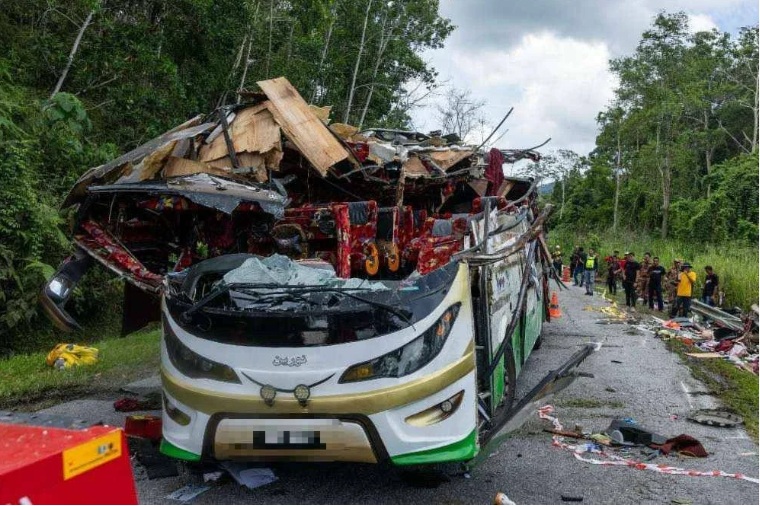
The report stated that the collision sequence was identified as consistent, starting with a skid, followed by a tilt and overturn to the left, a collision and collapse of the W-beam barrier, and then a collision with the rear of the Perodua Alza.
"The barrier penetrating the bus cabin was identified as the main mechanism that increased the level of injuries and deaths of passengers," the report quoted.
Meanwhile, the investigation found that the driver driving at the time of the incident had a high record of traffic offences, with several outstanding traffic summonses, the majority involving speeding offences.
The report revealed that the 53-year-old driver had 22 summonses while the 39-year-old driver had 13 outstanding summonses.
“This record reflects a pattern of risky driving behaviour and a tendency to ignore the set speed limit.
“In the context of this incident, the pattern is significant because technical analysis confirmed that the bus entered the downhill bend at a speed far in excess of the safe limit for the road geometry.
“This shows that speeding is not an isolated behaviour, but rather part of a pattern of driver discipline,” the report explained. – January 23, 2026