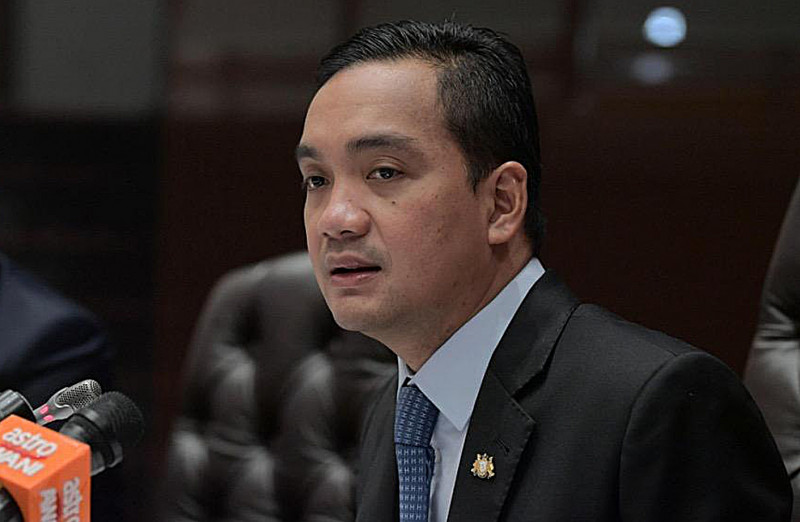
THE impending Johor state election is emerging as a critical political battleground with implications extending far beyond the state’s borders, placing Menteri Besar Datuk Onn Hafiz Ghazi at the centre of a high-stakes test of leadership, governance and electoral strategy.
Having inherited a commanding electoral mandate and one of Barisan Nasional’s strongest political fortresses, Onn Hafiz now faces the challenge of converting administrative achievements into renewed public support at the ballot box.
Unlike the previous state election, where he benefited from the momentum generated by earlier leadership, this campaign will see him assume direct responsibility for shaping both the coalition’s political narrative and electoral machinery.
Universiti Teknologi Malaysia (UTM) Faculty of Social Sciences and Humanities lecturer Associate Professor Dr Mohd Azhar Abd Hamid opined that as one of Johor’s youngest chief ministers, the Machap assemblyman has sought to redefine state governance through the ‘Maju Johor’ agenda, positioning it as the cornerstone of economic development, investment growth and public sector transformation.
He argued that his administration has navigated a particularly complex period marked by global economic uncertainty, rising living costs, shifting geopolitical dynamics and the lingering socioeconomic consequences of the COVID-19 pandemic.
Supported by senior party figures, Onn Hafiz has cultivated a leadership image viewed by many as more contemporary and responsive to the expectations of a younger and increasingly discerning electorate.
Yet political analysts caution that governing success does not automatically translate into electoral victory.
“The greatest challenge confronting Barisan Nasional may lie in candidate selection. In an era where voters increasingly scrutinise integrity, competence and performance, electoral success is no longer guaranteed by seniority, party loyalty or historical influence alone,” Mohd Azhar told BH.
The coalition’s ability to field candidates with strong local standing, credible service records and broad cross-community appeal is expected to be a decisive factor in determining whether it can preserve its dominance across traditional strongholds.
Recent speculation surrounding an alleged list of 56 prospective candidates, despite being publicly denied by Onn Hafiz, has fuelled debate within party ranks and highlighted concerns over grassroots acceptance.
Mohd Azhar warns that any perception of imposed candidacies could trigger internal dissatisfaction, passive resistance or reduced campaign enthusiasm among party supporters. Such developments, while seemingly minor, could create a significant electoral impact across closely contested constituencies.
Consequently, analysts argue that candidate selection must be based on merit, performance, integrity and proven contributions to local communities rather than political connections or factional considerations.
Beyond candidate selection, Barisan Nasional faces the equally important task of persuading voters that continuity in government remains the best option for Johor’s future development.
With social media now exerting substantial influence over voter behaviour, campaign messaging, political communication and digital engagement strategies will be scrutinised more closely than ever before.
“The election is widely expected to feature a three-cornered contest involving Barisan Nasional, Pakatan Harapan and Perikatan Nasional, creating a highly competitive environment in which local issues, targeted campaigning and voter mobilisation efforts could prove decisive,” Mohd Azhar said.
For UMNO, the stakes extend well beyond Johor. The state election is increasingly viewed as a rehearsal for the 16th General Election, with Onn Hafiz carrying not only the hopes of Johor UMNO but also the broader expectations of the party at national level.
A convincing victory could strengthen arguments within UMNO for a more independent electoral strategy and potentially establish Johor’s political model as a template for future state elections and the next general election campaign.
The outcome will also be closely examined through the lens of voter support rather than seat totals alone.
Although Barisan Nasional secured a landslide victory in the 2022 Johor state election by winning 40 of the 56 state seats, its popular vote share stood at 43.11 per cent, equivalent to 599,753 votes. This meant that a majority of voters collectively supported other parties despite BN’s overwhelming dominance in the State Legislative Assembly.
Perikatan Nasional secured 334,457 votes, representing 24.04 per cent of the vote, while Pakatan Harapan obtained 284,969 votes or 20.48 per cent. Collectively, support for opposition parties exceeded BN’s overall vote tally, though Malaysia’s First-Past-The-Post electoral system translated BN’s vote distribution into a two-thirds legislative majority.
As a result, Mohd Azhar contend that the most significant measure of success in the coming election will not merely be retaining a two-thirds majority but increasing BN’s share of the popular vote beyond the 43.11 per cent achieved in 2022.
Should Onn Hafiz accomplish both objectives, he is likely to emerge as one of UMNO’s most prominent younger leaders and a central figure in efforts to revitalise the party’s national standing.
“Such an outcome would reinforce his reputation as the principal architect of Barisan Nasional’s continued dominance in Johor and strengthen his credentials as a leader capable of uniting party machinery, public support and electoral strategy in an increasingly volatile and competitive political environment,” Mohd Azhar added. - June 7, 2026