THE Perlis Inland Port (PIP) has handled 100,000 twenty-foot equivalent units (TEUs) in just 4.5 months of full operations, putting the northern state on a faster track to becoming a strategic logistics gateway linking Malaysia with key Asean and regional markets.
Economy Minister Akmal Nasrullah Mohd Nasir said the milestone highlighted PIP’s potential to transform Perlis into a major cross-border trade and logistics hub, particularly as cargo flows from southern Thailand and the wider Asean region continue to grow.
“The achievement of 100,000 TEUs in just 4.5 months demonstrates PIP’s enormous potential as the country’s strategic gateway for cross-border trade.
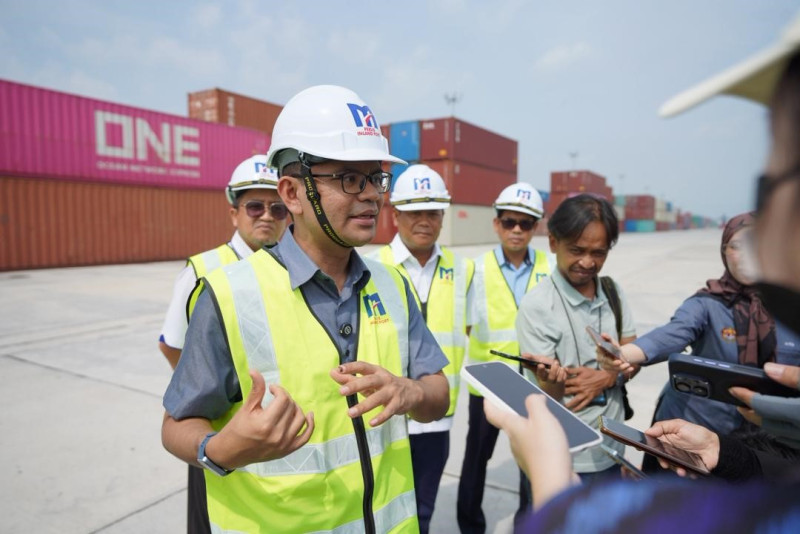
“The Government’s priority is to ensure Perlis’ locational advantage translates into more competitive logistics costs, high-value investments and greater economic opportunities for the people,” he said during a visit to the Tuanku Syed Sirajuddin Free Trade Zone-Perlis Inland Port in Chuping, Perlis today.
Akmal said the port’s integration with rail, road and maritime networks could give Malaysia a more competitive position in regional supply chains while improving access to Asean, Chinese and other international markets.
“With an integrated network of railways, roads and ports, PIP has the potential to strengthen Malaysia’s position as a regional logistics hub while providing more efficient access to the Asean, Chinese and wider markets,” he said.
Phase One of PIP has an annual capacity of up to 300,000 TEUs, with cargo operations at the Padang Besar Container Terminal being progressively transferred to PIP to accommodate rising freight movements from southern Thailand and the wider Asean region.
The minister was also briefed on expansion plans, including the development of an on-dock depot, expansion of container-handling areas and enhanced cargo services in collaboration with Keretapi Tanah Melayu Berhad (KTMB).
The daily STC rail service between Perai and PIP, which began operating in December 2025, has further strengthened multimodal connectivity and provided a faster and more efficient option for moving cargo.
PIP is also being integrated with key economic and logistics nodes across northern Peninsular Malaysia, including the Bukit Kayu Hitam Inland Clearance Depot (BKH ICD), Chuping Valley Industrial Area (CVIA), Kedah Rubber City (KRC) and Kedah Science and Technology Park (KSTP).
The wider network is expected to support the Malaysia-Thailand Border Economic Zone (MY-TH BEZ) and stimulate greater cross-border trade and investment.
PIP’s connectivity with Penang Port and Belawan New Container Terminal (BNCT) in Indonesia also forms a 388-kilometre logistics corridor linking Indonesia, Malaysia and Thailand.
The corridor could reduce cargo costs and transit times compared with conventional routes while improving the resilience and efficiency of regional supply chains.
Its strategic location could also help Malaysia capture high-value investments under China+1 supply-chain strategies by offering competitive access to Asean markets and the Greater Mekong Subregion.
The development is expected to generate wider economic benefits for Perlis, including the potential creation of more than 500 jobs for the local community.
Akmal Nasrullah thanked the Northern Corridor Implementation Authority (NCIA), Transport Ministry, Home Ministry, Perlis Government, Mutiara Perlis Sdn Bhd (MPSB) and other strategic partners for their cooperation in developing PIP.
He said the Government would continue investing in logistics infrastructure and connectivity to strengthen Malaysia’s competitiveness as a regional trade and investment hub while ensuring the benefits of economic development reach local communities.
This headline is stronger because it moves beyond the achievement itself and connects the 100,000-TEU milestone to Malaysia’s wider Asean trade and supply-chain strategy. - August 29, 2026