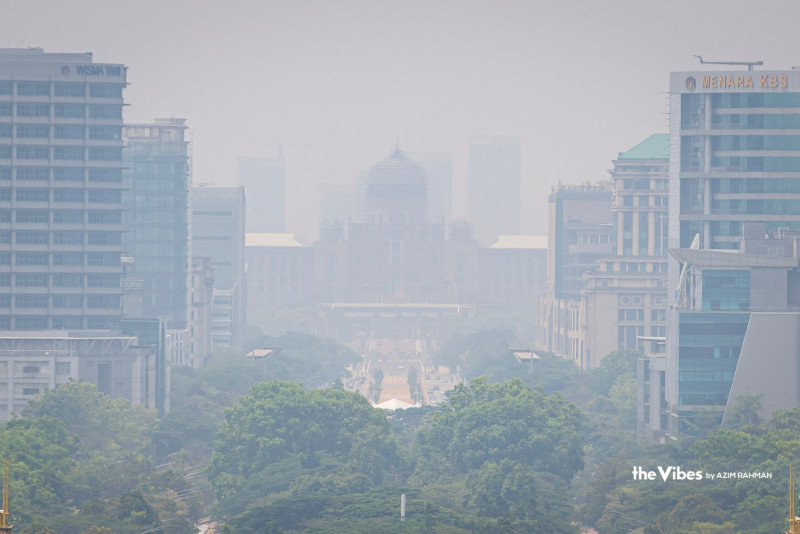
MALAYSIA will continue to rely on diplomacy and ASEAN cooperation to address transboundary haze with Indonesia, maintaining a different approach from Singapore's increasingly tougher legal measures against parties linked to forest fires.
Deputy Natural Resources and Environmental Sustainability Minister Syed Ibrahim Syed Noh said Malaysia preferred to strengthen the implementation of the existing ASEAN Agreement on Transboundary Haze Pollution (AATHP) rather than pursue legal action that could affect diplomatic relations between neighbouring countries.
"Malaysia, in terms of its approach with ASEAN, continues to emphasise diplomacy. As for Singapore, in our view, its legal action has, to some extent, affected diplomatic relations between Singapore and Indonesia.
"Therefore, Malaysia's position and commitment are towards diplomacy and strengthening existing agreements at the ASEAN level, but with more systematic and active implementation," he said during the question-and-answer session in the Dewan Rakyat today.
He was responding to a supplementary question from Dr Halimah Ali (PN-Kapar) on whether Malaysia could cooperate with Singapore or adopt its approach in addressing transboundary haze.
Relations between Singapore and Indonesia have reportedly come under strain over transboundary haze caused by forest fires in Indonesia, as well as Jakarta's decision to reduce gas supplies to the republic.
On Oct 24, Singapore's National Environment Agency (NEA) issued notices to 10 Singapore-registered companies involved in the palm oil and forestry sectors, seeking information on their possible links to forest fires in Indonesia and transboundary haze pollution.
Yesterday, Singapore's Parliament passed amendments to its Transboundary Haze Pollution Act (THPA), including higher maximum fines and stronger investigative and enforcement powers against entities responsible for causing transboundary haze.
Meanwhile, responding to a supplementary question from Rodiyah Sapiee (GPS-Batang Sadong) on whether the government planned to review the AATHP to introduce stricter enforcement mechanisms, Syed Ibrahim said the agreement remained the regional framework for addressing transboundary haze pollution.
He said its key areas of cooperation included monitoring, information-sharing, early warnings, prevention and coordination among ASEAN member states.
However, he acknowledged that the agreement had limitations, as it did not provide for interstate enforcement mechanisms or compensation claims.
"The agreement is based on the principles of cooperation, consensus and respect for national sovereignty, with enforcement responsibilities against parties responsible for fires subject to the jurisdiction and domestic laws of the respective countries.
"Therefore, any proposal to introduce enforcement or compensation mechanisms requires comprehensive consideration of legal aspects, jurisdiction, diplomatic relations and, no less importantly, scientific evidence," he said. - November 5, 2026