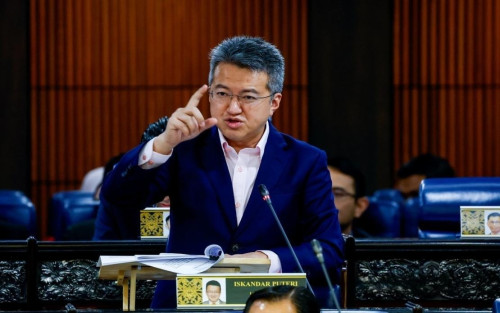

KUALA LUMPUR – Already reeling from an unprecedented rebuke from the king, the government is now under a new spotlight for having disregarded the principle of separation of powers as enshrined in the federal constitution, following Law Minister Datuk Seri Takiyuddin Hassan’s announcement on the retroactive revocation of emergency ordinances.
Constitutional expert Datuk Wan Ahmad Fauzi Wan Husain pointed to Article 150(5) of the constitution, which permits the government to table a bill without first consulting the Yang di-Pertuan Agong, with certain exceptions under Article 150(6) but subject to Clause (6A).
“The precondition is that all proclamations and ordinances must be tabled and laid out in Parliament, but not necessarily debated,” he told The Vibes.
“Once both the proclamation and ordinances are laid out, the second phase can take place, whereby either the Yang di-Pertuan Agong decides to revoke them, or Parliament may annul the proclamation and ordinances by resolution, and these resolutions must be passed by the Dewan Rakyat and Dewan Negara.
(Prior to the announcement,) the Agong reacted rightfully in asking the government to go to Parliament and table the emergency (proclamation) and ordinances so that the issue of him acting or not acting based on (the government’s) advice would not be raised. This shows the wisdom of the Agong.”
However, he said, Prime Minister Tan Sri Muhyiddin Yassin’s cabinet can still redeem itself by following the king’s advice to table the emergency proclamation and ordinances in Parliament.
Putrajaya can keep the ordinances in effect for the next six months if Parliament decides to vote in favour of the matter, he said.
“But whether or not to annul them requires the matter to be tabled. They have to be recorded in the parliamentary Hansard, not done outside.”
On Muhyiddin’s standing in the House, Wan Fauzi said the prime minister should table a confidence vote.
If he wants to dispel claims that support for him has faded, the spirit of parliamentary democracy requires him to table a vote of confidence for himself.
“He should not only use the federal constitution on the Agong’s requirement to follow the executive’s advice, but he must also not avoid a confidence vote in the spirit of the parliamentary system.”

Better for Muhyiddin to resign
Singapore Institute of International Affairs senior fellow Oh Ei Sun said the government has lost its dignity, if not its legitimacy, in misleading the Dewan Rakyat.
If the Muhyiddin administration follows the Westminster principle of governance, he said, it would be the “rightful” thing to do for the government to resign as a whole.
At the very least, Takiyuddin must resign, and I think they will make him do it because somebody has to be the fall guy. The word (on the revocation of emergency ordinances) came out of his mouth.
“He may just be following orders (from Muhyiddin), but he could be made the sacrificial lamb. He has to go whether he likes it or not. The honourable thing to do is resign.”
If resignations do take place, said Oh, the king will exercise his discretion on who is likely to command the majority, and since Umno ministers are also with the government, they would not be suitable candidates.
This means former prime minister Tun Dr Mahathir Mohamad or opposition leader Datuk Seri Anwar Ibrahim, who secured the people’s mandate in the last general election, would have to be appointed, he said.
“PAS is also now in an awkward position, as never in history has the king issued such a strongly worded statement. Now, Takiyuddin is bearing the brunt of the statement, and his party has lost a lot of credibility.”
PM can be removed
Meanwhile, lawyer Mohamed Haniff Khatri Abdulla reiterated that the Agong has the power to remove the prime minister from office in line with provisions of the Emergency (Essential Powers) Ordinance 2021.
This is because the ordinance is promulgated by His Majesty pursuant to Clause (2B) of Article 150 of the constitution.
This essentially means that the Agong has been accorded absolute authority over appointments with regard to executive and legislative powers, as granted to Muhyiddin under Section 11 of the ordinance dated January 14.
Section 11 provides for the prime minister and cabinet appointed immediately prior to the emergency declared on January 11, and who have been conferred executive functions, to continue to exercise the executive authority of the Federation.
This also applied to menteris besar or chief ministers, and the respective states’ cabinets and exco line-ups.
“The king can cancel the ordinance immediately because he can point out that Muhyiddin did not follow his instructions of administering under Section 11 of the ordinance,” said Haniff.
“The king can also cancel the powers he vested in Muhyiddin under the current emergency ordinance.”
He said the Agong can decree the removal of Section 11, immediately nullifying all of Muhyiddin’s powers under emergency laws.

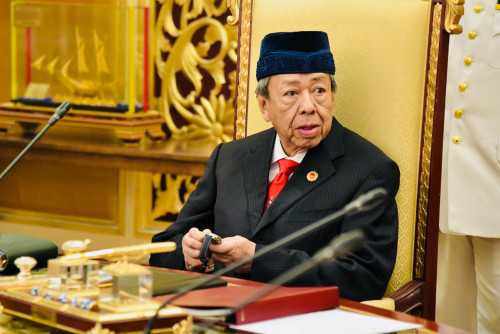
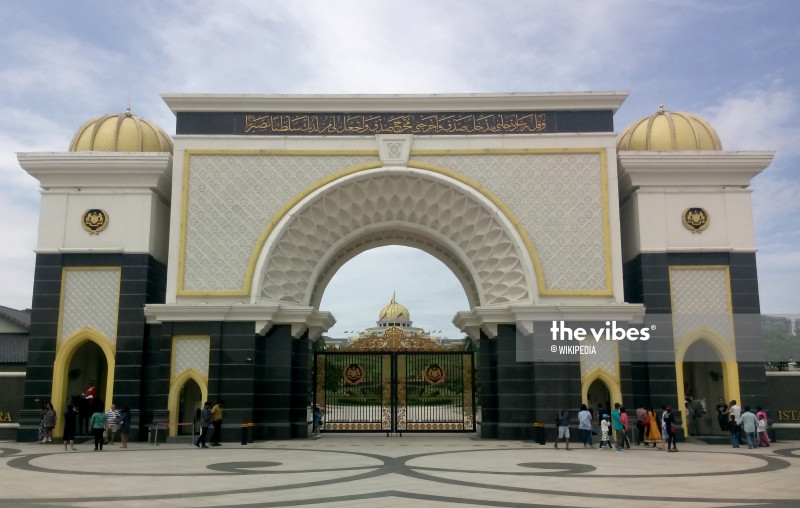
Istana Negara yesterday issued a rebuke against the Muhyiddin government over its decision to revoke emergency ordinances.
The Agong reprimanded Takiyuddin over his Monday statement on the emergency proclamation and its ordinances, saying it is “inaccurate” and “misled lawmakers in the Dewan Rakyat”.
Comptroller of the Royal Household Datuk Ahmad Fadil Shamsuddin said Agong Al-Sultan Abdullah Ri’ayatuddin Al-Mustafa Billah Shah asserted that the application to revoke the emergency ordinances, backdated to July 21, was “hastily made without presenting it in Parliament”, and that “the contradictory and misleading statement in Parliament failed to respect the principle of the rule of law in the Rukun Negara”.
This “disregarded His Majesty’s functions and powers as the head of state, as enshrined in the federal constitution”.
“To this, His Majesty expresses great disappointment over the statement made on July 26 that the government has revoked all emergency ordinances promulgated by His Majesty, although the revocation has not yet been given royal assent.”
In response, Muhyiddin’s office issued a statement insisting that there is no need to debate the revocation, pointing to a royal audience at noon next Tuesday.
However, said Haniff, based on the palace’s statement, the ordinances are still considered alive because the king has not consented to the revocation. – The Vibes, July 30, 2021