
KOTA KINABALU – The story of Veveonah Mosibin, a university student forced to climb a tree for internet service, was an eye-opener for internet service providers (ISPs) and the government as it showed the kind of internet access that Sabah is getting.
But as more focus is being given on beefing up the internet service in the rural areas, those in the semi-urban and urban areas say the service is just as bad, if not worse than what their rural counterparts get.
With hundreds of ringgit spent on unlimited service and mobile data from internet providers each month, The Vibes has uncovered a slew of complaints – from poor service, slow internet speeds and blind spots, to zero service rendered by local ISPs.
Daniel John, 43, who lives in Kg Tanak in Papar said the internet speed is only 0.4Mbps, a far cry from the 8Mbps speed promoted by the provider.
“The problem is not just in my village, but also in hundreds of villages in Kg Kompipinan, Kg Marahang, and Kg Gana. The internet service is just out,” said John, adding that the internet issue in the area appears to show a pattern.
“The service is especially terrible near the ongoing Pan Borneo Highway roadworks,” he said.
John’s fellow villager, Michael Johnny, who lives in Kg Marahang, also in Papar, said he had called technicians to look into his poor internet service twice, but the service remains bad.
It is probably a marketing problem, but it does not make sense. The ISP goes around promoting its service in areas where it does not have coverage,” said Johnny, refusing to name the ISP.
Johnny, who works as a teacher, said that he had to drive out to Papar town, which is about 30 minutes away, just to get better service.
Papar is some 48 minutes or 37.6km from Kota Kinabalu, the capital of Sabah.
A Penampang resident who only wishes to be identified as Doris said her residential apartment area does not have any ISPs, and that she has to rely on the hotspot from her mobile phone to use the internet.
“But the mobile hotspot is also very poor. My telco provides a speed of only up to 6Mbps. I can hardly go online, especially in the evening.
“It’s probably congested as many who return home in the evening are using their own hotspots,” said Doris, adding that she has been living in the area for over 10 years.
She believes that the management corporation has stopped ISPs from entering and providing their service.
Initially, there was an exclusive ISP providing internet service in her area, and they were heavily promoted by the management corporation.
“I believe the management is earning a commission from the provider. We were charged around RM140 a month for what they called 4G speed service. But it was terrible. There were times when there was no internet at all while I worked at home,” said the office worker, who had to work from home throughout the lockdowns.
The apartment located behind Bukit Padang here is just a few kilometres away from a transmission tower, but the service is extremely poor, said Doris’ neighbour, Jason Paul.
“I have spoken to a provider here. They say it is probably a blind spot problem. But this should not be the case as this place is less than five minutes from the Kota Kinabalu city centre.
“In the evening, my cell phone network can go down to as low as just two bars.
“There will be no internet service at all when there’s a blackout, which constantly happens now that rain is continuously occurring and blackouts are becoming more frequent,” he said.
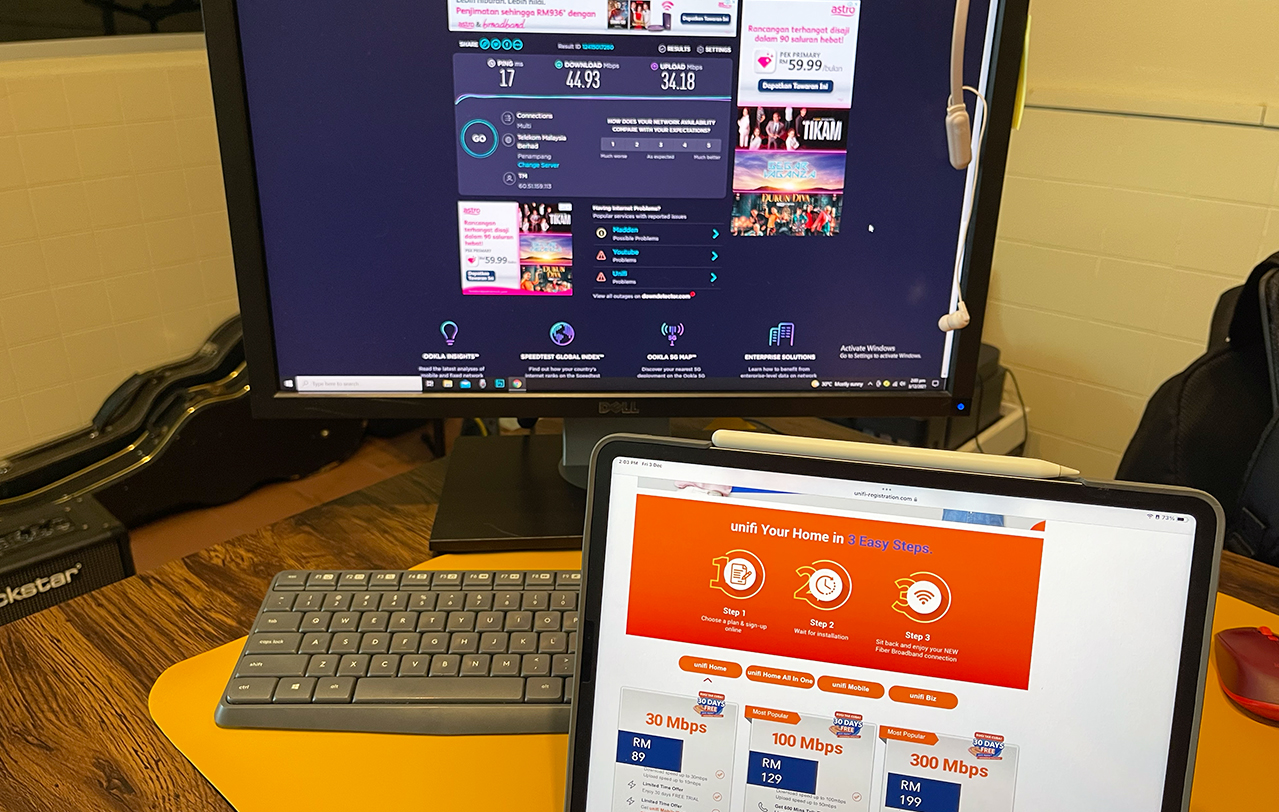
Paul, who runs a website development firm, said he had to drive out to the office everyday just to get internet, although he could run his business from home.
“There’s just too many resources wasted with the poor internet service. I could easily work from home, but I had to drive out to the office, spend hours there, and come home only in the evening.
“It is bad when clients ask me to update their websites or amend some details to my designs,” said Paul, adding that he had subscribed to a service of 300Mbps from a provider, which is costing him some RM300 plus a month.
Telco workers themselves admit that their service is not at its highest potential, with them saying that 5Mbps is only enough to enjoy a low-quality YouTube video.
5Mbps is not enough for a hotspot. There is no point in getting higher speeds if you are living in areas where connections are low.
“It all depends on the location,” said a telco worker who spoke on condition of anonymity.
In Sandakan, areas like Batu Sapi and Sibuga have blind spots in residential areas.
“For Digi, it is Taman Nasalim Mile 5, Taman Harbour View Mile 1½, and other areas.
“For Celcom, it is Mile 7’s residential areas near Sejati Walk. For Maxis, it is in Sim-Sim, Taman Indah Jaya,” said a Sandakan resident.
However, he said all telcos generally have good service in major Sandakan townships like Mile 4 and Mile 6, but it is especially bad at the islands near the East Coast district.
A check on prices showed that Maxis is charging between RM35 to RM60 for speeds between 5Mbps and 24Mbps for unlimited internet service.
Digi, on the other hand, charges between RM45 and RM105 for broadband speeds of between 25GB and 100GB a month, while Celcom’s prices range from RM38 to RM58 a month for speeds up to only 6Mbps.
The most recommended service, Unifi, charges from RM89 to RM349 for speeds between 30Mbps to 800Mbps.
However, most urban residents and those living just at the edge of Sabah’s major townships claim that they do not experience the speed promoted by ISPs.
On September 16, Prime Minister Datuk Seri Ismail Sabri Yaakob said that some RM3.61 billion will be allocated to Sabah over a five-year period to enable the state to switch to 5G technology, promising that via the National Digital Network Plan (Jendela), wider and better internet coverage and facilities can be obtained.
He said the internet facilities will benefit 3.8 million people in Sabah.
A total of 535 new towers will be built and 1,874 existing towers will undergo 4G upgrades across Sabah under the Jendela initiative.
Qhazanah Sabah Sdn Bhd via its subsidiary, Common Towers Technologies Sdn Bhd, has been given the responsibility to spearhead the development of telco towers in Sabah.
A day after the state government signed away its authority to Common Towers Technologies, 45% shares of the company had been sold to a Peninsular Malaysia-based firm called Stealth Solutions Sdn Bhd.
The federal government also aims to ensure that 30,000 out of 251,000 premises have fibre optics installed by next year, under the 12th Malaysia Plan.
The Malaysian Communications and Multimedia Commission recently called for all 3G users to switch to 4G sim cards, while signing a memorandum of understanding with eight Sabah local governments to regulate telecommunications towers in Sabah. – The Vibes, December 4, 2021
Additional reporting by Rebecca Chong