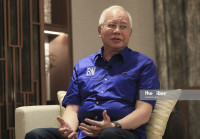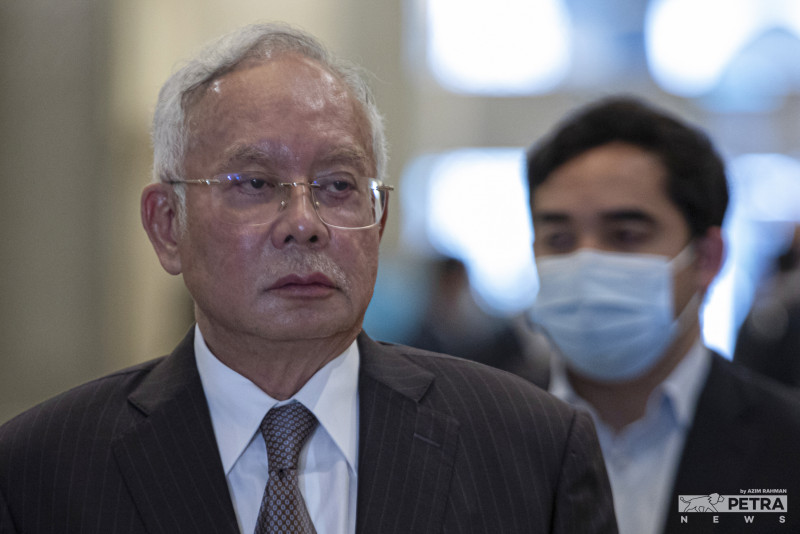
KUALA LUMPUR – Former prime minister Datuk Seri Najib Razak established companies to circumvent objections to his decision to award contracts without tender in the China-linked East Coast Rail Link (ECRL) and other projects, court documents stated.
This was revealed in a Kuwaiti court in March during a trial related to the Malaysian sovereign wealth fund 1Malaysia Development Bhd (1MDB) financial scandal, which has since convicted in absentia fugitive Low Taek Jho, better known as Jho Low, for money laundering charges.
The Edge, which reported the Kuwaiti court documents, said Najib had first instructed the Land Public Transport Commission (SPAD) to submit a proposal to the National Economic Action Council to implement the ECRL at a cost of RM45 billion to RM 55 billion, but SPAD objected as the process was not made through public tender.
To circumvent this, the Finance Ministry (MoF) under Najib who was then finance minister, established the Malaysia Rail Link Sdn Bhd (MRL) to manage and implement the ECRL project. China Communications Construction Company (CCCC) was appointed as the contractor.
“A memo was prepared for the Malaysian cabinet, chaired by Najib, to approve the agreement for the ECRL as well as an oil pipeline project at a cost of RM55 billion,” The Edge said in its report.
MRL then entered into an agreement with the Export-Import Bank of China (China Eximbank) where the latter agreed to provide a loan of up to 85% of the project cost, while the Malaysian government was to provide the remaining 15% through the issuance of bonds.
Another company formed that was linked to 1MDB was Surai Synergy Energy Resources Sdn Bhd (SSER) under the state investment firm’s subsidiary, SRC International Sdn Bhd (SRC), for two oil and gas pipeline projects, which saw Putrajaya bearing the cost of buying land for the project.
The implementors for the pipeline projects were China Eximbank and the China Petroleum Pipeline Bureau (CPP), with the former agreeing to finance a maximum of 85% of the project value while the Malaysian government acted as project guarantor.
“The Malaysian government agreed for SSER to pay the balance 15% in advance payment to CPP as consideration since the remaining SRC debt was also to be acquired by CPP,” the report said.
The court documents also showed that funds from the loans by Chinese entities for these projects were transferred to companies in Kuwait, via two CCCC subsidiaries in Hong Kong. The subsidiaries were named Multi Strategic Investment Limited (MSIL) and True Dragon Properties Limited (TDPL).
“The court document stated that Malaysia’s Penal Code and Attorney-General’s Chambers considered these funds to be theft-related and fraud crimes that harm Malaysia’s interests as the funds were obtained illegally by the offer and acceptance of bribes,” The Edge’s report said.
Naib is currently serving a 12-year prison sentence following the Federal Court’s decision last year to uphold the guilty verdict in his SRC corruption case, which also saw the former Pekan MP being hit with a RM210 million fine.
In March, a five-member bench of the apex court rejected his review application in a non-unanimous ruling. – The Vibes, May 16, 2023