


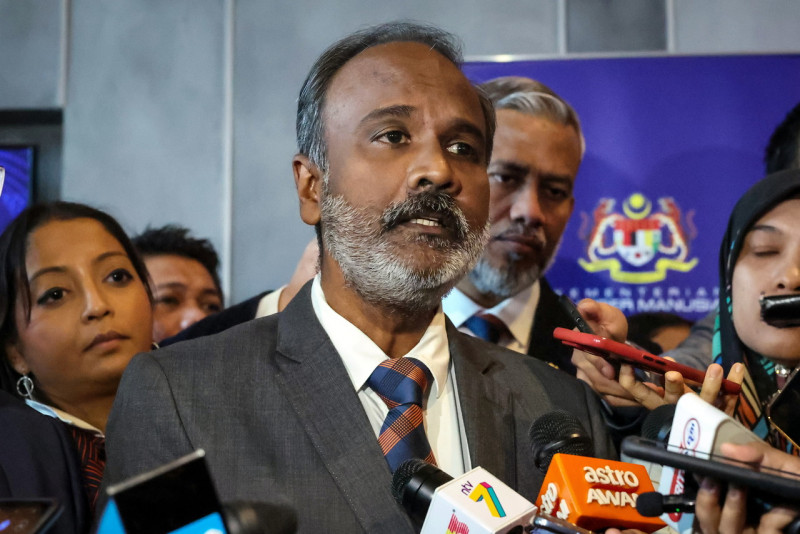

GEORGE TOWN – Malaysia aims to get 35% of its 15.7 million people in the workforce under the highly skilled category by year-end – up from 28.2% in 2020.
Human Resources Minister V. Sivakumar said the ministry is going all out to improve the capacity of the country to produce top-notch skilled workers, particularly in growth areas such as information communications technology.
“We will also provide programmes on top of training to enable the workers to obtain more skills,” Sivakumar said after launching the National Human Capital Conference and Exhibition for the northern region, here.
Among those present was Penang Chief Minister Chow Kon Yeow.
“The training dynamics are also important because there are constant changes in the workplace due to the evolving tech and challenges from it.”
“There are now many new technologies being introduced into the workplace and industries so there is a need for the human resources capacity not to fall behind.
“The Human Resources Development Corporation (HRD Corp) has a crucial role to play here,” he said, adding that with new skills, the workers can enjoy the opportunity to locate new jobs.
On the subject of gig economy workers, Sivakumar said that since the pandemic, the jobs arising from the pandemic have increased by two-fold.
Over one million Malaysians are now employed in the gig economy, which stands for short-term contracts and freelance jobs.
Given this and the need to provide social security protection, Sivakumar said plans are underway to better regulate workers in the gig economy.
He also stressed that the ministry has directed the manpower department to ensure that no foreign worker is left stranded in the country due to the irresponsibility of agents and employers.
“We do not want any repeats of workers left stranded in the country. We will act against errant agents and employers.”
Earlier, he said that the country is on a solid growth trajectory, and Malaysia needs to build on this momentum.
“Last year, we recorded gross domestic product growth of 8.7%. This is our highest annual growth in 22 years, indicating that Malaysia is on a solid path to recovery despite global and domestic uncertainties of the past few years.”
In recent times, Sivakumar said Malaysia has also witnessed significant investment commitments from global giants like Tesla, AMD Global Services, and Amazon Web Services.
“These investments will not only generate new job opportunities for Malaysians but also boost the development of our technological infrastructure and elevate our high-value economic activities.
“However, this is not the time to remain complacent. As global competition intensifies, countries are competing among themselves for a finite pool of foreign investments.
“In fact, our regional counterparts, such as Indonesia, Vietnam and the Philippines, have all embarked on intensive and proactive efforts to attract more investors to their countries.
“There is a need for greater upskilling and reskilling opportunities for employees,” he added.
Meanwhile, Chow said that the world is grappling with a slowing global economy and international logistic disruption.
“Despite these uncertainties, Penang’s economy has remained robust and resilient.
“The state currently houses more than 350 multinational corporations, including three of the top 10 semiconductor giants and six of the top 30 medical device companies in the world.
He said that the Northern Corridor Implementation Authority has also reported encouraging numbers while the Northern Corridor Economic Region, consisting of Penang, Kedah, Perak and Perlis, has realised 18,299 jobs and RM23 billion in investments in the last few years.
“Penang and our regional counterparts play a pivotal role in shaping and growing Malaysia’s economy. In fact, recent reports stated that Kedah had secured RM7.34 billion in high-impact investments in 2022.
“These will be channelled to the Kedah Rubber City and Kedah Science Technology Park.
At the same time, Perak is on track to attract RM4.2 billion in approved investments focusing on new economies, while the establishment of the Chuping Valley Industrial Area in Perlis will take advantage of the cross-border trade potential of the state, Chow added.
“While such investments place Penang and the northern states in good stead, the country needs a strong, dynamic and agile workforce and talent pool to sustain and grow these investments in the long term,” he said.
To realise this, Chow announced that Penang will collaborate with HRD Corp to form the National Human Capital Development Committee.
“This committee will formulate talent nurturing, talent crisis and talent development strategies in the state, ensuring that Penang continues to develop world-class talents,” he said. – The Vibes, June 1, 2023

















.jpeg)

