


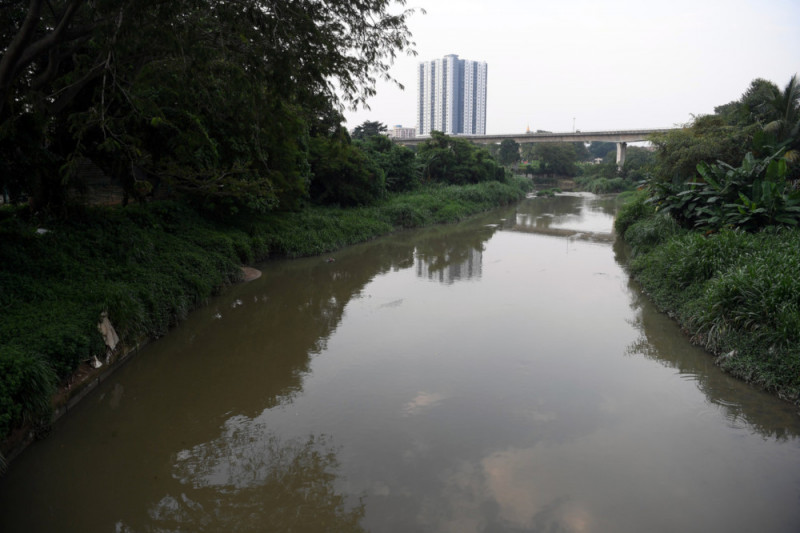

GEORGE TOWN – The Penang Water Supply Corporation Sdn Bhd (PBAPP) will deliver a crisis management plan to the state government to protect the 1.4 million consumers here from growing instances of river pollution in Sg Muda at Kedah.
As Sg Muda remains the main supplier of raw water to the state, PBAPP chief executive officer (CEO) K. Pathmanathan said the state water authority is now poised to unveil engineering solutions to prevent frequent recurrences of water turbidity from Sg Muda.
Logging and land clearing near Gunung Inas in upstream Baling, which is part of the Ulu Muda Forest Reserve ecosystem, was blamed for the severe disruption to the treated water supply when raw water with high turbidity flowed into the water intake stations in Penang.
Years earlier, former PBAPP CEO Datuk Jaseni Maidinsa had warned on countless occasions about logging near the Ulu Muda forest reserve area, but his appeals had allegedly failed to generate a quick response from the relevant authorities.
It has disrupted the treatment of water at the Sg Dua treatment plan, halting PBAPP’s ability to effectively supply treated water across the channel to the island.
Therefore, Pathmanathan said in a statement that PBAPP will seek approval to implement suitable “preventive engineering solutions” to minimise the impact of recurrences.
He said that Phase 2B of the Mengkuang Dam Expansion Project must be expedited to increase emergency drawdowns from the expanded Mengkuang Dam to 600 million litres per day (MLD).
The key details of the crisis management framework are:
- 400 MLD emergency drawdown pipelines by connecting the expanded Mengkuang Dam to the Sg Dua Canal;
- boost maximum emergency drawdowns from 300 MLD (million litres per day) currently to 600 MLD, and subsequently to 1,000 MLD;
- raw water pre-treatment works by pre-filtering (treated raw water) from entering the Sg Dua WTP;
- effective removal of particles and sediments from highly muddy/turbid raw water from Sg Muda; and
- having components which prevent contaminated water from flowing into the main treatment plant in Sg Dua, Butterworth.
Such solutions may be implemented separately, progressively or concurrently to minimise the negative impacts of future Sg Muda incidents on water supply services in Penang.
However, the state needs to consider that each solution is likely to cost millions of ringgit in capital investments while some may also end up not cost effective.
Furthermore, PBAPP’s crisis management plan needs approval from the state and the National Water Services Commission (federal government).
Each solution may also take years to complete and commission.
All major water supply engineering works undertaken by PBAPP in Penang will have to legally comply with government regulations and standard operating procedures (SOPs).
PBAPP serves a customer base of 676,857 water consumers in Penang.
About 465,004 (68.7%) of them are dependent on treated water from the Sg Dua, which treats raw water abstracted from Sg Muda.
Without solutions on hand, their water supply in Penang is likely to be affected whenever a water turbidity incident occurs.
Since July 2022, there have been three water crises in Penang:
“Baling Flood Waters 1” (July 2022); “Sudden Drop in River Level” (May 2023) and “Baling Flood Waters 2” (September 2023).
All mishaps arose from incidents involving Sg Muda that originated in Kedah.
In all likelihood, there will be more future mishaps in Kedah that will threaten water supply services in Penang, he said.
Pathmanathan said that there is an urgent need to expand the Mengkuang Dam, which is a federal initiative to offset the continued reliance on Sg Muda.
The riverine, which originates from Kedah, is now seen as an unreliable supplier of raw water. – The Vibes, October 4, 2023




.jpeg)












_Datuk_Rusdi_Mohd_Isa._Facebook_pic..png)
