By Murray Hunter
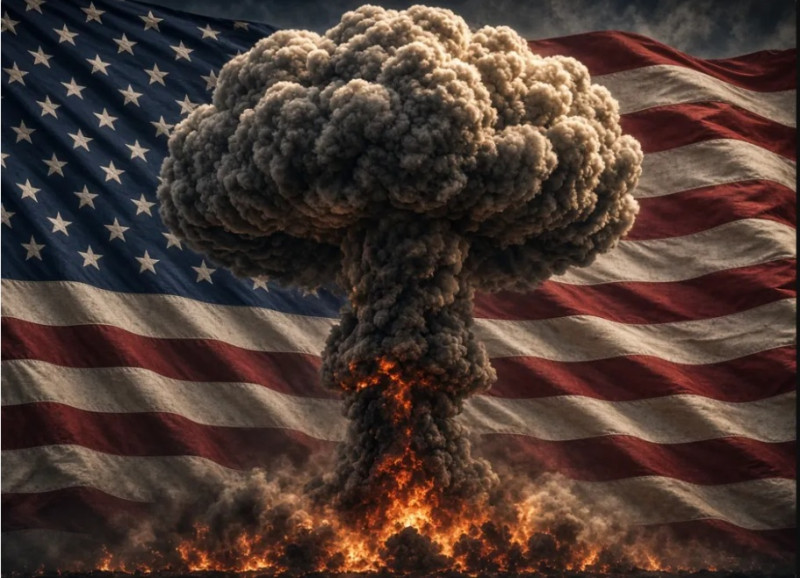
NUCLEAR weapons have long stood as the ultimate deterrent in great-power relations, embodied in the doctrine of mutually assured destruction (MAD).
The concept holds that any nuclear exchange between major powers would ensure the annihilation of both sides, making deliberate first use irrational.
The Doomsday Clock, maintained by the Bulletin of the Atomic Scientists, tracks how close humanity stands to catastrophe from nuclear risks and other existential threats.
Only once have nuclear weapons been employed in war by the United States against Japan in 1945.
The human and moral consequences of Hiroshima and Nagasaki were so severe that a powerful taboo against their use took hold, even as arsenals expanded dramatically during the Cold War.
That taboo has held through decades of conventional conflicts.
Nuclear options were never seriously contemplated in Korea, Vietnam, the Gulf Wars, or other U.S. military engagements. Yet recent discussion surrounding the ongoing U.S.-Iran conflict has revived speculation about tactical nuclear weapons.
The irony is absurd, where initial US and Israeli actions against Iran were framed in significant part as efforts to prevent Tehran from acquiring its own nuclear capability.
In an interview with podcaster Tucker Carlson, former National Counterterrorism Centre director and presidential counterterrorism adviser Joe Kent addressed the possibility directly.
Kent, who resigned earlier in 2026 over disagreements with the administration’s Iran policy, argued that if Washington remains committed to removing Iran’s leadership and compelling total surrender, conventional options are running short.
A full-scale ground invasion, he said, is “not feasible whatsoever” given Iran’s size, terrain, and population.
Playing out the logic of regime change long enough, Kent claimed, leads relatively quickly to consideration of weapons of mass destruction.
Kent described a hypothetical limited nuclear strike against deeply buried uranium enrichment facilities in Iran’s mountainous regions as one possible path under discussion in extreme scenarios. “We would be fools to think that this couldn’t happen here, in this current scenario, especially as the [Trump] administration scrambles for a way out,” Kent stated.

President Donald Trump has issued stark public warnings. In April, he declared that Iran’s “whole civilisation will die” absent compliance with U.S. demands.
He has repeatedly spoken of the capacity to obliterate civilian infrastructure, such as power plants, bridges, and more.
Carlson and others have interpreted such language as implicitly raising the nuclear threshold, arguing that destruction of a civilisation on that scale would be difficult to achieve solely with conventional means.
Kent’s remarks came against a backdrop of reported strains on US precision munitions and interceptor stockpiles after months of strikes. The administration has suspended certain waves of attacks, with media accounts citing depletion of high-end munitions.
Trump and senior officials have firmly denied shortages, insisting ample inventories remain.
In an apparent tactical shift, Trump recently announced a “crushing economic operation” against Iran, labelling it “Economic D-Day.”
Treasury Secretary Scott Bessent followed with expansive new sanctions targeting nearly 60 entities, individuals, and vessels across jurisdictions, including many linked to China.
The stated goal is to render Iran an economic outcast by punishing any actors facilitating its financial networks or money laundering, with threats of removal from the US dollar system.
These developments illustrate the limits of pure military pressure. Iran’s geography, air defences, dispersed and hardened facilities, and ability to retaliate through proxies, ballistic missiles, and disruption of the Strait of Hormuz have complicated efforts to force rapid political collapse from the air.
Economic isolation seeks to achieve what bombing has not yet delivered. Yet the persistence of maximalist political aims, total surrender and leadership change keeps extreme military options theoretically on the table in some analysts’ minds.
Serious institutional, strategic, and normative barriers remain against nuclear first use.
The United States maintains a vast conventional advantage and has historically treated nuclear weapons as a last resort for existential threats, not tools for regime change against a non-nuclear state.
Escalation risks are enormous: any nuclear employment could shatter the global non-proliferation regime, invite retaliation or proliferation by others, alienate allies, and produce long-term humanitarian and environmental catastrophe.
Domestic political costs would be severe. Even tactical or limited strikes against underground targets would cross a threshold unbroken since 1945 and invite unpredictable second- and third-order effects.
Kent’s comments and Trump’s rhetoric highlight genuine frustration over stalled objectives and the high costs of prolonged conflict.
They do not constitute official policy or an imminent decision. The administration’s pivot toward intensified sanctions suggests a preference for non-nuclear leverage at present.
Whether economic pressure can compel the desired political outcome remains uncertain.
What is clear is that introducing nuclear weapons into the equation would represent a profound break with decades of restraint, one whose consequences would extend far beyond Iran and reshape international security for generations. The historical record and the logic of deterrence counsel extreme caution.
In contrast, the Russian State Duma International Affairs Committee Chairman Leonid Slutsky recently told Tucker Carlson that Moscow could have employed tactical nuclear weapons against Ukraine long ago to secure a decisive military victory, yet deliberately chose not to do so.
Speaking in late August 2026, Slutsky emphasised that Russia prioritizes minimizing civilian casualties and does not view nuclear arms as instruments of terror in the manner of the 1945 bombings of Hiroshima and Nagasaki.
Slutsky stated that such weapons would only be considered if Western powers supplied Ukraine with weapons of mass destruction, expressing hope that the situation would not reach that point.
This public assertion of self-imposed limits, coming from a senior Russian lawmaker, underscores how even nuclear-armed states engaged in high-stakes conventional wars have so far adhered to the post-1945 taboo against nuclear use, preferring other means despite the theoretical availability of the ultimate option. – September 1, 2026









.jpeg)