LONDON, 1661. A Swedish ambassador enters the city in ceremonial procession. Behind him, the French and Spanish ambassadors both want the same place of honour.
Their coaches converge near Tower Wharf. Their armed entourages do what armed entourages were apparently brought along to do.
The argument moves into the streets. Men are killed and wounded. In the account sent by the French ambassador, Godefroi d'Estrades, to Paris, six Frenchmen are dead and thirty-three injured.
The Spanish coach gets through first.
At the time, a carriage's position was not read as a traffic arrangement. The coach represented the sovereign.
To follow another coach meant letting the kingdom itself be seen following another crown.
Louis XIV does not admire the result. He demands satisfaction, and in 1662 Spain formally recognises French precedence on such occasions. Spain wins the traffic jam. France wins the sequel.
This is where protocol comes from. Not from a fascination with polished silver, but from the discovery that shooting people over the order of carriages is inefficient.
At the Congress of Vienna in 1815, Europe's powers found a brutally sensible answer to quarrels over diplomatic rank. Within each class, precedence would depend on the date of official notification of an envoy's arrival. Ancient crowns, wounded vanity, magnificent uniforms: all defeated by an entry in a register.
The system has since acquired conventions, manuals and enough footnotes to stop a charging rhinoceros.
But the basic operation remains unchanged. Protocol takes something combustible - rank, recognition, access, pride - and gives it an administrative shape.
Modern summits look cleaner than Tower Wharf. The retainers have earpieces instead of muskets, and the carriages are armoured. Yet precedence still moves through the room disguised as furniture, timing, typography and access.
Sometimes the shape fights back.
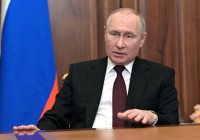
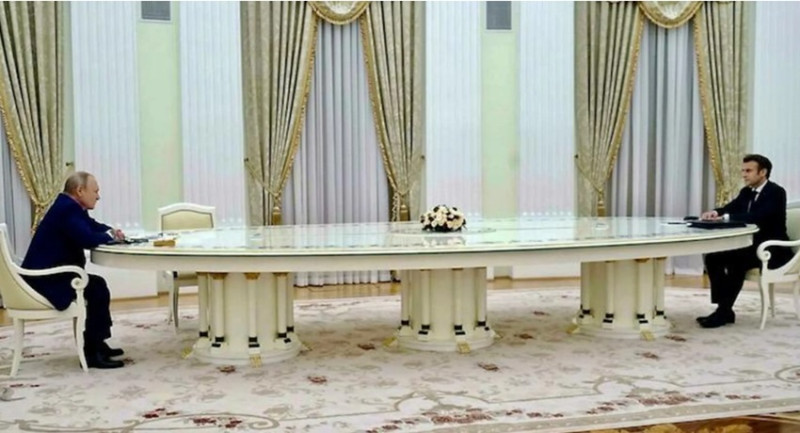
Moscow, February 2022. Emmanuel Macron sits at one end of an enormous white table. Vladimir Putin sits at the other.
The Kremlin says the distance resulted from Macron's refusal to take the Russian PCR test required for closer contact. That may explain the furniture. It does not control the picture.
The picture, intended or not, says that one man owns the room and the other has been placed on its horizon. It travels around the world before any official explanation can catch it.
Protocol officers arrange objects. Cameras give them a second career.
Biarritz, August 2019. The G7 meets under the French presidency. Donald Trump is absent from a session on climate and biodiversity, held amid the fires in the Amazon.
The White House points to bilateral meetings elsewhere in the programme. Emmanuel Macron says an American official is present.
None of this helps the chair.
It sits empty among the other leaders and produces an instant verdict: the United States is missing.
The diary may offer an innocent explanation. The image has already moved on.
The same summit provides the opposite lesson. Macron brings Iranian Foreign Minister Mohammad Javad Zarif to Biarritz for talks with French and European officials. Zarif does not meet Trump, but his unexpected presence changes the temperature of a summit already divided over Iran.
The guest list has altered the summit before the next meeting even begins.
This is protocol with the safety catch-off. Admission, exclusion, a motorcade allowed through the perimeter: minor operational decisions can rearrange the political room.
New Delhi, September 2023.
Narendra Modi opens the G20 summit behind a nameplate reading "Bharat". Days earlier, the official dinner invitation had referred to Droupadi Murmu as the "President of Bharat" rather than the more internationally familiar "President of India".
Both names have constitutional standing. The choice is therefore legal, deliberate and anything but neutral.
No speech is required. A strip of card on a conference table carries the argument: how India names itself, which history it foregrounds, and which audience it is addressing.
Protocol is often described as a mirror of power. Mirrors are passive. A nameplate can do more. It can help edit the national story while everyone is still taking their seats.
Brasilia, January 2023.
Luiz Inácio Lula da Silva returns to the presidency. Tradition would have the outgoing president place the presidential sash on his successor. Jair Bolsonaro has left the country and is absent from the ceremony.
The script now has a hole in it.
Lula does not fill that hole with the next official in the hierarchy. He walks up the ramp of the Planalto Palace with a diverse group of Brazilian citizens.
Aline Sousa, a 33-year-old waste picker, places the presidential sash on him.
The missing predecessor has not stopped the transfer. His absence has allowed the ceremony to say something new about where authority comes from.
A broken tradition produces a stronger image than faithful repetition might have done.
That is protocol at its best: not rigid, not casual, and never quite innocent. It knows the rule, understands what the rule was built to protect, and recognises the moment when literal obedience would protect nothing.
There can be no complete protocol manual for living beings. People arrive late, refuse tests, skip sessions, change names, leave countries and decline the roles written for them.
The room never behaves exactly as the diagram promised.
Bad protocol panics. Bureaucratic protocol reaches for another page. Good protocol reads the power in the room and acts before the accident hardens into an insult.
The work is sometimes comic because human vanity is comic. It is also serious because vanity travels with flags, armies, markets and nuclear codes.
Moving a chair will not make rivals agree. It may stop them from beginning with the wrong argument.
The carriages have gone. The fight is still in the room. Protocol keeps it off the street. – September 30, 2026
Pascal H. Grégoire is a career diplomat and essayist who served as Belgium's Ambassador to Malaysia from 2018 to 2022. He is the editor of Contre-Jour and currently the ambassador of Belgium to the Kingdom of Saudi Arabia.