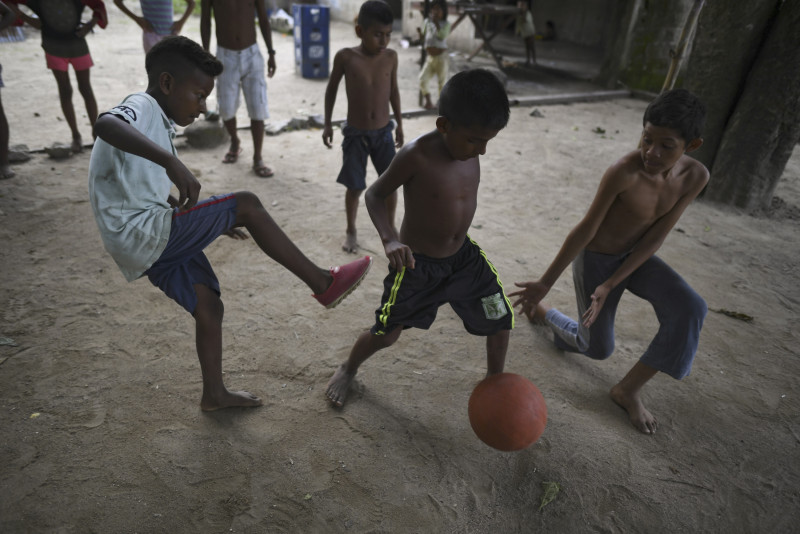

KUALA LUMPUR − “Why have we forgotten our Orang Asli?” was the question posed by local football consultant, E. R. Subramaniam, who is passionate about improving the quality and standards of the sport in Malaysia.
In a conversation with The Vibes, Subra claims that the effort put into advancing the football potential of the Orang Asli community by exposing them to proper channels is seriously inadequate, and the effects are apparent when we observe a lack of indigenous representation in our national team.
“The biggest problem with football clubs is that their efforts come in too late. If they only start scouting and training players over a certain age instead of developing young talent, then we are already losing out on a wealth of potential.”
“The Orang Asli community have, in a way, been segregated out of the system,” he said, adding that this denial of opportunity is a form of prejudice.
Citing his experience with Orang Asli players, who struggle to adapt to centralised training in places far away from their homes, Subra mentioned how those over the age of 18 were more likely to face difficulties, resulting in a deterioration of both their mental and emotional states.
He also referenced the tendency of the Malaysian Football Association (FAM) to naturalise foreign players instead of focusing on developing local talent, saying: “It is a short-cut that will only produce short-term glory.”
“We have the talent, it’s just that we are not looking in the right places,” he added, noting that there is a “lack of proper protocol” within football associations, which leads to lesser talent being discovered during scouting exercises.
“It is not too late for us to intensify our efforts with the Orang Asli community; in fact, it is our duty to do so.”
Earlier last week, former Malaysian international, Serbegeth Singh, had slammed the FAM for their persistence with naturalised players despite their lacklustre track record.
The Vibes also spoke to Samsul Anak Senin, the village chairman of the Kampung Orang Asli Busut Baru in Banting, Selangor, and his input proves that Subra’s stand on the matter is not based on unfounded beliefs.
Despite there being a number of proficient players amongst the indigenous population, Samsul says that he is “confused” by the lack of opportunities for Orang Asli to play at national, or even, state levels.
“Perhaps there is a perception that Orang Asli players cannot go far or maybe the criteria set is too high, but there are definitely talented Orang Asli players who do not get the chance to advance professionally.
“If other races can play and are given the platform to do so, surely Orang Asli individuals can be afforded the same privilege as well? Give us a chance to play and we will show you what we can do,” he challenged.
Samsul also stressed the importance of having Orang Asli representation on the playing field to prove that his community is equally as capable as other races. He also hopes that the government will provide more opportunities for indigenous players to shine at the national level.
Malaysia Orang Asli Development Association (Moada) president, Bob Manolan Mohamad, also agrees that there is a lack of Orang Asli football players at the national level despite the abundance of talent amongst youths.
“Although we have invested millions in an effort to qualify for the World Cup, we have yet to earn a spot. There must be something wrong somewhere, so why don’t we try taking in Orang Asli players?
“The early stages might be difficult, but I have confidence that we will succeed,” said Bob, suggesting that a special unit be formed to identify and develop talent among Orang Asli youths.
He also hinted at the political scene within the local football industry, claiming that since many of Malaysia’s top officials were not footballers, they were unlikely to contribute positively to the sport’s development.
“Since our current sports minister was not even a national sports player, how can we expect him to develop sports in our country?” he questioned, adding that there has been less focus on football over the years. − The Vibes, October 21, 2021