
KUALA LUMPUR – Being a national athlete comes with a very high price as one bears the hope of the entire nation to bring home a medal.
Athletes have conditioned themselves through years and decades to perfect their form so they could be able to stand in the eyes of the world and compete for a podium medal.
However, what is the cost to be at the top?
Former national shuttler Daphne Ng recalled her times as a national athlete that they were only taught to focus on winning a tournament no matter what it takes.

So, when they lose, it puts them on a deep end. So much so that they feel like taking their own lives.
“Many times, when we do not perform or win a competition, we tend to see ourselves as useless or do not have the potential in that sport.
I think the biggest issue about athletes is that we do not know our self-worth.
“So, when we lose in a competition, we would feel so down – and sometimes we would think of ending our lives because we do not know what comes next,” Daphne said during an online talk organised by NGO Hub called Mental Health Challenges Among Athletes.
To this very day, mental health is still a topic that has not been widely talked about or accepted within the national sports fraternity.
Daphne also shared that mental health has not been discussed openly enough as athletes have always been signified as being the strongest people with the strongest mentality – and they are not allowed to show any form of weakness.
“When I was an athlete, I did not know about mental health. I only knew to focus on my goal, and I have to do well – but along the way, I felt lost.
“Now that I am a coach, I hope to share with the younger athletes that there are ways to manage your stress better and control your anxiety during a competition as it contributes to a big part in performing.”
Pursuing PhD in Sports Psychology to help young athletes
Daphne, who is also a sports specialist consultant, is currently completing her PhD in Sports Psychology, which she someday aims to share and build awareness on mental conditioning among youth athletes.
She explained that even therapy sessions between athletes and psychologists need a lot of work as both need to have trust in each other.
She opined that many athletes are not willing to share what they are going through because they prefer to hold on to their pain over the concern that it might reduce their chance to qualify for the upcoming tournament if they show any sign of weakness.
“I have been coaching for the past 10 years. I think a good support system, not only coaches, parents, and friends but also the surrounding is important to take time and listen to the athletes.
If they are facing any challenges, they should break them down, instead of piling and adding additional stress that deters them from performing better.
“If the mental part can be built from young, I believe they can grow up with a stronger mentality.”
Body positivity among athletes
Former national rhythmic gymnast Sarina Sundara Rajah, meanwhile, added that the idea of body positivity is not necessarily understood fully in the sport.
“You have to constantly look a certain way and have the ideal body weight, which creates a lot of stress and eventually mental health issues.
“This predicament is, unfortunately, still not being addressed openly enough,” said Sarina who entered the sport at the age of 11.

Echoing Sarina, the idea of being physically perfect for athletes has also taken a toll on national karate coach Puvaneswaran Ramasamy’s health when he was just starting in the arena.
Being an athlete, I always want to perform my best. So, I pressured myself that I must win a medal, I must be number one, no seconds.
“Eventually, it was hard for me to sleep due to all the stress. I would get tired easily due to a lack of rest.
“But I was not going as far as I expected,” he said.
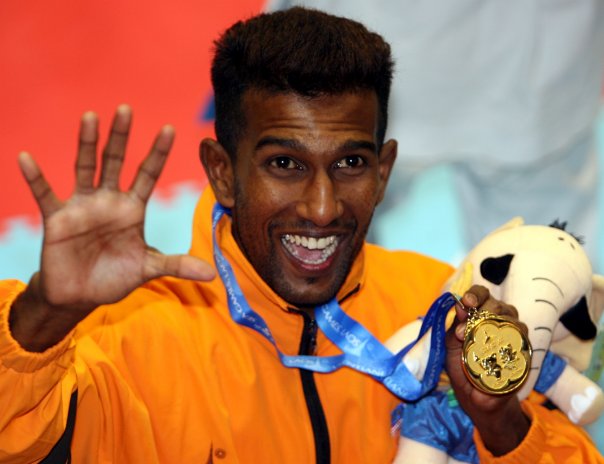
He shared that since he learned to focus on his well-being in 1998, his performance had gotten better and he continued to win two gold medals at the 2002 and 2010 Asian Games, and another gold at the 2007 SEA Games in Thailand.
Media headlines on mental health
Meanwhile, Astro Arena head of news and sports journalist Bazly Azmi opined that mental health issues among athletes have not been the favourite topic amongst the media practitioners, saying that they barely made it to the back page of a newspaper, unless a tragedy strikes.
Take for example Rabia Abdul Salam, a former national track and field athlete, who committed suicide in 1994. That made the headline.
“Family, friends, coaches as well as the media need to be a good channel of support for our athletes when they are faced with mental issues.
“Like the pocket rocketman Datuk Azizulhasni Awang. He is the embodiment of an athlete that has a very good support system from the NSI including a nutritionist, analyst, and psychologist.
“Azizulhasni has a good support system from his family too, although he had to leave his family in Melbourne for three months, while his wife was pregnant, to prepare for the 2020 Tokyo Olympics,” Bazly added.

Holistic support system for athletes
Sarina, who is also the Safe Sport Malaysia founding president, also noted that a holistic support system should be extended to the grassroots level.
She said, if being an athlete means being physically active and doing their job to compete and win, then all parties need to be proactive and take initiative to help them.
“Other than the Youth and Sports Ministry, National Sports Council, NSI, Olympic Association of Malaysia and all the sports associations, we also need to take into consideration the sports organisation at the grassroots level.
“So, everyone needs to understand what our athletes are going through,” Sarina added. – The Vibes, August 6, 2022