THE United States launched a third consecutive night of military strikes against Iran as the conflict expanded across the Gulf, with two oil tankers coming under attack in the Strait of Hormuz and both sides exchanging threats over control of one of the world's most strategically important shipping lanes.
US President Donald Trump announced that Washington was reinstating its blockade of Iranian shipping and declared that the United States would ensure the Strait of Hormuz remained open for international commerce.
"The Hormuz Strait is OPEN, and will remain OPEN, with or without Iran. We are reinstating THE IRANIAN BLOCKADE," Reuters cited Trump saying on Truth Social.
"The U.S.A. will be, from this point forward, known as 'THE GUARDIAN OF THE HORMUZ STRAIT', but as such, and as a matter of FAIRNESS, will be reimbursed, at the rate of 20% on all cargo shipped."
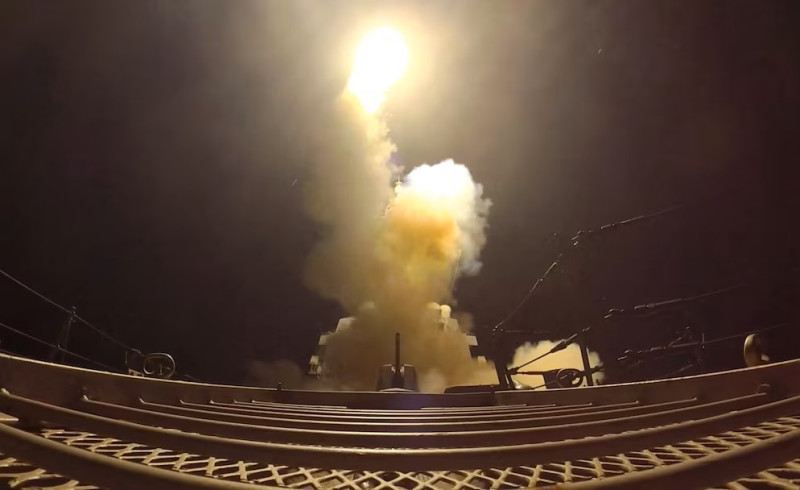
US Central Command (CENTCOM) said it launched fresh strikes on Iranian targets shortly after Trump vowed that Iran would be hit "very hard tonight, and we're going to hit them hard tomorrow".
The US military said the latest operation targeted Iranian air defence systems, coastal radar installations and small military vessels operating around the Strait of Hormuz in an effort to weaken Tehran's ability to threaten commercial shipping.
Shortly afterwards, the United Arab Emirates Ministry of Defence said Iranian cruise missiles struck two Emirati oil tankers, the Mombasa and Al Bahiyah, while they were transiting the southern shipping lane of the Strait of Hormuz in Omani territorial waters.
One crew member was killed and eight others were injured in the attack.
Separately, the United Kingdom Maritime Trade Operations (UKMTO) agency reported that another tanker had been struck by an unidentified projectile about 40 nautical miles northeast of Qalhat, Oman. All crew members were reported safe, although it was not immediately clear whether the incident involved the same vessels identified by the UAE.
Iran did not immediately comment on the tanker attacks.
Iran's Joint Military Command rejected Trump's assertion that Washington could determine the future of the strategic waterway.
Foreign Minister Abbas Araghchi also dismissed Trump's proposal to levy transit charges on shipping, saying Tehran remained the true guardian of the Strait of Hormuz.
"20% is of course too much. We will be fair," Araghchi wrote on X.
Explosions were reported overnight in Bandar Abbas, Qeshm Island, Kish Island, Abu Musa Island and parts of Bushehr province as US strikes continued against targets across southern Iran.
Iranian media also reported that Khuzestan province came under attack early on Tuesday, leaving four people wounded as rescue operations continued.
Iran's state television said the country's armed forces had launched cruise missiles at what it described as a "hostile" US vessel and used drones to target American military facilities and equipment in Kuwait.
Iranian media further reported that the Islamic Revolutionary Guard Corps had shot down a US MQ-1 drone over the Strait of Hormuz, while air raid sirens sounded in Bahrain, which hosts a major US naval base.
The Revolutionary Guards said they had also struck US military facilities in Bahrain and Kuwait, destroyed radar systems in Oman and attacked fuel storage and ammunition depots at Prince Hassan Air Base in Jordan in retaliation for American strikes.
Bahrain said its air defence systems intercepted several Iranian missiles and drones directed towards the kingdom.
The confrontation follows Iran's decision over the weekend to close the Strait of Hormuz, a move that has significantly disrupted maritime traffic and heightened concerns over global energy supplies.
The United Nations' shipping agency said there was no legal basis under international law for imposing mandatory transit fees on vessels using international straits and reiterated its longstanding opposition to such charges.
The US Navy-led Joint Maritime Information Center said the renewed blockade of Iranian ports would take effect at 8pm GMT on Tuesday and would apply to all vessel traffic serving Iranian ports and oil terminals, regardless of nationality.
The centre said neutral vessels travelling through the Strait of Hormuz to destinations outside Iran would continue to enjoy safe passage, while humanitarian shipments would be permitted following inspection.
Before the conflict escalated earlier this year, approximately one-fifth of global oil and liquefied natural gas shipments passed through the Strait of Hormuz each day, transporting more than 15 million barrels of energy products valued at over US$1.2 billion daily.
Analysts estimate that a 20 per cent transit charge on global cargo moving through the waterway could generate approximately US$250 million in daily revenue if implemented.
The deteriorating security situation has severely affected commercial shipping activity, with vessel-tracking data showing traffic through the Strait of Hormuz fell by around 52 per cent between July 10 and July 12 compared with the previous week.
US officials said about 20 commercial vessels had been escorted safely through the waterway during the previous 24 hours despite the heightened security risks.
Global oil markets reacted sharply to the latest developments, with Brent crude rising more than nine per cent to record its largest single-day dollar gain since April and its highest settlement since June, while US crude futures also posted their biggest daily increase since late April.
The surge in energy prices is expected to increase political pressure on the Trump administration ahead of November's US midterm elections, where higher fuel costs are likely to become a key domestic issue. - July 14, 2026