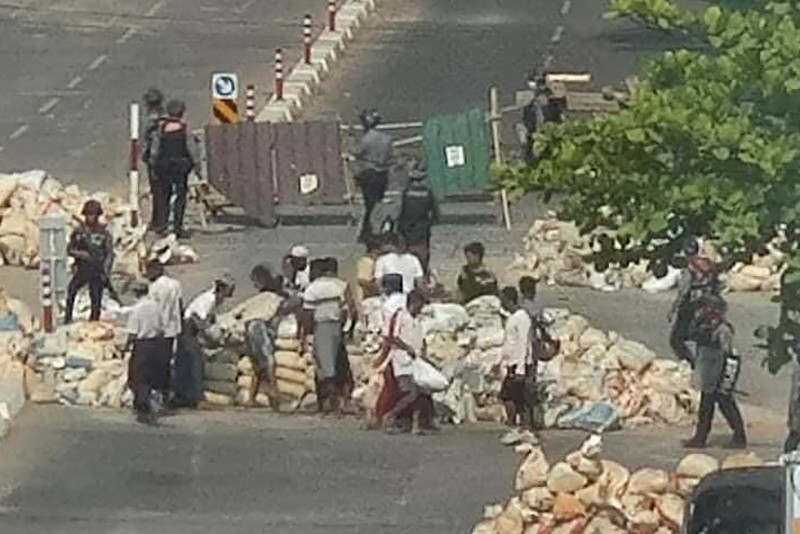
YANGON – Makeshift barricades of bamboo, brick and burning rubber tyres have lent the streets of Myanmar’s largest city the look of an urban warzone, and now the military are forcing civilians to dismantle them, piece by piece... at gunpoint.
Constructed using any material to hand, the barriers that have sprung up across here offer scant protection against the live rounds the security forces have resorted to with increasing frequency and lethal effect to crush mass opposition to the February 1 coup that ousted elected civilian leader Aung San Suu Kyi.
The protesters have the numbers, but no real means of fighting the tear gas, rubber bullets and rifle fire of the army and police.
The Assistance Association for Political Prisoners monitoring group suggests around 230 people have been killed in the unrest, and the actual toll across the country is believed to be far higher.
The barricades have become something of a protester trademark, blocking main roads and employing everything from sand-filled cement bags and bamboo screens to large, wheely garbage bins and housing bricks.
They have been partially successful in slowing down the movement of the security forces, who are now intent on forcing local residents – including those not involved in the protests – to dismantle and remove them.
Tun Hla, 60, was at home when armed personnel banged on his door and demanded he work on clearing a barrier erected in his neighbourhood.
“I have experienced this kind of situation before and it shouldn’t happen again,” Tun Hla, not his real name, told AFP.
The February coup brought an abrupt end to a 10-year experiment with democracy in Myanmar, which had previously been under strict military rule for five decades. During that period under the junta, it was typical for military personnel across the country to order families to provide one able-bodied person to perform backbreaking work.
“This use of forced labour is nothing new in Myanmar,” said John Quinley of Fortify Rights, adding that it was a “brutal tactic used to create an environment of fear and intimidation”.
Despite being afflicted with chronic back pain, Tun Hla had no option but to follow the orders of the armed guards and – hiding his children at home – joined his neighbours in removing the sandbags and bamboo poles piled up in the street.
“I was worried for my children since... there are young people dying,” he said.
Yangon, Myanmar’s former capital and commercial hub, has been a focus of resistance to the coup, and the city has witnessed some of the most violent scenes, with security forces patrolling and opening fire indiscriminately in residential areas.
Martial law has been imposed in six Yangon districts, effectively placing nearly two million people under the direct control of military commanders.
Sabel, 20, said she and her widowed mother were forced at gunpoint to dismantle one street barricade in their neighbourhood.
“I have never done this before in my life,” she said, declining – like Tun Hla – to give her real name for fear of repercussions.
Sabel and her mother were forced to remove five rows of heavy bags filled with marble sand.
“I got bruises on my hands, it really hurt me,” she said, adding how she saw security personnel pointing guns at two young boys as they struggled to hoist sandbags and untie bamboo fences.
One Yangon resident who grew up in northern Chin state – an area of long-standing conflict between the military and armed ethnic groups – recalled how, aged just 10 under the previous military regime, he had been forced to dig trenches and cut down trees around his hometown.
“I don’t want my sons to experience those nightmares like me,” he told AFP. – AFP, March 20, 2021